
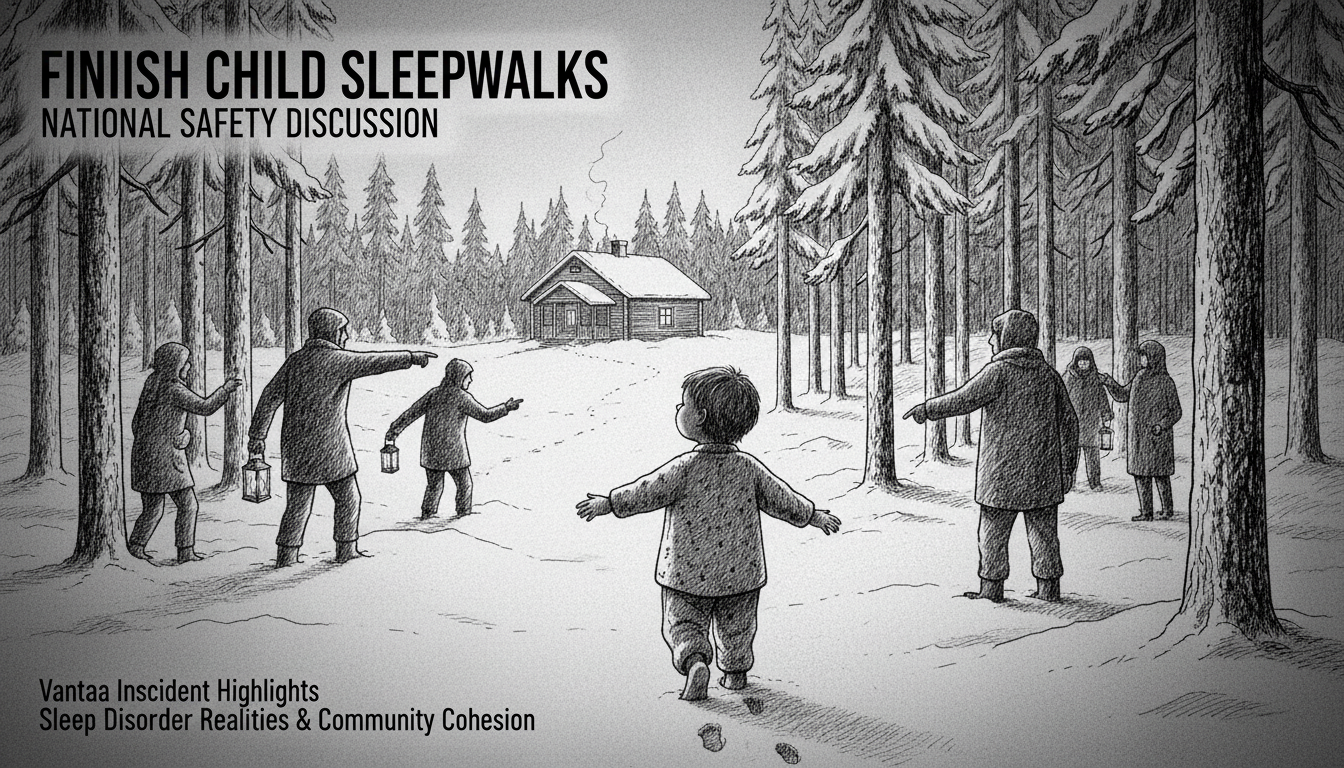
A twelve-year-old child walked out of their family home in Vantaa while asleep, triggering a late-night search and a broader conversation about sleep disorders and urban safety in Finland. The incident occurred in the Tammisto district, where the child awoke alone on a residential parking lot after unconsciously leaving their apartment. The child then navigated several hundred meters to a 24-hour supermarket to seek help, where alert citizens provided assistance and contacted authorities. Sleep researcher and Professor Markku Partinen explains that sleepwalking affects approximately five percent of children before puberty and is often hereditary. The event has prompted the family to install a door alarm, a practical response highlighting a common parental concern in Nordic countries where independent mobility for children is culturally encouraged yet carries inherent risks.
Professor Partinen, a leading Finnish expert, detailed the neurological mechanisms behind sleepwalking. He stated that the phenomenon occurs when parts of the brain responsible for deep sleep remain active while areas controlling motor functions awaken. This state can lead to complex behaviors performed without conscious awareness. While most episodes involve simple actions, rare cases can include leaving the home, driving, or other dangerous activities. The professor advised that sleepwalkers should be guided calmly back to bed, as forced awakening can cause severe disorientation and distress. He noted that factors like fatigue, illness, or stress can increase the likelihood of an episode, a relevant point in a society where long, dark winters can impact sleep patterns and mental well-being.
This Vantaa case underscores a tension in Finnish social policy between fostering childhood independence and ensuring security. Finnish children commonly walk to school and play outdoors unsupervised from a young age, a practice supported by high levels of social trust and safe community design. However, this incident reveals a vulnerability that standard urban planning cannot fully mitigate. The child’s successful navigation to a known, all-night service point like the Citymarket reflects a pragmatic, resourceful response ingrained from an early age. The assisting citizens’ refusal of any reward, stating the child's safety was paramount, exemplifies the communal responsibility felt in Nordic neighborhoods, a social contract that remains strong even in anonymous urban settings.
The family's experience has practical implications for housing safety standards. Many Finnish apartment buildings have keycode locks that deactivate overnight for security, which trapped the child outside their stairwell. This design standard, intended to prevent unauthorized entry, inadvertently created a barrier to safe return. The incident may prompt building associations and families to reconsider auxiliary safety measures, such as individual door alarms, which are now used by the affected family. For international observers, the story illustrates how Nordic welfare states, despite comprehensive safety nets, still face basic human challenges. The system relies on a combination of formal infrastructure, like all-night public spaces, and informal social cohesion, demonstrated by the vigilant citizens, to function effectively.
Looking forward, this event is likely to resonate in public health discussions. Municipal family guidance centers and school nurses in Finland routinely provide advice on child safety and sleep health. This case provides a concrete example for professionals to use in preventative education. It also highlights the importance of sleep hygiene in the national curriculum, where topics of physical and mental health are integrated from primary school onward. While the outcome was positive, the clear message from the child’s parent is a sobering reminder for all urban residents: never walk past someone who appears lost or distressed at night, as their situation may stem from an involuntary condition beyond their control. This call for collective vigilance is the key takeaway from a frightening but ultimately community-affirming night in Vantaa.