
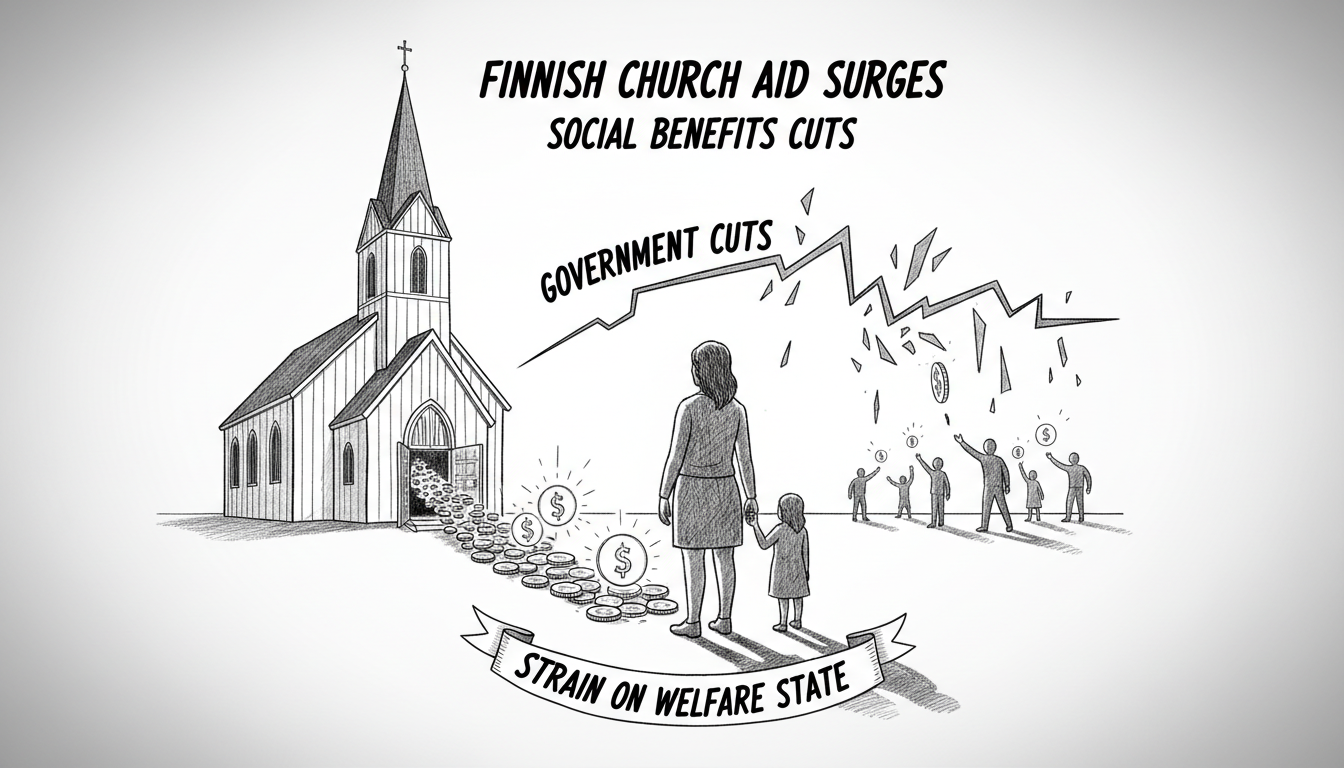
The Evangelical Lutheran Church of Finland reports a sharp increase in financial aid requests from low-income families, with single-parent households facing the most severe strain. Church officials directly link this surge to recent reductions in national social security benefits implemented by the governing coalition. The data reveals a 47 percent increase in the monetary value of aid distributed by parishes when comparing the first quarters of two recent years, a clear indicator of deepening economic distress among vulnerable populations.
Anita Salonen, a diaconal expert with the Church Council, stated that the growing financial problems reflect cuts made to social security over a two-year period. The center-right coalition government led by Prime Minister Petteri Orpo of the National Coalition Party has enacted reductions in housing allowance and basic social assistance. These policy changes, debated extensively within the Eduskunta, the Finnish Parliament, are now manifesting as increased demand on local parish charities, which operate as a critical last-resort safety net.
This trend highlights a significant shift in Finland's welfare model, where traditional state support is contracting and civil society organizations are being forced to fill the gap. The situation poses important questions about the long-term sustainability of relying on charitable institutions to address systemic poverty. For international observers, this development offers a window into the practical effects of Finland's current fiscal consolidation efforts, which aim to curb public debt but carry immediate social costs.
Historical context is crucial here. Finland has long prided itself on a comprehensive Nordic welfare state designed to prevent exactly this kind of dependency on charitable aid. The current increase in church aid requests echoes patterns seen during previous economic downturns, but analysts note the trigger now is deliberate policy rather than a broader market recession. The government argues these cuts are necessary for long-term economic health, but the immediate human impact is becoming visible in communities across Helsinki and beyond.
The implications extend beyond national borders, touching on ongoing EU-level debates about social cohesion and fiscal responsibility. As a member state, Finland's domestic policy choices contribute to the broader European discussion on balancing budgets with social protection. The growing reliance on church aid also raises issues about equality, as support can vary significantly between parishes, unlike standardized state benefits. This creates a postcode lottery for vulnerable families, depending on the resources and priorities of their local congregation.
What happens next? Municipal social services are likely to face parallel pressure as the most vulnerable citizens exhaust church-provided options. The coming months will test the resilience of local community networks. The government maintains its course, suggesting other forms of activation and employment support will ultimately lift people from poverty. Yet, the stark numbers from the Church present a clear, measurable challenge to that narrative, proving that for a growing number of Finns, the safety net has tangible holes.