
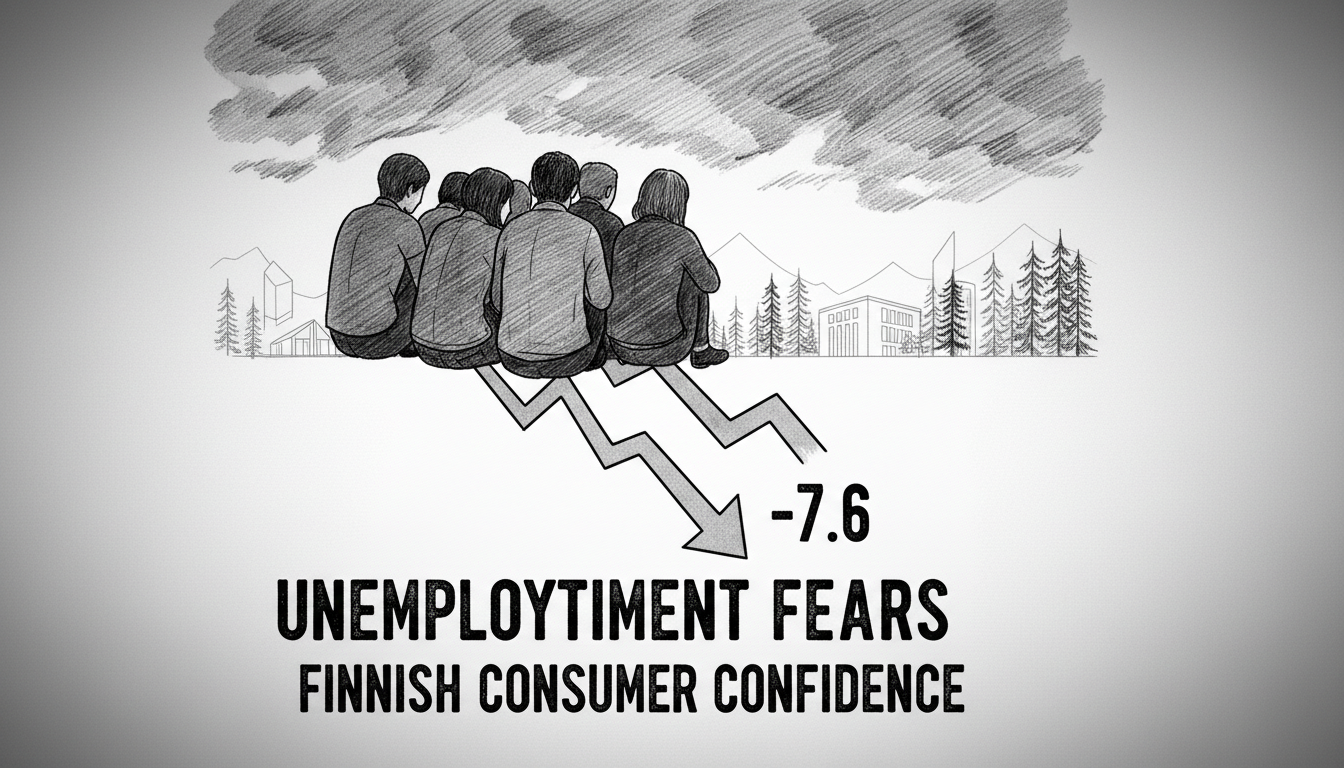
Finnish consumer confidence dropped further in October as unemployment fears continue to plague the economy. The consumer confidence indicator stood at -7.6, down from -6.6 in September. A year earlier, the reading was -6.8.
Many economists say weak consumer confidence is currently the biggest problem facing Finland's economy. Fear prevents people from spending, which hurts economic growth. Instead of consuming, citizens are saving more. Private consumption accounts for about half of Finland's economy, making consumer behavior critically important.
Expectations about unemployment trends darkened further in October. Only 15% of consumers believed unemployment would decrease over the next year, while 59% expected it to increase.
Among employed consumers, nearly one-third (30%) felt their personal risk of unemployment or layoff had increased. Just 4% believed the threat had decreased. However, 35% of employed Finns reported no risk of losing their jobs.
"The threat of unemployment is the biggest bogeyman," said Timo Vesala, chief economist at Municipal Finance, in a social media statement.
Assessments of personal financial situations weakened compared to September and remained at poor levels. Expectations for both personal and national economic situations in one year remained unchanged but subdued.
Compared to last year, consumer sentiment about personal finances declined in October, while expectations for Finland's economy continued unchanged.
Twenty-six percent of consumers felt their financial situation was worse than a year earlier, while 24% considered it better. A striking two-thirds (67%) believed Finland's economic situation had weakened compared to last year, with only 8% seeing improvement.
Just 22% expected Finland's economic situation to improve over the next year, while 39% anticipated deterioration. Regarding personal finances, 27% expected improvement and 18% feared worsening conditions.
October was still considered very unfavorable for durable goods purchases. Only 14% thought it was a good time for expensive purchases.
Consumer intentions to spend money on durable goods within the next year remained meager. Only 10% planned to increase spending, while 38% expected to reduce durable goods expenditure.
Fewer consumers considered buying a car within a year compared to long-term averages. Plans for home purchases and major renovations were clearly below normal levels.
Only 13% of consumers intended to buy a car within a year. Just 10% considered purchasing a home or building a house. Fifteen percent planned to spend money on major home renovations.
"It feels like being a parrot repeating the same thing month after month," said Henna Mikkonen, chief economist at Savings Bank. "But still: consumer confidence remains at a low level and shows no clear upward or downward trend."
Some positive news emerged from the survey. Estimates of consumer prices decreased, which could support future purchasing decisions. Future inflation expectations also moderated.
"A more significant turnaround in Finnish confidence will likely only be seen when unemployment trends turn positive," said Kaisa Kivipelto, private sector economist at Danske Bank.
She noted that monitoring upcoming labor market reports will be critical for assessing Christmas shopping prospects. Recovery in housing transactions and markets will also require increased confidence in employment before people dare to enter the housing market.
The data comes from a consumer confidence survey conducted October 1-19 with 1,128 Finnish residents.
Separate business confidence data showed some encouraging signs. Finnish companies' economic development has turned slightly better in recent months after a weak early summer.
"After a weak second quarter, recent months have been somewhat better, with particular expectations for continued growth in industry," said Penna Urrila, chief economist at the Confederation of Finnish Industries. "The very weak economic picture in construction could also begin to slowly improve."
The persistent fear-driven restraint among Finnish consumers reflects a troubling economic reality. When nearly 60% of the population expects unemployment to rise, economic recovery becomes a self-fulfilling prophecy of caution and reduced spending.