
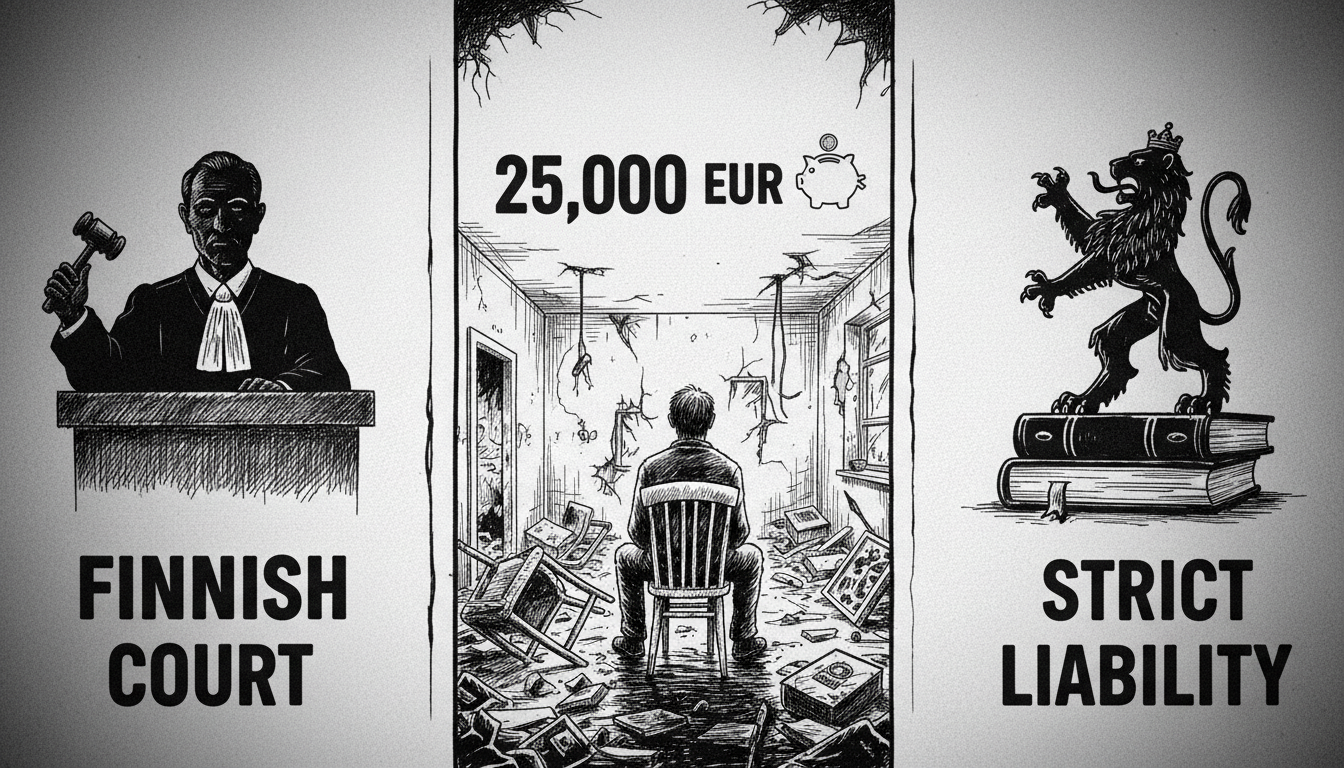
The Satakunta District Court has issued a conditional prison sentence to a 50-year-old man for aggravated property damage after he destroyed a rental apartment in Pori. The man was ordered to pay nearly 25,000 euros in damages to the housing company. The extensive destruction, which included ripping electric radiators from walls and discarding a door, was discovered earlier this year. Images from the scene show a kitchen floor piled with wet firewood and a bucket on the counter, indicating attempts to extinguish a fire in a wood stove that caused smoke and water damage. The court considered imposing an unconditional prison term due to the man's prior conviction for a serious violent crime from over six years ago. However, given the time elapsed and his full admission of guilt, including liability for compensation, the court deemed a five-month conditional sentence appropriate. The ruling is not yet legally binding.
This case highlights critical aspects of Finnish tenancy law and property rights within the Nordic social framework. Finland's legal system strongly protects housing companies and landlords, with tenants bearing full financial responsibility for damages beyond normal wear and tear. The substantial compensation sum reflects the high cost of construction and repair in Finland, where labor and material standards are stringent. For international readers, it is important to understand that Finnish rental agreements typically include clauses making tenants liable for all damages they cause, a standard practice across the Nordic region.
The court's deliberation over an unconditional sentence connects to broader discussions in Finnish society about rehabilitation and recidivism. The decision to opt for a conditional sentence, influenced by the time since the previous offense, aligns with Finland's penal policy which emphasizes reintegration. This approach has contributed to Finland having one of the lowest incarceration rates in Europe. The case also underscores the operational challenges for Finnish housing companies, which are often cooperatively owned by residents, when managing severe property violations.
From a practical perspective, this incident serves as a stark reminder for expats and international tenants in Finland. Understanding the legal and financial responsibilities of a rental contract is paramount. Finnish courts do not hesitate to enforce substantial damage claims, and a conviction can impact future rental applications and residency permits. The case from Pori, a major city on Finland's west coast, is not an isolated event but part of a pattern where tenant misconduct leads to complex legal and financial consequences, stressing the importance of responsible tenancy in a system built on mutual trust and contractual obligation.