
A comprehensive new study from the Family Federation of Finland provides a detailed map of the nation's social fabric. The latest Family Barometer survey, conducted in the third quarter, examines the kinship and friendship networks of Finnish adults. The findings reveal distinct patterns in how Finns maintain relationships, with notable differences emerging along gender and educational lines. The research involved responses from 5,117 Finns aged 18 to 79, offering a robust snapshot of societal connections.
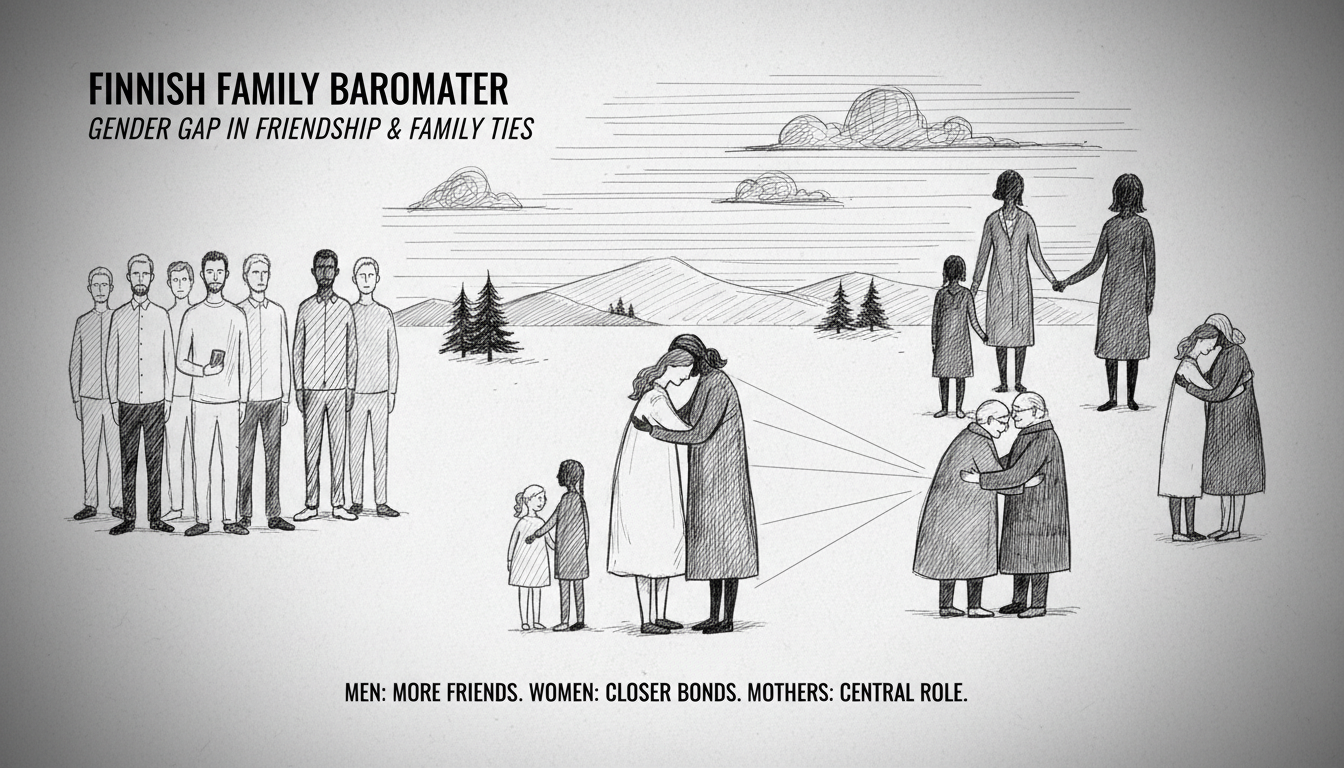
Finnish adults report having an average of six close relatives outside their household and four close friends. Men list an average of twelve friends, with four considered close. Women report ten friends on average, with three deemed close. The data indicates a correlation between family and friend networks. Those with many close relatives also tend to have more close friends. Individuals with few close connections are more frequently dissatisfied with the quantity of their intimate relationships.
The role of mothers remains paramount in Finnish adult life. Nearly nine in ten respondents with a living mother had been in contact with her during the past week. Six in ten had met their mother face-to-face. Contact with fathers is somewhat less frequent on average. Roughly five percent of respondents have no contact with their father at all. Mothers are also perceived as closer on average than fathers. This enduring matriarchal bond is a consistent feature of Finnish social life, reflecting deep cultural patterns.
For grandparents, grandchildren stand out clearly. More than seven in ten grandparents selected a grandchild as a close relative. Over half of those consider their grandchild very close. For those without children of their own, the children of siblings gain importance. Six in ten childless individuals selected a niece or nephew, like a sister's child, among their three closest relatives. For others, this figure was four in ten.
Research fellow Tiia Sorsa explained the gender dimensions evident in the choices. Women selected women more often, and men selected men. The experience of closeness also typically connects to gender. Mothers and daughters are on average the closest parent-child pairs. Sisters are the closest sibling pairs. Closeness to female relatives and those on the maternal line is generally higher than to male relatives and those on the paternal line. This gendered dimension of intimacy suggests social norms and emotional labor are still distributed along traditional lines.
Nearly one in four respondents included their spouse or a relative among their three closest friends. The majority of close friendships are remarkably durable. Among 40 to 49-year-olds, nearly half of friendships have lasted at least two decades. For those aged 70 to 79, two-thirds of friendships span 20 years or more. Research fellow Noora Lehtonen notes that new close friendships can form throughout life. The most common avenues for starting a close friendship are through other friends, acquaintances, family, school, or the workplace.
Finns maintain tight contact with their friends. Women keep in touch more frequently through calls and messages. Men meet their friends face-to-face more often. This distinction points to different communication styles and social rituals between genders. The study's depth offers crucial insights for policymakers in Helsinki concerned with social cohesion, public health, and wellbeing. Loneliness and social isolation are growing concerns across the Nordic region. Understanding the structure of Finns' natural support networks is the first step in crafting effective interventions. The data clearly shows that strong family bonds, particularly with mothers and sisters, form a critical safety net. Yet the persistent gender gap in friendship intimacy and the challenges for those with small networks highlight areas where community support could be strengthened.