
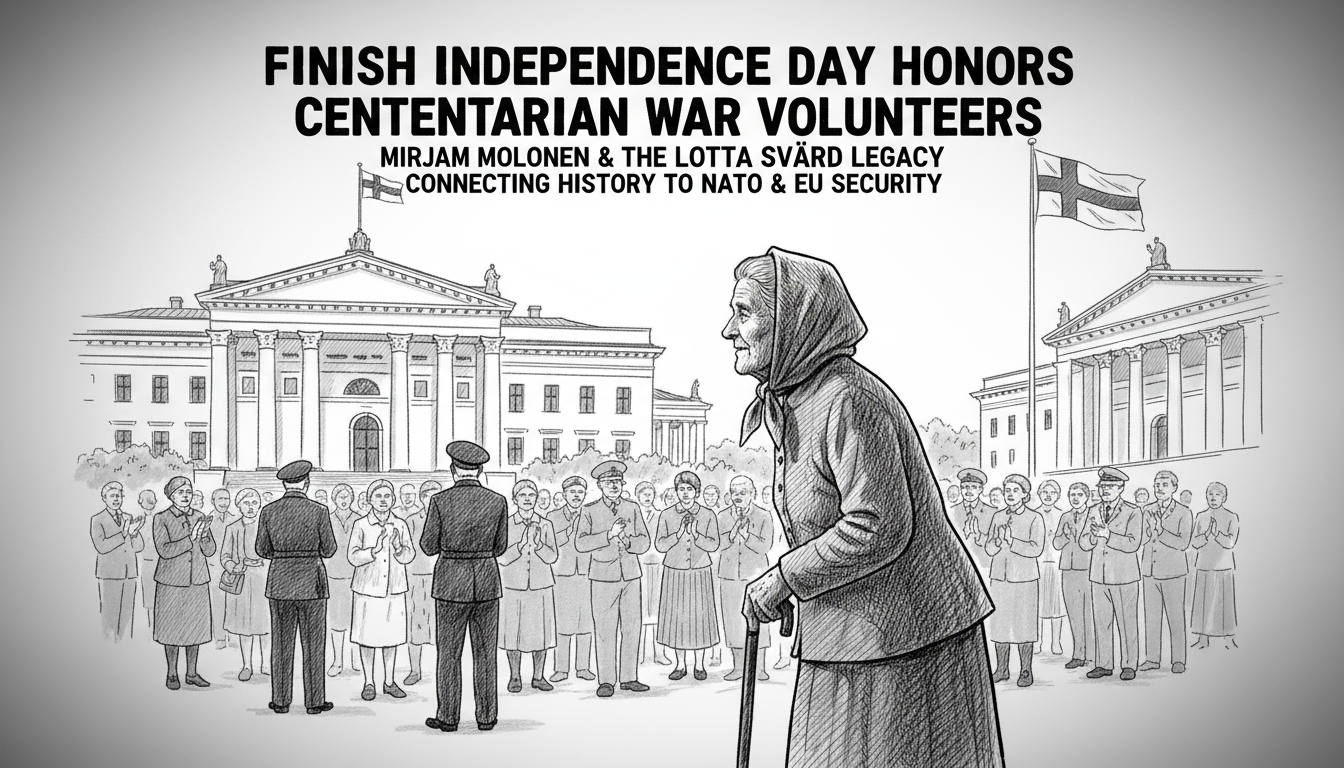
President Alexander Stubb and Suzanne Innes-Stubb hosted a select group of honor guests at the Presidential Palace in Helsinki to mark Finnish Independence Day. The gathering included veterans, Lotta Svärd members, and representatives from the war generation, with an average age exceeding one hundred years. Among the distinguished attendees was Mirjam Molonen, a 100-year-old former 'pikkulotta' or junior Lotta and military canteen sister from Kotka. Her presence underscores the nation's enduring commitment to honoring the citizens whose personal sacrifices underpinned Finland's sovereignty during the Winter War and Continuation War. The event, intimate in scale with just under twenty guests, reflects a tradition of direct presidential recognition for the wartime generation, a cornerstone of Finland's national identity and collective memory.
Molonen shared detailed recollections of her service, which began at age fourteen during the Winter War. She knitted socks and knee warmers for troops at the front. Her commitment deepened as she and her twin sister later volunteered as junior Lotta Svärd members in Hamina and the eastern archipelago of the Gulf of Finland. She described the decision to serve as self-evident, driven by a desire to contribute to preserving Finland's independence. Upon reaching adulthood, she volunteered as a military canteen sister, dispatched to Säkkijärvi in Karelia where she and a friend established a canteen in an abandoned house to serve soldiers. The work involved baking with scarce flour supplies and brewing homemade beer, providing not just sustenance but crucial morale and a semblance of normalcy for troops under constant threat.
The psychological dimension of this service was profound. Molonen recalled ever-present fear, with the group running to hide under berry bushes during air raids. Their green uniforms provided camouflage. She emphasized the critical importance of maintaining a cheerful facade and engaging the soldiers in conversation and laughter, deliberately masking the shared anxiety to create a vital respite from the horrors of the front lines. This aspect of the Lotta Svärd and canteen sister work—providing psychological support and a haven—is a historically significant but often less highlighted component of the civilian war effort. After the Soviet major offensive, her unit relocated, and she continued service in Turku before returning home in 1945 to rebuild her civilian life.
Today, Molonen lives independently and follows world affairs closely. She expressed deep distress over Russia's war of aggression in Ukraine, questioning why the Russian leadership cannot be compelled to stop. Her personal Independence Day tradition now involves lighting white candles in a blue candlestick holder and watching the official ceremonies on television, a quieter observance compared to earlier years of laying wreaths at war hero graves. Her reflection that independence holds great meaning because 'we were not taken by force, nor by a mere whistle' encapsulates the hard-won value of Finnish self-determination. This sentiment resonates strongly in contemporary Finnish security policy, which has been fundamentally reshaped by NATO membership following Russia's invasion of Ukraine.
The Presidential Palace event, while ceremonial, connects directly to current Finnish political and defense priorities. The government, led by Prime Minister Petteri Orpo, consistently frames national resilience and comprehensive security as extensions of the societal solidarity demonstrated by Molonen's generation. The Eduskunta recently passed a new Defense Cooperation Agreement with the United States, reinforcing national security. Honoring figures like Molonen reinforces the historical continuity of popular will in defending sovereignty, a narrative actively utilized in public discourse to support increased defense spending and societal preparedness. The story transcends simple commemoration, serving as a living bridge between the existential struggles of the 1940s and Finland's modern geopolitical stance within the European Union and NATO, reminding citizens and international observers alike of the deep-rooted foundations of Finnish resolve.