
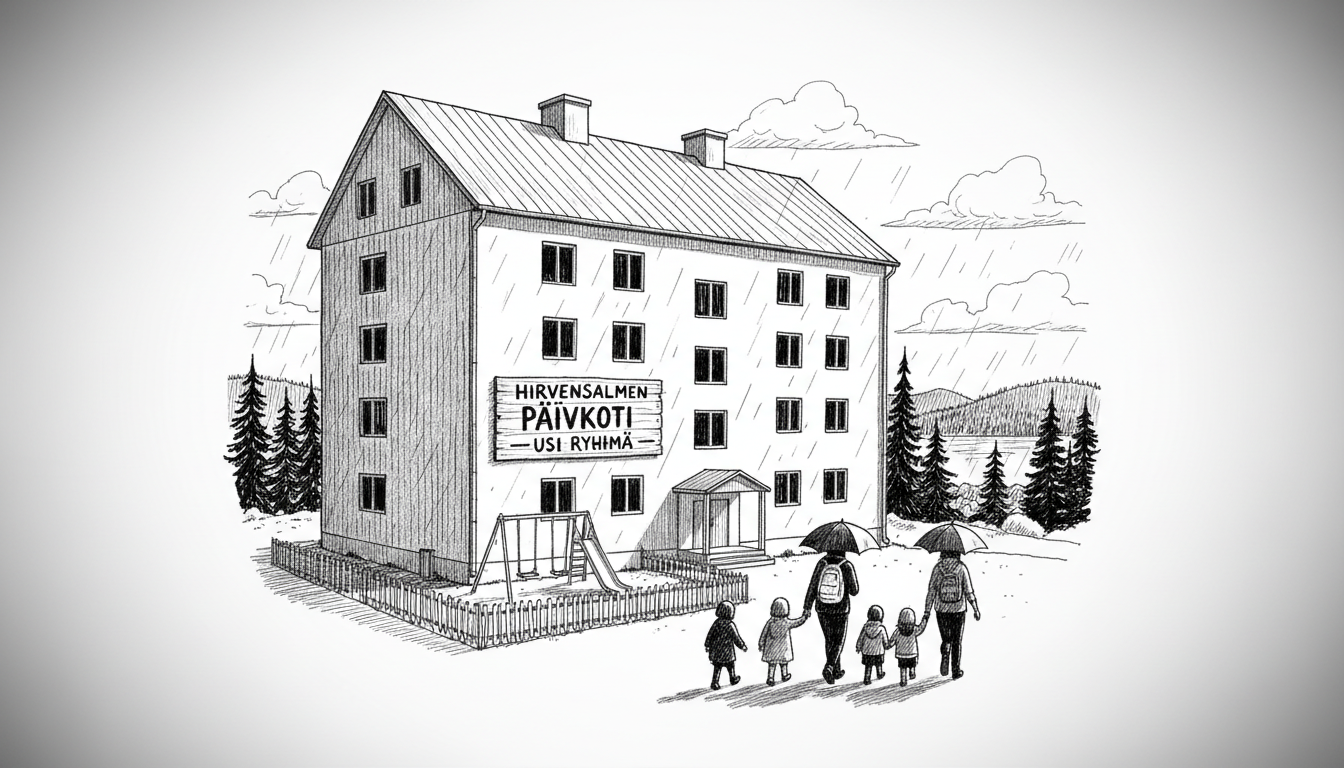
The small municipality of Hirvensalmi in Eastern Finland has taken direct action to address a growing demand for early childhood education places. Local authorities recently renovated a standard apartment in a residential building to create a new group space for children. This new facility filled almost immediately, reflecting a broader national pressure on Finland's renowned early education system. The situation in Hirvensalmi, a town of roughly 2,000 residents, highlights the complex challenges facing rural municipalities as they strive to uphold the country's constitutional right to early childhood education and care.
In practical terms, the conversion involved adapting a multi-room apartment in a standard block to meet the safety and pedagogical standards required for a daycare group. Officials report strong initial uptake, with the new group reaching capacity shortly after opening. This local solution emerges against a backdrop of national debate in the Eduskunta, Finland's parliament, concerning long-term funding models for municipalities and their social services. The Finnish government, led by Prime Minister Petteri Orpo, has faced scrutiny over its budget allocations to local governments, which bear primary responsibility for providing these services.
The move has clear political and financial implications. Converting existing residential property can be a faster and sometimes more cost-effective solution for a municipality than constructing a new dedicated building. This approach allows local councils to respond quickly to demographic shifts or increased birth rates in specific areas. However, it also raises questions about the sustainability of such adaptations and whether they represent a temporary fix or a new model for flexible service provision. Finland's commitment to high-quality early education is a cornerstone of its social policy, but maintaining it requires continuous investment and innovative planning from Helsinki down to the smallest municipality.
From an EU perspective, Finland's situation is watched closely. The European Pillar of Social Rights emphasizes the right to affordable early childhood education and care. Member states are working towards EU-level targets for participation, making Finland's domestic challenges relevant to broader European policy discussions. Successes and struggles in Finnish municipalities serve as case studies for other regions grappling with similar demographic and fiscal pressures. The solution in Hirvensalmi demonstrates a pragmatic, community-level response to a systemic issue, balancing immediate need with fiscal reality. The true test will be whether such adaptations can maintain the high pedagogical standards for which Finnish early education is globally recognized, or if they signal a quiet compromise in the face of budgetary constraints.