
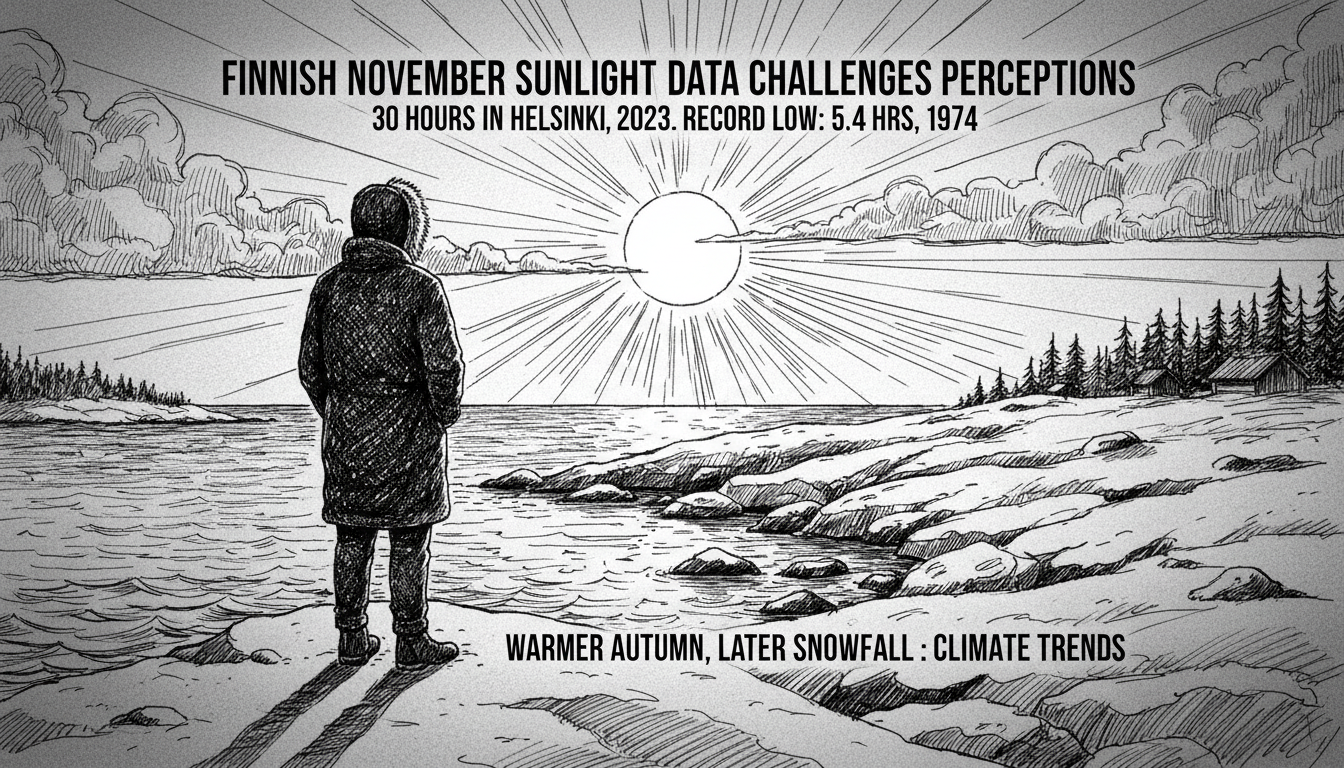
New meteorological data from Finland's national weather institute reveals a significant gap between public perception and climatic reality regarding November's darkness. While many residents in Helsinki and across southern Finland experienced the month as exceptionally gloomy, official measurements tell a different story. At Helsinki-Vantaa Airport observation station, the sun shone for approximately 30 hours during November. This figure sits only slightly below the long-term average of 34 hours for the station. The data provides a concrete counterpoint to the common subjective feeling of a deeply dark autumn month, a sensation amplified by Finland's high latitude and shortening days.
Meteorologist Pauli Jokinen provided crucial historical context for these readings. He stated that the darkest November on record at Helsinki-Vantaa occurred decades ago. In that year, sunlight was recorded for a mere 5.4 hours throughout the entire month. This stark comparison illustrates how contemporary Novembers, while still dim, are far from historical extremes in terms of solar exposure. The Helsinki-Vantaa station has maintained consistent records since the early 1960s, providing a reliable dataset for long-term climate analysis.
The broader weather statistics for November paint a picture of an unusually warm autumn across most of Finland. The Finnish Meteorological Institute reported that this autumn ranked as the second warmest in measurement history at many observation stations. Nationwide, November's average temperatures were 1 to 3 degrees Celsius higher than typical, except in Lapland where conditions were cooler than average. Precipitation was also below normal in the south and far north, contributing to the atypical seasonal pattern.
A critical trend highlighted by the data involves the timing of winter's arrival. Jokinen directly connected changing snowfall patterns to ongoing climate change. He noted that the first lasting snow now arrives later in southern and central Finland and melts away earlier in the spring. This shift is clearly visible in the institute's long-term statistics. The phenomenon was observed in Helsinki's Kumpula district, where the first one-centimeter snow cover was recorded in November, but such early cover is becoming less reliable and persistent.
These meteorological findings carry implications beyond weather reports. For Finnish energy policy, understanding sunlight and temperature trends is vital for solar power projections and district heating demand. The data also informs public health discussions about seasonal affective disorder, as perceived darkness can impact well-being regardless of actual sunlight hours. The clear attribution of shifting snow patterns to climate change adds to the body of evidence guiding national adaptation strategies. While a single month's data does not define a trend, its placement within decades of records offers a valuable snapshot of a changing Nordic climate, where subjective experience and objective measurement increasingly diverge.