
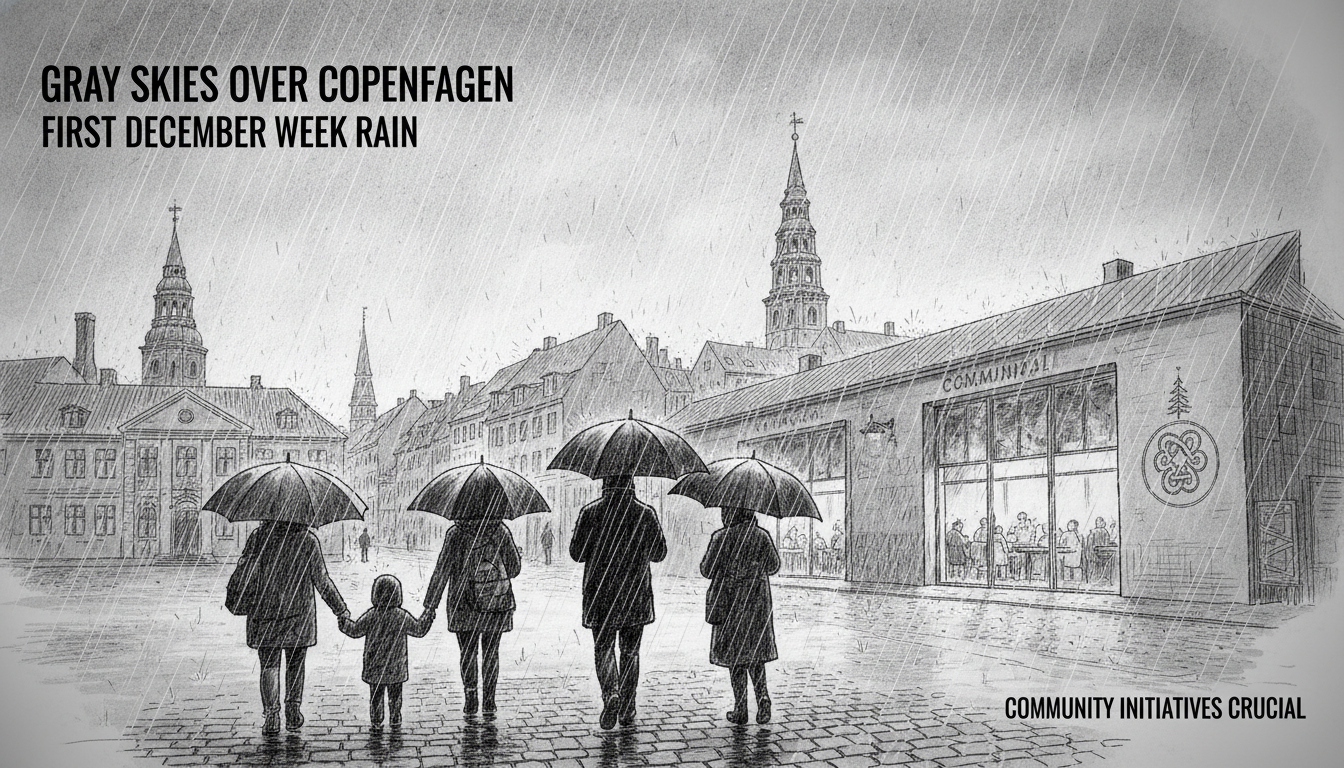
The first week of December in Denmark begins with a familiar pattern of gray skies and steady rain. Meteorologist Mille Jensen from the Danish Meteorological Institute delivered the forecast on Monday morning. She noted the day would start with clear weather and sunshine in many areas, but clouds would gather throughout the afternoon. Rain from the west will arrive by the end of the day, particularly affecting the Jutland peninsula and Funen. Daytime temperatures will hover between four and eight degrees Celsius, with winds picking up from a south to southwesterly direction.
The rest of the week's workdays will primarily feature overcast, gray weather accompanied by light rain. Thursday offers a brief respite, expected to stay dry for most of the day. Nighttime temperatures could dip to around two degrees, with the first chance of frost not arriving until Friday. A slight warming trend is predicted for the weekend, offering a minor break from the chill.
When asked about the prospects for a white Christmas, the meteorologist offered a sobering statistical reality. The forecast is too distant for reliable prediction, but historical data is not promising. The official Danish criterion for a white Christmas requires at least 90 percent of the country to have a minimum of half a centimeter of snow on December 24th. By this strict definition, Denmark has recorded only nine white Christmases in its modern history, with the most recent occurring over a decade ago. The last event in 2010 brought clear, cold conditions with temperatures as low as minus ten degrees and even a snowstorm on the island of Bornholm.
This weather pattern holds a deeper significance within the context of Danish society and its welfare system. The long, dark winters present a tangible challenge to public well-being and social cohesion. Municipal social centers and community programs often see increased demand during these months, as gray weather can exacerbate feelings of isolation, particularly for new arrivals navigating the integration process. The Danish approach to social policy actively accounts for seasonal affective challenges, with many municipalities organizing indoor community events and 'hygge' gatherings to combat the gloom.
From an integration perspective, the first Danish winter is a profound cultural experience for many newcomers. The lack of light and persistent gray skies can be a stark contrast to climates in the Middle East, Africa, or Southern Europe. Understanding and adapting to this environment is an unspoken but critical part of settling into Danish life. Community leaders in neighborhoods like Nørrebro and Vestegnen often highlight how shared experiences of the weather become a point of common ground, a topic everyone can discuss regardless of background.
The economic implications are also measurable. Energy consumption rises, public health services prepare for seasonal illnesses, and absenteeism can see a slight uptick. The Danish welfare model is designed to buffer these systemic stresses, but the annual test is real. The conversation about a white Christmas, while whimsical, touches on a collective longing for the beauty and light that snow can bring to the dark season. It represents a hope for a break in the monotony, a transformation of the gray landscape into something bright and unifying, however statistically unlikely that may be.