
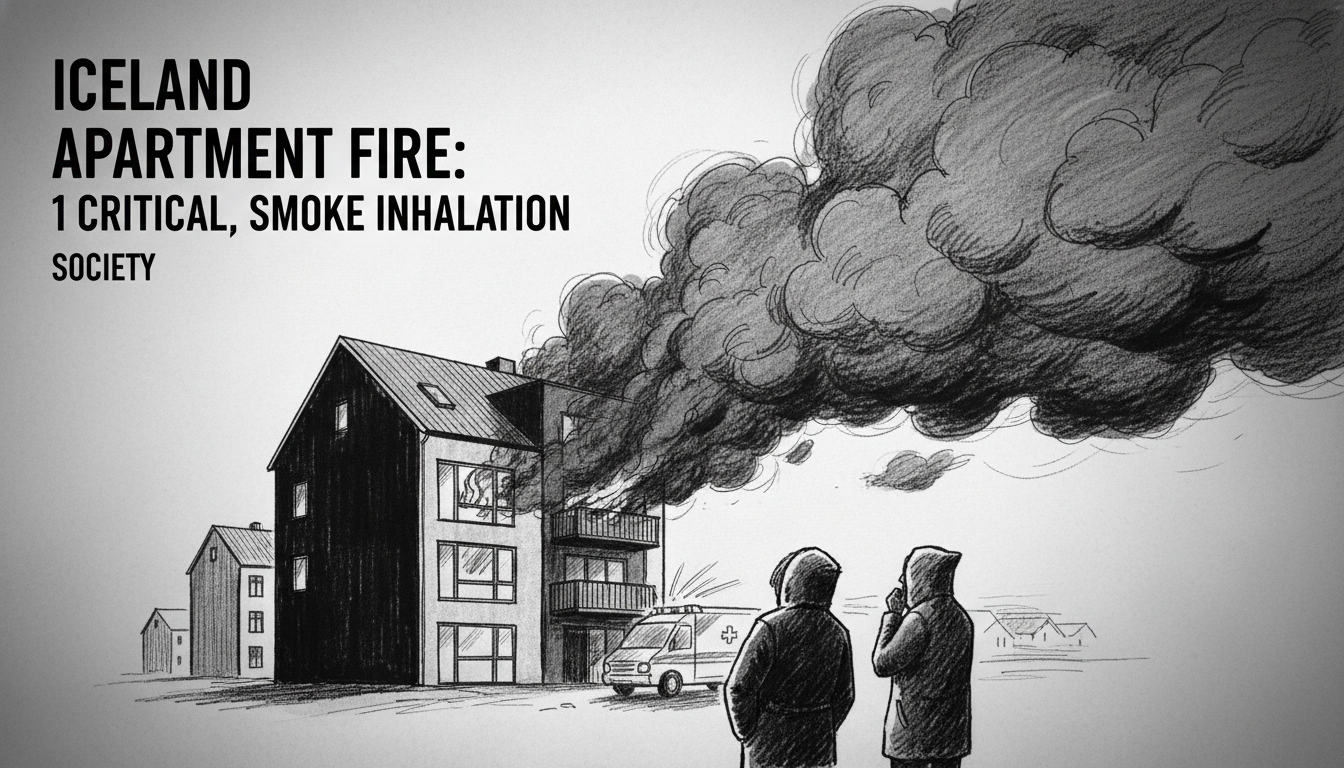
Iceland's emergency services recorded another serious residential fire today as smoke filled a Mosfellsbær apartment. One resident was transported to the hospital with suspected smoke inhalation following a blaze in the Þverholt area of the Reykjavik suburb. The incident tests Iceland's much-praised fire safety infrastructure and renews focus on urban building standards.
"The firefighting work progressed quickly. We have extinguished the fire and are now working on ventilation," said Deputy Chief Stefán Kristinsson of the Capital Region Fire Department in a statement. Eyewitnesses reported seeing three ambulances and a fire truck responding with priority traffic rights around six in the evening. The response highlights the integrated emergency protocol between Mosfellsbær and Reykjavik's central services.
From Alarm to Hospital Transfer
The sequence of events was rapid. After emergency calls, units from the Greater Reykjavik Fire Department were dispatched to the residential address. Their primary focus shifted from containment to rescue upon confirming a person was inside. The individual was removed from the smoke-logged environment and handed over to awaiting EMS personnel. Transport to the hospital's accident and emergency department followed for treatment of potential smoke poisoning, a common and dangerous consequence of house fires.
This response is standard but critical. "Time is the decisive factor with smoke inhalation. The coordination between fire crews and paramedics on scene is fundamental," explains Dr. Anna Þórhallsdóttir, a Reykjavik-based emergency medicine consultant. "The toxic compounds in smoke can cause rapid deterioration." Iceland's low population density outside the capital can sometimes mean longer response times in rural areas, but within the capital region, targets are stringent.
Iceland's Fire Safety Paradox
Statistics show Iceland has a relatively low rate of fatal fires compared to other Nordic nations, attributed to strict building codes and widespread use of non-combustible materials like concrete. However, each incident receives outsized attention due to the small, close-knit population. The fire in Mosfellsbær, a growing suburb of just over 13,000 people, will be felt community-wide.
Modern Icelandic building regulations mandate interconnected smoke alarms, fire-resistant materials in common areas, and clear escape routes. The effectiveness of these measures is often proven by limiting damage, as hinted at by the deputy chief's report of a fast containment. Yet, older apartment buildings, or íbúðarhús, from the 1970s and 80s may have different standards. Investigators will examine the point of origin and the performance of safety systems in this specific building.
"The codes are strong, but maintenance is key," says Hallgrímur Jónasson, a building inspector with the Icelandic Housing and Construction Authority. "Residents must ensure alarms are active, and building managers must keep ventilation systems and access points clear. It's a shared responsibility."
The Human Element in Suburban Growth
Mosfellsbær, nestled between Mount Esja and the capital, represents Iceland's rapid suburban expansion. Towns like these have absorbed much of the region's population growth, putting pressure on infrastructure. While emergency services are coordinated, local knowledge is vital. The Mosfellsbær fire crew, which likely assisted, provides crucial familiarity with local building layouts and access roads.
The incident raises quiet questions about the density of new housing projects and the preservation of safety margins. Althing member for the region, Katrín Jakobsdóttir of the Left-Green Movement, has previously called for reviewing safety protocols in fast-growing municipalities. "Growth must not outpace our commitment to safety. Every new development plan must have emergency access and resource allocation baked in from the first draft," she said in a recent committee meeting.
This fire may fuel that discussion. While not on the scale of the tragic fire at the Grenfell Tower in London, it serves as a sharp reminder that safety is a continuous process, not a one-time box to tick during construction.
Nordic Cooperation on Emergency Response
Iceland's system does not operate in isolation. The Nordic countries share best practices for emergency response and disaster management through forums like the Nordic Council of Ministers. Iceland, with its unique volcanic and geothermal risks, contributes expertise in unconventional scenarios, while learning from Swedish and Danish models of urban firefighting and emergency medical integration.
The patient's transfer to the National University Hospital of Iceland in Reykjavik involves a system benchmarked against other Nordic trauma centers. The hospital's accident and emergency department is the country's primary receiving unit for such injuries, equipped with hyperbaric oxygen therapy—a treatment sometimes used for severe smoke inhalation—reflecting standards seen in Oslo and Helsinki.
This cross-border learning is essential for a nation of Iceland's size. "We cannot maintain expertise in every rare medical event internally," admits a senior HSE official. "Our Nordic networks allow us to consult and prepare, ensuring a patient gets the best possible care here or can be stabilized for transfer if needed."
Looking Ahead: Prevention and Policy
The immediate aftermath focuses on the resident's recovery and the fire's cause. An investigation by fire marshals will follow, which could lead to recommendations for national building code updates or local enforcement actions. Data from such incidents is pooled nationally to identify trends, like fires linked to specific electrical appliances or heating systems.
Iceland's reliance on geothermal district heating is generally a safety advantage, reducing individual in-home boilers. However, electrical systems and personal appliances remain common ignition sources. Public awareness campaigns, often promoted by the Icelandic Association for Search and Rescue (ICE-SAR), stress simple steps: checking smoke alarm batteries, not overloading outlets, and having a home escape plan.
As the smoke clears in Þverholt, the broader conversation continues. It balances celebrating the effective, swift response of Iceland's emergency crews with the sobering reality that even one preventable injury is one too many. For a society proud of its tight-knit community and high safety standards, this fire is a call to vigilance, reminding everyone that safety is a collective duty, from the parliament in Althing to every apartment doorstep.
Will this event lead to tangible policy reviews, or will it fade as a narrowly-averted crisis? The answer depends on how loudly local residents and their elected officials choose to speak.