
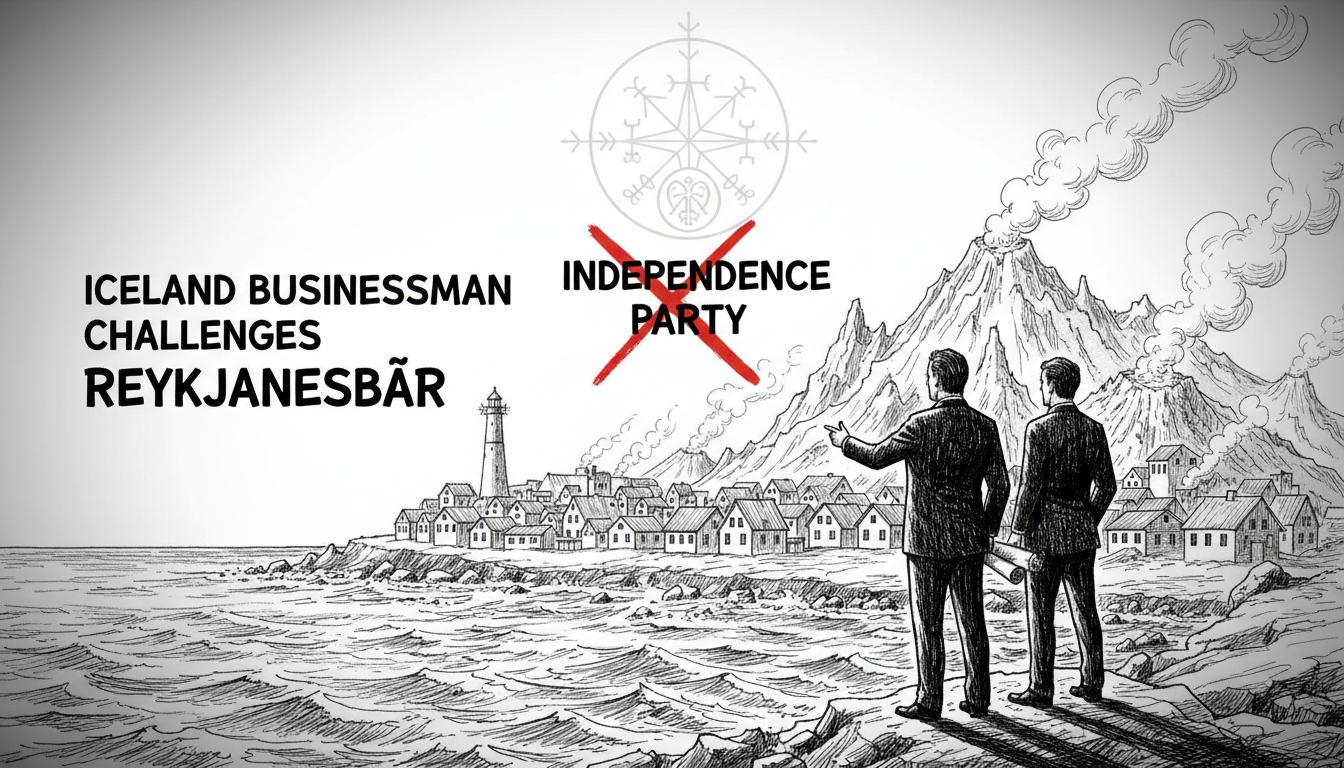
Iceland municipal elections in 2026 are already seeing early challengers emerge. Ásgeir Elvar Garðarsson, a business executive, announced he will run to lead the Sjálfstæðisflokkurinn (Independence Party) list in Reykjanesbær. His leadership primary is set for January 31, 2026. The move signals a potential shift towards a more corporate-style governance model in the key southwestern municipality.
"Not all storms are there to sink ships, some change course," Ásgeir Elvar said in his announcement. He positioned himself as an outsider offering a new vision. "I do not have years of political experience, though I have followed it closely and taken an active part in my community. A new approach is necessary for the municipal level."
His central argument is that Reykjanesbær must operate more like an efficient company. He argues it should be less like a slow-moving public institution. "It is not enough that operations look good on paper when residents experience the complete opposite on their own skin," he stated.
A Businessman's Vision for Municipal Politics
Ásgeir Elvar Garðarsson is the managing director of the car rental company Geysir. His candidacy represents a clear push for business principles in local government. Reykjanesbær is a critical economic hub. It is home to Keflavík International Airport and major geothermal energy projects. The municipality's management directly impacts national infrastructure and tourism.
Analysts see his run as a test of appetite for non-traditional politicians. "This is a classic insider-outsider dynamic within a dominant party," said a political scientist at the University of Iceland, who spoke on background. "The Independence Party has deep roots here. A business leader arguing for efficiency could resonate, or it could be seen as lacking necessary political nuance."
The candidate's lack of a long political record is a calculated risk. It frames him as untainted by bureaucratic inertia. Yet it also raises questions about his understanding of complex municipal law and public sector bargaining.
The Stakes in Reykjanesbær's Future
Reykjanesbær faces unique pressures that make governance style a pivotal issue. The region has experienced significant seismic and volcanic activity in recent years. This has disrupted communities and infrastructure. Managing emergency response and long-term resilience requires both swift action and careful public consultation.
Furthermore, the municipality sits at the heart of Iceland's tourism and energy sectors. Balancing industrial growth with community needs is a constant challenge. The fishing industry, while less dominant than in the north, still contributes to the local economy. Decisions made in Reykjanesbær's council affect airport expansion, port fees, and geothermal resource allocation.
Ásgeir Elvar's platform implies a critique of current municipal operations. He suggests processes are too slow and disconnected from residents' daily experiences. His solution appears to be leaner management and a stronger focus on measurable outcomes. Critics might argue this overlooks the democratic and social service roles of a municipality.
The Independence Party's Crossroads
The Sjálfstæðisflokkurinn is Iceland's historically dominant center-right party. Leadership primaries within its local chapters are often quiet, consensus-driven affairs. A contested primary led by a business outsider introduces an element of public debate. It forces the local party membership to define its priorities for the 2026 campaign.
Will they prioritize traditional political experience and party loyalty? Or will they opt for a managerial shake-up? The result will signal the party's direction in a key municipality. A win for Ásgeir Elvar could inspire similar business-focused candidates elsewhere in Iceland.
"Local chapters have significant autonomy," the analyst noted. "A victory here would show a segment of the party's base is hungry for a different type of candidate. It's about applying private sector discipline to public budgets and services."
The primary election is over a year away. This gives Ásgeir Elvar time to build support within the party membership. It also gives the current political establishment time to mount a defense of their record.
The Broader Nordic Context of Local Governance
This development in Reykjanesbær mirrors wider discussions across the Nordic region. Municipalities in Sweden, Norway, and Denmark also grapple with demands for more efficient, responsive governance. The tension between professional management and representative democracy is common.
Iceland's system grants its towns and cities considerable power over local taxes, planning, and schools. The quality of municipal leadership directly impacts daily life. A business executive promising to "run the town like a company" taps into a familiar Nordic debate about public sector modernization.
However, the Icelandic context is distinct. Its communities are smaller and more intimate. The personal connection between voters and councilors is strong. A purely managerial approach may clash with expectations of accessibility and consensus.
Looking Ahead to the 2026 Campaign
The January 31, 2026, primary is just the first step. The winner will lead the Independence Party's list in the general municipal elections later that year. Those elections will determine the composition of the Reykjanesbær town council.
Ásgeir Elvar Garðarsson's candidacy ensures that the philosophy of governance itself will be a campaign issue. It moves beyond specific policy debates about roads or schools. It asks a fundamental question: what is the best model for running a modern Icelandic municipality?
Can the principles of a bílaleiga (car rental company) be effectively applied to a bær (town)? Residents of Reykjanesbær's districts will soon weigh in. Their decision will reflect whether they desire a change in course or steady, experienced hands at the wheel during continued geological and economic uncertainty. The storm, as the candidate himself noted, may yet change direction.