
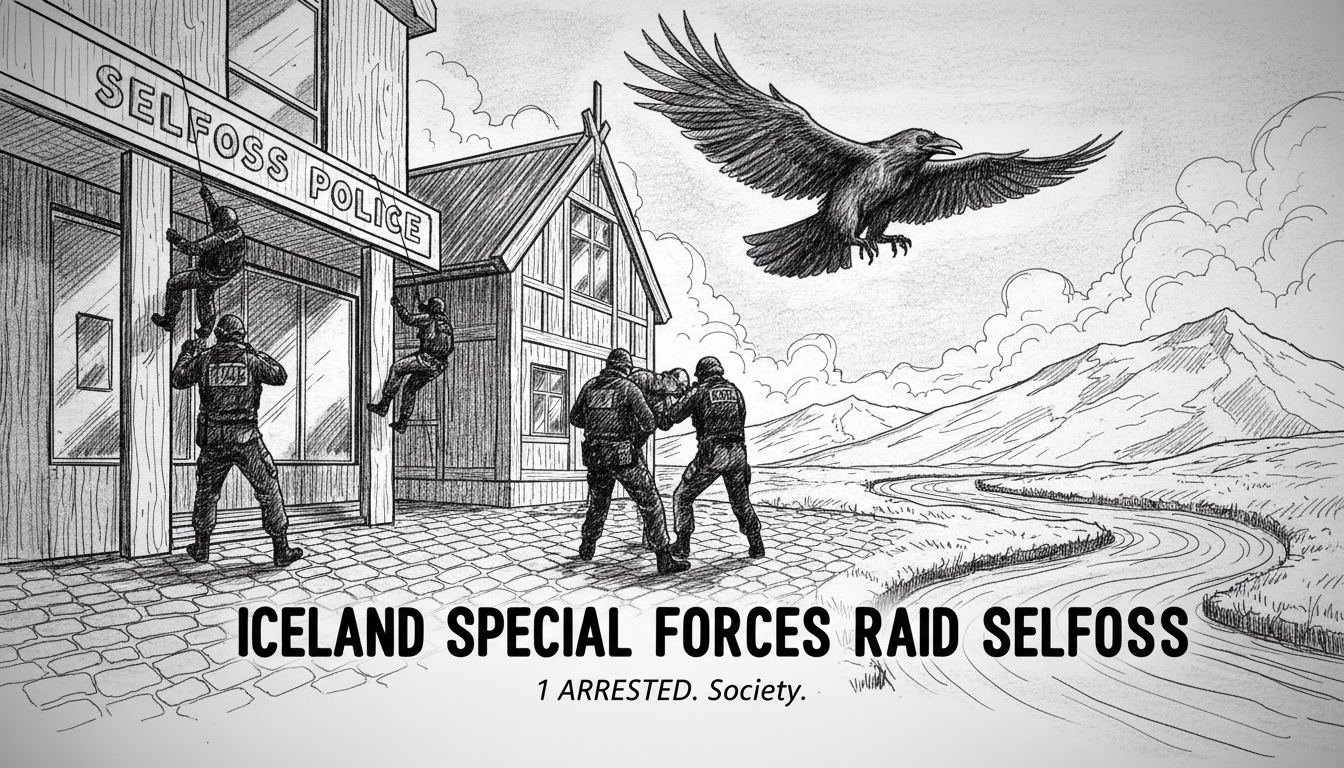
Iceland's elite police special forces deployed to a residential street in Selfoss on Thursday, resulting in one arrest. The operation, requested by South Iceland Police, saw the heavily armed Sérsveit Ríkislögreglustjóra unit enter a home in the quiet town of 10,000 people. Authorities have released minimal details, citing an ongoing investigation, but confirmed the arrest was made without incident.
Garðar Már Garðarsson, Chief Superintendent of South Iceland Police, stated only that "one person was arrested in a residential building in Selfoss." He declined to provide further information about the nature of the operation or the identity of the individual detained. The National Police Commissioner's office confirmed the special forces' involvement but referred all substantive questions back to regional commanders.
A Rare Display of Force
The deployment of Iceland's special police unit is an uncommon event that immediately signals a perceived high-risk scenario. Unlike the routinely unarmed general duty officers, members of the Sérsveit are equipped with firearms, tactical gear, and specialized training for hostage situations, armed confrontations, and counter-terrorism. Their visible activation in a community like Selfoss, the primary service center for the agricultural South, is highly unusual.
"When the special forces are called in, it means local police have assessed a situation as being beyond their normal capacity to handle safely," explains Dr. Anna Þórhallsdóttir, a criminologist at the University of Iceland. "In a country with such low violent crime, this suggests intelligence pointed to a serious threat—potentially involving weapons, barricaded individuals, or a significant risk to public safety." The unit's last major public deployment was a 2023 operation in Reykjavik linked to a transnational drug investigation.
The Selfoss Context and Community Impact
Selfoss, located 60 kilometers east of Reykjavik in the Árborg municipality, is better known for its dairy production, riverfront, and role as a hub for the surrounding farming communities than for high-stakes police raids. The operation's location in a residential area, not an industrial zone or remote location, adds a layer of concern for residents. News of the raid spread quickly through the tight-knit town, fueled by the unusual sight of tactical vehicles and armed officers.
Local council member for Árborg, Jónína Rós Guðmundsdóttir, expressed confidence in the police but acknowledged community anxiety. "Selfoss is a peaceful town. People see this and naturally worry. We trust the police to handle matters professionally, but clarity in the aftermath is important for public reassurance," she told Nordics Today. The South Iceland Police district, responsible for a vast but sparsely populated region, has a relatively small contingent of officers, making external support logical for a major operation.
The Nordic Policing Model Under Scrutiny
This incident places a spotlight on Iceland's unique position within the Nordic law enforcement model. Like their Norwegian and Danish counterparts, Icelandic police officers do not carry firearms as a matter of course. The special forces unit represents a critical, but rarely used, armed capability. The decision to escalate to this level involves a high threshold and command approval from the National Commissioner.
"This is the balancing act of Nordic policing," notes Lars Mikkelsson, a Swedish security analyst who studies regional cooperation. "You maintain a largely unarmed, community-focused force for day-to-day work, but you must invest heavily in a highly trained, rapid-response unit for extreme situations. The efficiency of that model is tested in events like the Selfoss operation." Iceland's police have increasingly focused on combating organized crime linked to the drug trade, a area where special forces are sometimes deployed for high-risk arrests.
Secrecy and the Public's Right to Know
The blanket of silence following the arrest is standard procedure for Icelandic authorities during an active investigation, but it often creates tension. Police cite the need to protect operational methods, ensure a fair judicial process, and avoid compromising future actions. However, this can leave a vacuum filled with speculation, particularly in a small community.
Legal expert Brynjar Þór Þórðarson argues that while operational secrecy is valid, a basic framework for public communication is needed. "Authorities can state the general category of crime being investigated—such as serious narcotics offenses, weapons violations, or threats to national security—without detailing evidence. This maintains public trust without harming the case," he says. Currently, the public in Selfoss knows only that an arrest occurred, not why the nation's top tactical unit was required to make it.
Environmental and Economic Angles in an Icelandic Town
While directly a police matter, the raid intersects with broader themes in South Iceland. The region's economy is a mix of robust agriculture, growing tourism, and geothermal energy production. Any perception of instability or serious crime can impact community cohesion and the area's reputation. Furthermore, the environmental focus central to Icelandic policy finds a parallel here: just as the country monitors seismic activity, so too must it monitor social and criminal tremors.
"A single event does not define a region," says economist Dr. Helga Jónsdóttir. "But for a town like Selfoss, which relies on a sense of safety and stability for its quality of life and business climate, swift and transparent resolution is beneficial. The fishing industry in nearby Eyrarbakki or the greenhouse operations using geothermal heat depend on predictable, secure communities." The operation's long-term impact will depend on what charges, if any, are filed and the narrative that eventually emerges from the courts.
Looking Ahead: The Judicial Process
The case now moves from the tactical sphere to the judicial one. The arrested individual will be brought before a judge for a custody hearing, typically within 24 hours. At that initial hearing, more information may become public, including the suspected crimes. The police will have to present grounds for continued detention. This legal step will provide the first substantive clues about the severity and nature of the case that prompted such a significant police response.
MPs at the Althing, Iceland's parliament, are likely to seek briefings from the Minister of Justice regarding the operation, especially if it connects to larger patterns of organized crime or national security. "Any use of the special forces warrants parliamentary oversight," stated Sigurður Ingi Jóhannsson, chair of the parliamentary committee on general affairs. "We operate on a principle of proportionate force. Once the investigation allows, we will examine whether that principle was correctly applied."
For now, the quiet streets of Selfoss have returned to normal. The special forces vehicles are gone. But the questions remain, hanging in the crisp South Icelandic air as the community, and the nation, await answers. The episode serves as a stark reminder that even in one of the world's most peaceful countries, the capacity for high-level police action lies in readiness, just beneath a serene surface.