
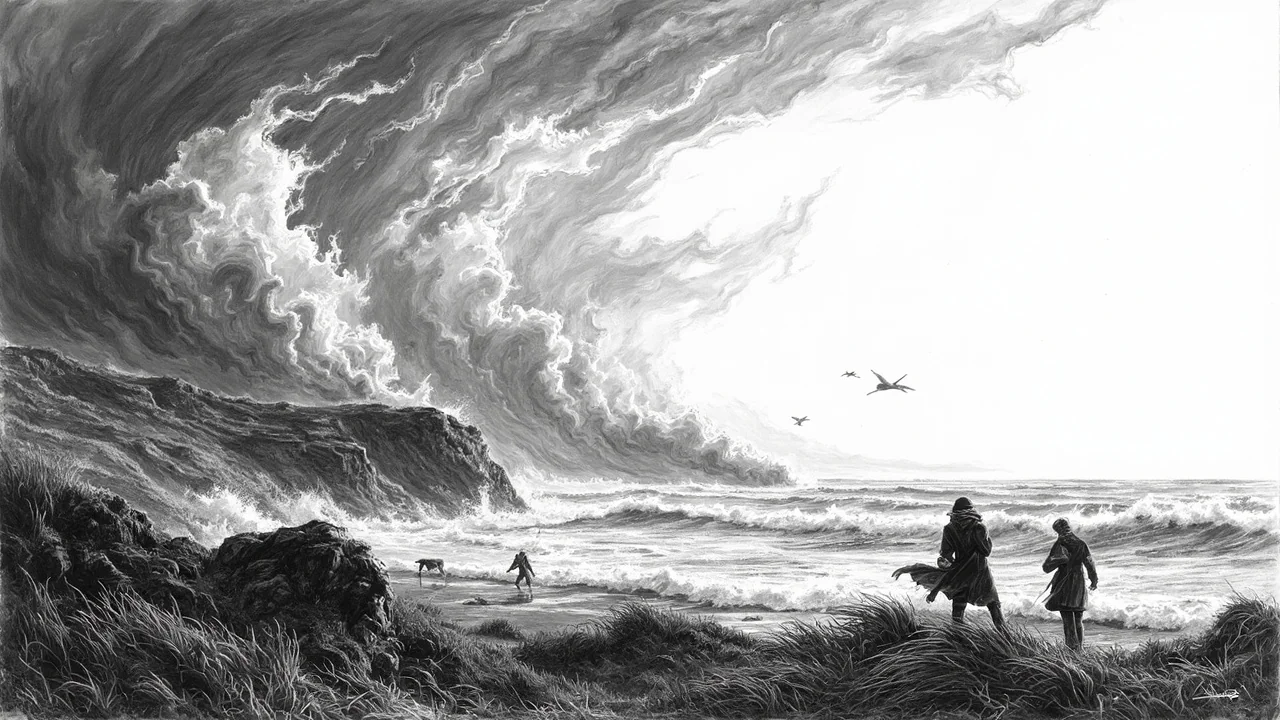
Iceland's Met Office has issued a severe weather warning for the country's eastern and southeastern regions tonight. A deepening low-pressure system between Iceland and Scotland is moving northeast, threatening coastal communities with hurricane-force winds and blizzard conditions. The storm could severely disrupt transport and power infrastructure across the Suðurnes peninsula and the remote Eastfjords.
Immediate Threats and Official Warnings
The Icelandic Met Office forecasts winds intensifying to 13-18 meters per second across wide areas this evening. Specific zones along the southeast coast and the Austurland region face extreme gusts of 18-23 m/s, officially classifying as a severe gale or storm. A heavy snow band is expected to move over the easternmost part of the country, creating blizzard conditions and near-zero visibility. The combination creates a high probability of transport disruptions.
The forecast warns of widespread sleet and snow across northern and eastern Iceland. Only the southwestern part of the country, around the capital region, will see partly cloudy conditions. Temperatures will remain cold, with frost between 0 and -6 degrees Celsius nationwide. Road authorities have urged against all non-essential travel in the affected regions after dusk.
"This is a classic, powerful winter storm for our eastern coasts," said a senior forecaster with the Icelandic Met Office. "The geography of the Eastfjords funnels these northerly winds, amplifying their speed. The primary risks are whiteouts on the roads and potential wind damage to infrastructure."
Regional Breakdown and Economic Impact
The storm's path poses a direct threat to key economic sectors. The Suðurnes peninsula, home to the international Keflavík Airport and major fisheries, is in the line of the strongest winds. Flight schedules may face delays or cancellations if crosswinds exceed safety limits. The fishing fleet, a cornerstone of Iceland's economy, will likely remain in port, halting fresh catches.
In the Eastfjords, communities like Reyðarfjörður and Fáskrúðsfjörður are geographically vulnerable. Steep valleys can act as wind tunnels. Local emergency teams are checking on residents in isolated farms and older buildings. The region's reliance on the Ring Road (Route 1) makes it susceptible to isolation if a single pass closes due to snowdrifts or avalanches.
Further north, the weather will be less severe but still disruptive. Akureyri can expect gusty winds of 10-18 m/s and sleet. The colder, drier air north of the Vatnajökull glacier means snow accumulations will be lighter, but wind chill will make conditions hazardous. This pattern highlights Iceland's dramatic microclimates, where conditions can shift from calm to violent within 50 kilometers.
Environmental Context and Changing Climate
This storm arrives amid ongoing scientific discussion about North Atlantic weather patterns. While severe winter storms are not new to Iceland, some climatologists point to increasing volatility. Warmer ocean temperatures in the subpolar gyre can potentially fuel more intense low-pressure systems as they track northward. This storm, developing rapidly between Iceland and Scotland, fits that model of rapid intensification.
"We are monitoring frequency, not just intensity," noted an environmental scientist at the University of Iceland. "The question for our infrastructure and emergency services is whether the interval between major disruptive events is shortening. This has direct implications for road maintenance budgets and coastal defense planning."
Iceland's rugged terrain naturally exacerbates weather impacts. The Central Highlands act as a barrier, forcing moist Atlantic air upward and wringing out precipitation on the southern and eastern slopes. The current forecast for dry conditions south of the Highlands, while the east is inundated, is a textbook example of this rain-shadow effect in action.
Political and Infrastructure Response
The impending storm has triggered standard parliamentary scrutiny. Members of the Althing's Environment and Transport Committee routinely demand updates from the Minister of Infrastructure following significant weather events. The focus is often on the resilience of the national power grid, which relies on exposed transmission lines, and the response times of the Icelandic Road and Coastal Administration.
"Our infrastructure in the east is perpetually tested by nature," said an opposition MP from the Eastern Region. "Every storm like this one is a stress test for our power lines, our telephone masts, and our sea defenses. The government's long-term climate adaptation strategy must prioritize these peripheral regions."
National emergency coordination between police, the Icelandic Association for Search and Rescue (ICE-SAR), and the Coast Guard is standard for such warnings. ICE-SAR's volunteer network, particularly critical in remote areas, would be placed on standby. This community-based response model is often cited as a key factor in Iceland's high resilience to natural hazards.
Comparisons and Nordic Preparedness
Iceland's approach to storm management shares similarities with its Nordic neighbors but is distinct in its challenges. Norway faces similar coastal storms along its long coastline but has a more sheltered inland population. Iceland's population and critical infrastructure are almost entirely coastal. Denmark and Sweden deal with less intense winter wind events but greater population density.
The Nordic Council has previously funded joint projects on climate adaptation and early warning systems. Iceland's expertise in managing volatile North Atlantic weather is a valued contribution to this cooperation. The data collected from this storm will feed into regional models used by all Nordic meteorological institutes.
Greenland, facing analogous Arctic weather systems, often shares real-time observational data with Iceland during major storms. This collaboration helps track the movement of large low-pressure systems across the Denmark Strait. It is a practical example of Arctic cooperation that improves forecast accuracy for both nations.
Historical Precedent and Looking Ahead
Storms of this projected intensity are memorable but not unprecedented. Historians and older residents may recall similar events, like major storms in the 1980s that caused significant coastal erosion in the east. Each event provides lessons. Following past storms, authorities improved building codes for wind resistance and relocated some vulnerable road sections.
The forecast suggests the worst conditions will ease by Tuesday, with winds decreasing to a northerly or northwesterly flow. The weather will remain cold and dry for most. However, the clean-up and assessment phase will begin. Farmers will check livestock, municipalities will survey for damage, and engineers will inspect key bridges and wind turbines.
The fundamental question for Iceland remains one of balance. The nation must harness the immense natural forces that provide geothermal energy and sustain fisheries while protecting communities from those same forces when they turn destructive. This storm is another reminder that in Iceland, environmental policy and daily life are inextricably linked. Preparedness is not a seasonal activity but a permanent state of mind, woven into the fabric of society from the Althing down to each individual household. Will the next storm be a test passed or a lesson learned the hard way?