
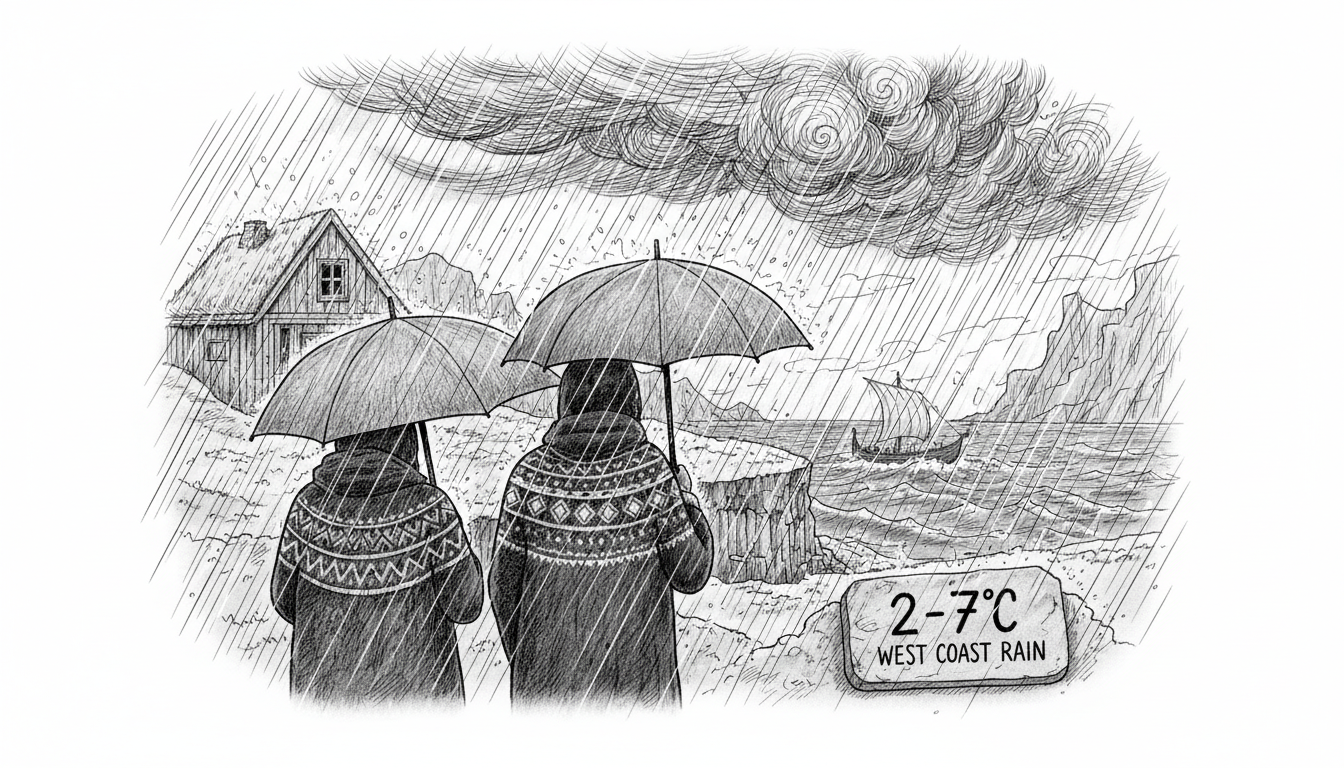
Iceland weather forecasts from the Icelandic Meteorological Office (Veðurstofa Íslands) predict a classic day of variable conditions across the island nation. Light rain is expected in western regions this afternoon, with temperatures hovering between 2 and 7 degrees Celsius. A southwest wind of 8-15 meters per second will sweep across the country, while eastern areas will see lighter winds and patchy frost that melts by late afternoon. This forecast underscores the rapid shifts that define Iceland's climate, where multiple weather patterns can exist within a few hundred kilometers.
For residents and travelers, this means a day of contrasts. The capital region, Reykjavík, falls within the zone expecting afternoon showers and brisk winds. Meanwhile, the South and East, including areas like Höfn and the Austfirðir, will remain dry under partly cloudy skies. This split personality is a direct result of Iceland's position at the convergence of Arctic and temperate air masses in the North Atlantic. The forecast is not extreme, but it is a textbook example of why checking Vedur.is multiple times a day is considered essential local knowledge.
A Nation Defined by Its Skies
Iceland's weather is more than small talk; it is a central character in the nation's story. The forecasted southwest wind is a dominant force, often bringing moisture from the Atlantic that condenses into rain over the western peninsulas like Snæfellsnes and the Westfjords. "The key to understanding an Icelandic forecast is understanding the wind direction," explains a meteorologist with the Icelandic Met Office. "A southerly or southwesterly flow, like today, typically means milder air but also precipitation for the south and west. It's a trade-off."
This daily dance with the elements has profound cultural and economic impacts. The fishing industry, a cornerstone of Iceland's economy, plans its fleet movements around these precise wind and wave forecasts. In Reykjavík's Grandi district, harbor masters and fishing company executives scrutinize the same data as families planning a weekend drive. The light rain predicted for the west today, while minor, could affect visibility on key roads like Route 1 along the southern coast or the highland routes, which remain closed for winter.
The Infrastructure of Forecasts
The reliability of Iceland's weather warnings is a point of national pride and a critical public service. The Icelandic Meteorological Office operates a dense network of automated weather stations, radar, and satellite monitoring to track the fast-moving systems. Their website, Vedur.is, and associated app are among the most frequently visited in Iceland. The forecast for "léttskýjað" (partly cloudy) in the east and "skýjað" (cloudy) with rain in the west is the product of this constant vigilance.
Road administrators at the Icelandic Road and Coastal Administration (Vegagerðin) use this data to issue travel advisories. While today's conditions do not warrant severe alerts, they illustrate the routine integration of weather into daily logistics. The mention of "víða vægt frost" (widespread light frost) in the east during the morning is a typical spring hazard, creating slippery conditions on roads and walkways in towns like Egilsstaðir until the afternoon sun takes effect.
Environmental Context and Climate Patterns
Analyzing a single day's forecast also invites a look at larger climatic trends. Iceland is a frontline observer of Arctic amplification, where warming occurs faster than the global average. While today's temperatures are seasonal, the increasing frequency of intense low-pressure systems and shifting precipitation patterns are subjects of ongoing research. The relatively mild 2-7°C range, with frost only in sheltered eastern valleys, aligns with recent trends of warmer, wetter winters.
This environmental angle is deeply political in Iceland. The Althingi frequently debates climate policy, balancing the nation's green energy credentials from geothermal and hydro power with the emissions from its fishing fleet and heavy industry. "Every weather report is now read through the lens of climate change," says a member of the Althingi's Environment Committee. "A calm day of rain in the west isn't just weather; it's data. It helps us model our future, from agriculture in the south to hydroelectric output in the highlands."
Travel and Tourism Implications
For the significant tourism sector, a forecast like today's is standard but requires careful planning. Tour operators running trips to the Golden Circle or south coast waterfalls will be preparing for wet-weather gear. The predicted winds of 8-15 m/s in the southwest are strong enough to make umbrella use impractical in Reykjavík's city center and could lead to choppy conditions on whale-watching tours departing from Reykjavík or Akranes.
The contrast between regions offers opportunities. Savvy travelers might choose to head east today, chasing the drier and brighter conditions forecast for the fjords. This internal redistribution based on weather is common and highlights the importance of flexible itineraries. The forecast ends with a note of a calmer night, with winds turning northerly and temperatures around freezing—a reminder that even a mild day is followed by a crisp Icelandic night.
A Nordic Perspective on Preparedness
Iceland's approach to weather communication holds lessons within the Nordic region. Its system of public alerts is robust, born from necessity. Compared to its neighbors, Iceland faces more volatile maritime conditions than Denmark and a wider range of day-to-day variability than the more continental climates of Sweden or Finland. This fosters a culture of preparedness that is deeply ingrained.
Nordic cooperation on weather and climate monitoring is strong, with data shared across the region to improve model accuracy for severe storms that often originate near Iceland. The forecasted southwest wind today is part of a system that will likely affect Norway's coast in the coming days. This interconnectedness reinforces the value of Iceland's detailed observational network for the entire region.
The Human Rhythm of Rain and Wind
Ultimately, the forecast for light rain west of the hills is woven into the rhythm of Icelandic life. It means farmers in the Borgarfjörður region might delay certain tasks, while students in Reykjavík will don rain jackets. It means the iconic hot pools, from the Blue Lagoon to local swimming pools, will feel that much more welcoming as steam rises into the cool, damp air. The weather is a shared experience, a common reference point that connects the remote Eastfjords to the urban buzz of the capital.
As the afternoon rain passes and gives way to a drier, colder night, the cycle resets. Tomorrow will bring a new forecast, a new configuration of wind, cloud, and temperature. This constant change is not a source of anxiety but a fundamental fact of life on this North Atlantic island. It demands respect, attention, and a good waterproof jacket—the unofficial national uniform. The Icelandic relationship with weather is not one of combat, but of adaptation, a daily lesson in resilience drawn from the sky itself.