
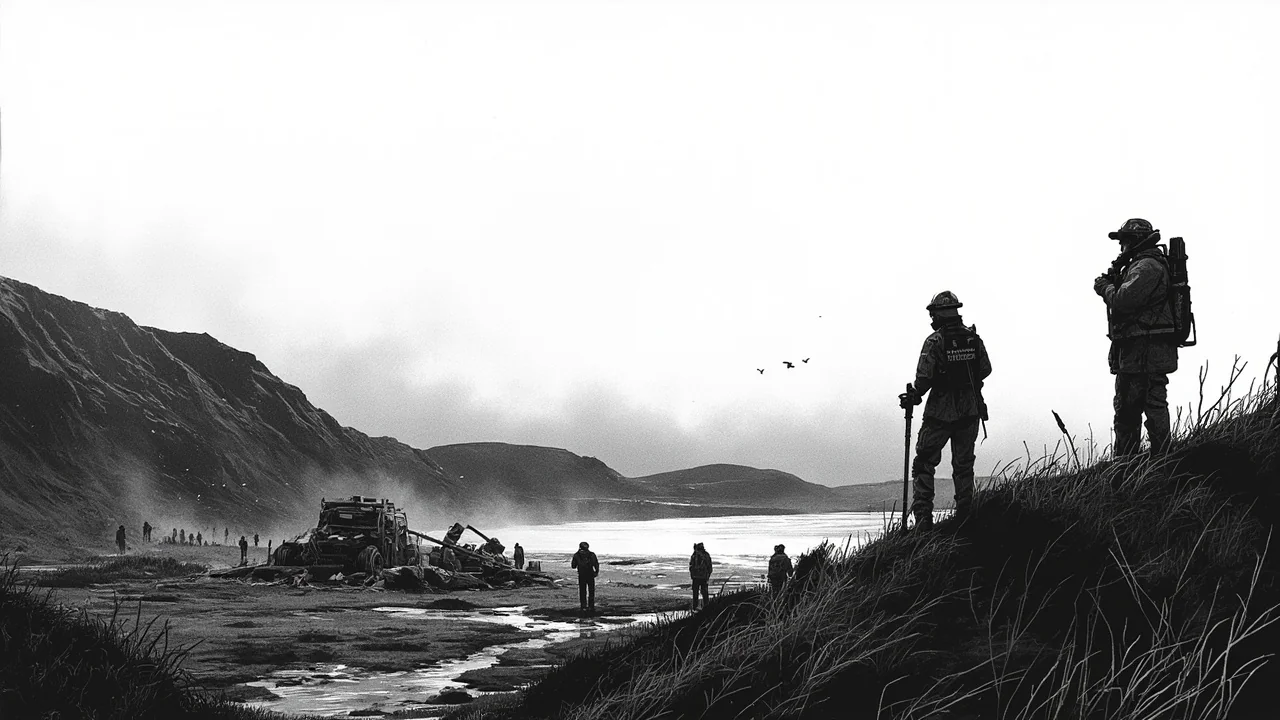
Iceland's South Iceland Police reported a fatal workplace accident in Rangárþingi on Tuesday afternoon. The notification came in shortly after 3 PM, prompting a multi-agency response from police, ambulance crews, and fire and rescue services. One individual was declared dead at the scene, marking a grim moment for the rural municipality and Iceland's workforce.
This incident occurs against a backdrop of intense national debate over workplace safety, particularly in Iceland's foundational industries. The accident in Rangárþingi, a region encompassing agricultural lands and small-scale industry, highlights persistent risks outside Reykjavik's urban core. It raises immediate questions for the Althingi and regulators about the enforcement of safety protocols across all of Iceland's diverse economic sectors.
A Rural Community Responds to Tragedy
The specific location and nature of the work being performed have not been disclosed by authorities, pending notification of next of kin. This is standard procedure in Iceland, reflecting the close-knit nature of many communities. Rangárþingi, formed from the merger of several districts in south Iceland, is an area where agriculture and related industries are central to local identity and economy.
Emergency services from the region converged on the site. The involvement of both ambulance and specialized rescue personnel suggests a complex extraction or response was required. Police have launched an investigation, which will be crucial for determining the sequence of events leading to the fatality. The Directorate of Labour and the Administration of Occupational Safety and Health will also likely conduct parallel inquiries.
The National Context of Workplace Safety
This fatality touches a nerve in Icelandic society. Iceland has made significant strides in workplace safety over decades, but fatalities still occur with alarming regularity in sectors like construction, fishing, and heavy industry. Each death triggers a national reckoning. Data from the Administration of Occupational Safety and Health shows that while numbers fluctuate, the trend has not seen a dramatic decline in recent years.
"Every single workplace death is one too many," said a member of the Althingi's Welfare Committee, speaking on condition of anonymity ahead of an official statement. "We have strong laws on the books. The question we must ask after Rangárþingi is whether the resources for inspection and enforcement match the geographical and industrial spread of our workforce, especially in the regions."
The contrast is often drawn between the regulated environment of large geothermal plants or aluminum smelters and the more isolated conditions on fishing vessels, farms, and small construction sites. This accident in a regional municipality will fuel that discussion. It underscores the challenge of maintaining uniform safety standards from the capital area to the most remote fjords.
Economic Pillars Under Scrutiny
While the exact industry involved in Tuesday's accident is not confirmed, the event inevitably turns attention to Iceland's primary industries. Fishing, while safer than in past generations, remains hazardous. Agriculture involves heavy machinery and livestock. Even the booming tourism sector, with its emphasis on adventure travel, presents unique occupational risks for guides and operators.
These industries are the backbone of the Icelandic export economy and regional employment. They are also sectors where a culture of self-reliance and experience can sometimes clash with formal safety management systems. Investigations often reveal a chain of small oversights or procedural shortcuts rather than a single, catastrophic failure.
"Complacency is the enemy of safety," noted an industry safety consultant based in Reykjavik. "In a small nation where everyone might know each other, there can be an unconscious pressure not to be the one who halts work over a potential hazard. That culture is harder to measure than a guardrail, but just as important."
The Nordic Comparison and Cooperation
Iceland often looks to its Nordic neighbors in matters of social policy and regulation. Norway and Sweden, with similar mixes of resource extraction and advanced technology, have also grappled with reducing workplace fatalities to zero. Nordic cooperation forums regularly share data and strategies on occupational health and safety.
However, Iceland's tiny population and vast, rugged terrain create unique logistical challenges for oversight. A safety inspector based in Reykjavik may face a full day's travel to visit a worksite in the Eastfjords. This reality necessitates a different model of enforcement, potentially relying more on digital reporting, local training of safety representatives, and empowering workers to halt unsafe work.
Some Althingi members have proposed adopting and adapting models from northern Norway or rural Sweden, where similar geographical challenges exist. This could involve increased funding for regional safety offices or mobile inspection units. The tragedy in Rangárþingi will give such proposals renewed urgency in the coming parliamentary session.
A Family and Community Await Answers
Beyond the policy debates, a family in south Iceland is beginning the painful process of mourning. Workplace fatalities carry a particular weight, occurring in a context where a person is contributing to their livelihood and community. The shock reverberates through co-workers, friends, and the entire municipality.
Support systems, including trade unions and community organizations, will mobilize. In Iceland's robust social welfare system, survivors have access to counseling and financial support, but these provisions are cold comfort in the face of sudden loss. The focus for the community now is on solidarity and waiting for a clear explanation from investigators.
The Path Forward from Rangárþingi
The investigation by South Iceland Police will be meticulous. It will examine equipment, procedures, training records, and environmental conditions. Its findings, which could take weeks or months to finalize, will be critical. They will determine if this was a tragic fluke or a preventable failure of systems.
This incident will almost certainly be cited in upcoming Althingi debates about the budget for the Administration of Occupational Safety and Health. It will be a case study in safety meetings across the country. The hope, always, is that a thorough analysis can prevent the next accident.
For now, the facts are stark. A worker went to a job in Rangárþingi and did not return home. This simple, devastating truth is a somber reminder that economic progress and national prosperity cannot be measured by GDP alone. The safety of every individual on the job, from a Reykjavik software developer to a farmhand in the south, remains the most fundamental metric of a society's priorities. The question for Iceland is whether the political will exists to match the regulatory ambition with the resources and cultural change needed to make zero fatalities a reality, not just an aspiration.