
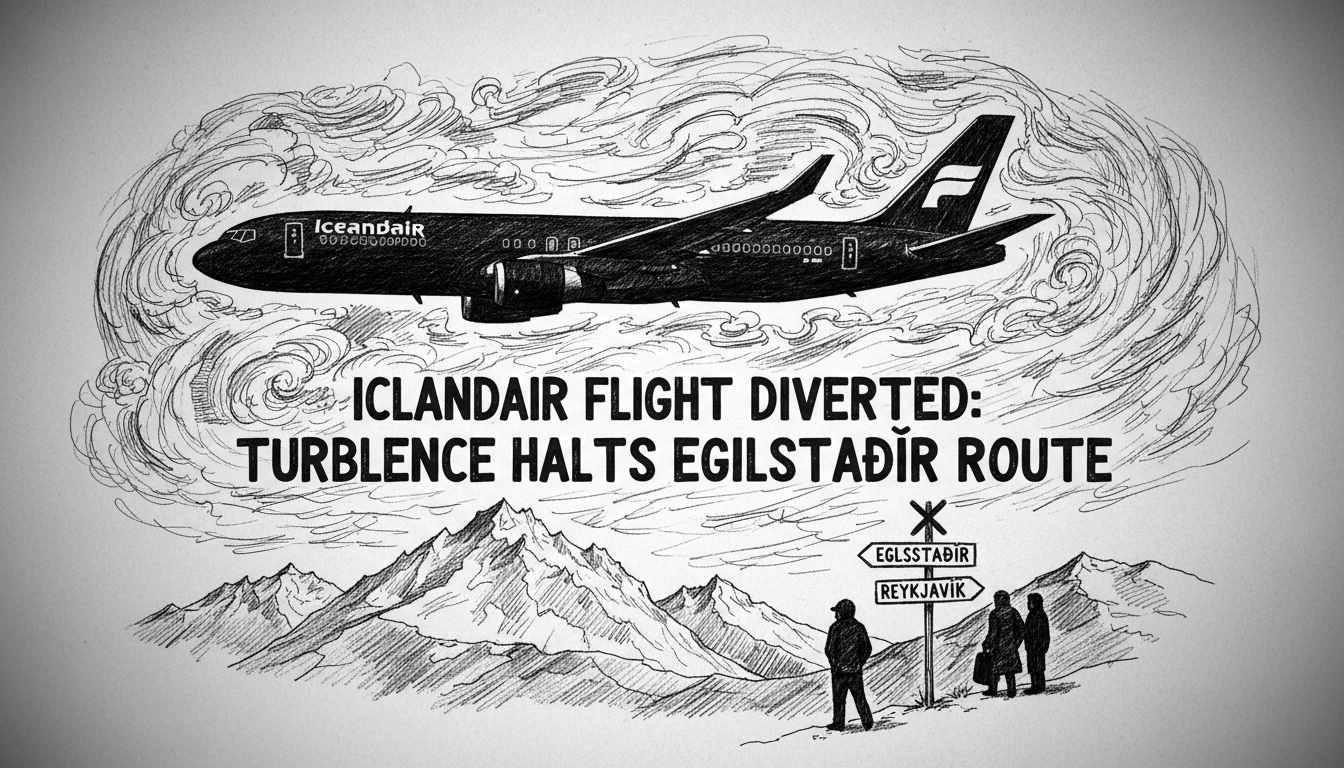
Icelandair flight delays and cancellations disrupted domestic travel today after severe turbulence forced a dramatic mid-air reversal. An Icelandair aircraft, nearly at its destination in East Iceland, was ordered to turn back to Reykjavík. The incident highlights the persistent challenge Iceland's volatile weather poses to its critical air bridge network.
Passengers bound for Egilsstaðir watched flight maps in confusion as their plane approached Hallormsstaður forest, only to execute a U-turn over the rugged eastern fjords. "The aircraft had traveled all the way east to Hallormsstaður when it was turned back to Reykjavík due to turbulence," confirmed Guðni Sigurðsson, an Icelandair information officer. The airline is now awaiting an updated weather forecast to assess if a later flight can proceed.
A separate flight to Ísafjörður in the Westfjords was also cancelled, compounding a difficult day for domestic connectivity. For isolated communities like Egilsstaðir, these cancellations cut vital links for business, healthcare, and family. The incident underscores a recurring tension between Iceland's ambitious tourism-driven economy and its formidable natural environment.
The Unpredictable Skies of the North Atlantic
Iceland's weather is a dominant force in daily life, but its impact on aviation is particularly acute. The nation's position in the North Atlantic, combined with complex mountainous terrain, creates a perfect storm for sudden turbulence. Winds channeling through valleys and over peaks can generate severe clear-air turbulence that is difficult to predict with standard forecasting.
"Forecasting in mountainous regions is an immense challenge," explains Dr. Elín Jónsdóttir, an aviation meteorologist based at the University of Iceland. "The models we use have a certain resolution. When you have steep terrain like in East Iceland, localized wind phenomena can develop rapidly between data points. A pilot might report smooth air, and the aircraft five minutes behind encounters a severe jolt." This scientific reality means airline dispatchers and pilots must often make last-minute, safety-first decisions.
The financial and logistical ripple effects are significant. Diverting a jet back to its origin consumes extra fuel, disrupts crew schedules, and delays the aircraft for subsequent flights. For Icelandair, which operates a tightly coordinated fleet, one diversion can impact the network for hours. More critically, it strands passengers in Reykjavík who rely on air travel to reach remote regions where road alternatives are long or impassable in winter.
East Iceland's Lifeline Grounded
Egilsstaðir is not just a tourist destination; it is the commercial and administrative heart of East Iceland. The town of around 2,500 people serves a vast region where the next major settlement is hours away by car. The airport connects residents to specialized medical services in Reykjavík, enables business travel, and brings in tourists who explore the Eastfjords, Vatnajökull glacier, and the reforestation efforts at Hallormsstaður itself.
When the flight turns back, the impact is immediate. "This is our main link," says Birna Pétursdóttir, a council member from Fljótsdalshérað municipality. "We have patients with appointments at the National Hospital, students returning from university, and fresh seafood shipments that need to get to international markets. A cancelled flight isn't just an inconvenience; it has real economic and social consequences for our community." The region has long advocated for improved transportation infrastructure, but the harsh climate makes any solution expensive and complex.
The diversion near Hallormsstaður is ironic. The area is famous for Iceland's largest forest, a symbol of the nation's fight against soil erosion and a project that has tamed some of the raw wind-scoured landscape. Yet, the weather above this managed forest remains untamable, powerful enough to halt modern air travel.
Operational Calculus: Safety Versus Schedule
For Icelandair's operations center at Reykjavík Airport, days like this involve a constant risk assessment. The decision to divert or cancel is never taken lightly. Pilots receive weather briefings, but the final call often comes from real-time reports from other aircraft in the area or the crew's own assessment as they approach.
"Safety is the absolute, non-negotiable priority," Guðni Sigurðsson stated. "We are now over the weather forecast and waiting for a new one to assess whether it will be safe to fly east later today." This language reflects a standard protocol: pause, reassess with the latest data, and proceed only when conditions are confirmed to be within safe limits. The airline also had a second Egilsstaðir flight on the schedule for today, its fate hanging on the updated meteorological analysis.
An airline operations expert, who requested anonymity to speak freely, outlined the costs. "A diversion like this for a domestic flight can cost tens of thousands of Icelandic króna in extra fuel alone," they said. "Then you have passenger re-accommodation, potential hotel costs if delays stretch overnight, and the knock-on disruption to aircraft rotations. It's a significant financial hit, but it is always cheaper than the alternative of an accident."
Passenger communication becomes critical during these events. Travelers need clear, timely information about rebooking options and their rights. For international tourists connecting through Keflavík to domestic flights, a cancellation can unravel intricate travel plans across the country.
A Nordic Perspective on Climate and Connectivity
Iceland is not alone in facing these challenges. Neighboring Norway grapples with similar issues connecting its fjord and mountain communities, like Bergen or Tromsø, often using smaller, more agile turboprop aircraft that can sometimes handle difficult conditions better than jets. Sweden's northern routes also face extreme winter weather. There is ongoing Nordic cooperation in meteorological research and air traffic management, seeking shared solutions to a common problem.
However, Iceland's infrastructure is uniquely vulnerable. Its road network, particularly Route 1 along the eastern coast, is susceptible to closure from storms, avalanches, and flooding. This makes air travel not merely a convenience but, for much of the year, an essential service. The government subsidizes certain domestic routes to ensure these lifelines remain economically viable for airlines to operate.
As climate change alters weather patterns, the aviation industry is watching closely. Some studies suggest transatlantic flight routes may experience increased turbulence. For Iceland's domestic network, changing storm tracks and wind patterns could make current operational challenges more frequent or severe.
Looking Ahead: Technology and Adaptation
The solution lies in a combination of better technology and adaptive planning. Improved high-resolution weather modeling, powered by more powerful supercomputers, can provide finer-grained forecasts for Iceland's complex terrain. Enhanced satellite data and more frequent atmospheric sampling from aircraft themselves can feed these models.
On the ground, airports like Egilsstaðir are limited by their infrastructure. Investing in advanced landing systems could marginally improve accessibility in poor visibility, but they are powerless against high-altitude wind shear and turbulence. The fundamental limitation remains the aircraft's physical tolerance and the safety of those on board.
For now, communities in the Eastfjords and Westfjords must accept this inherent unpredictability. The incident over Hallormsstaður is a stark reminder that in Iceland, nature holds the final veto over human schedules. As one stranded traveler put it, waiting at Reykjavík's domestic terminal, "You can plan an itinerary, but you can't plan the wind." The success of Iceland's interconnected society continues to depend on respecting that simple, powerful truth.