
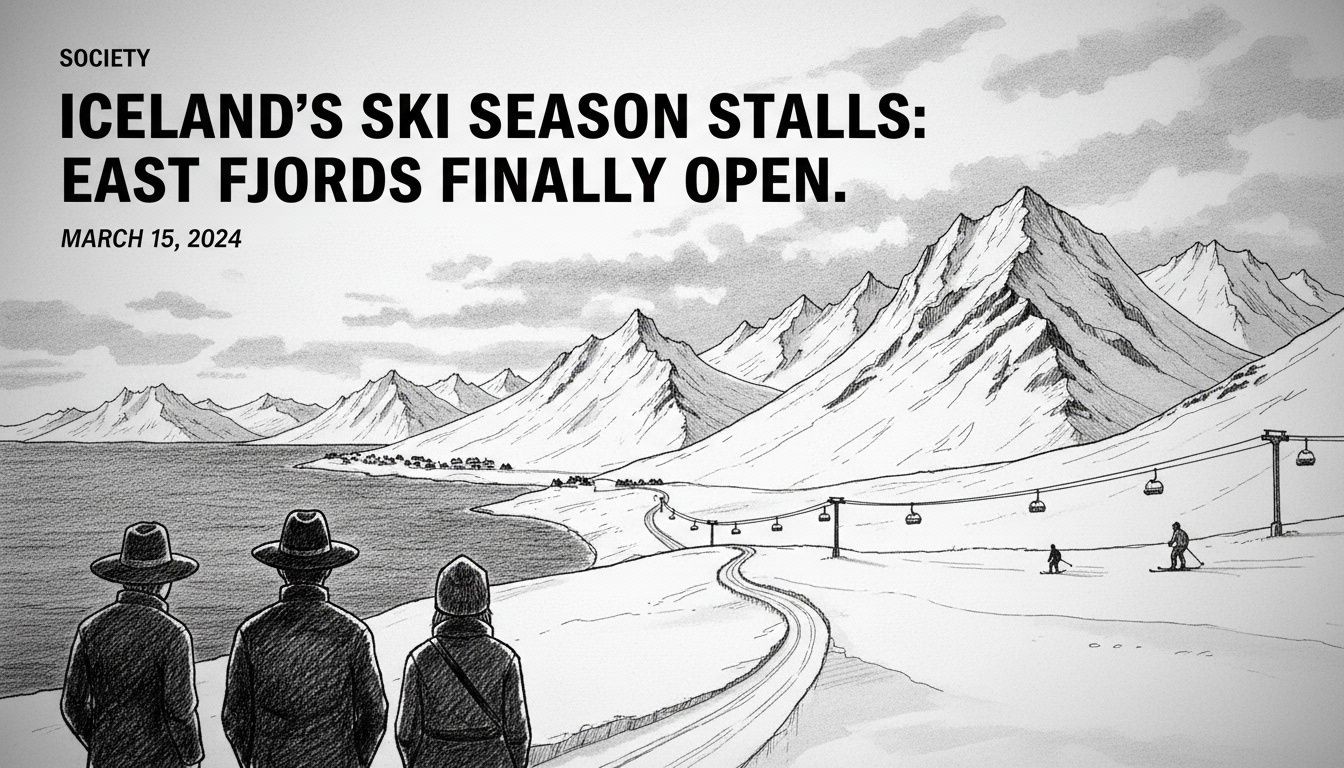
Iceland's ski season faces a delayed and uncertain start in the East Fjords, highlighting the growing climate pressures on the nation's winter tourism. Oddsskarð ski resort opened for the first time this winter on a limited evening schedule, while nearby Stafdal remains closed pending more snow. This slow start, driven by unusually mild and snow-scarce conditions, signals broader challenges for regional economies dependent on seasonal recreation.
"We will open for the first time this winter later today," said Sigurjón Egilsson, manager of sports facilities in Fjarðabyggð municipality. His statement carried more relief than celebration. The opening at Oddsskarð is provisional: only two lifts will run from 4 PM to 7 PM. Crews have spent recent days desperately gathering and moving what little snow exists to prepare the slopes. A similar scramble is underway at Stafdal, where officials hope for a mid-week opening if forecasted snow arrives.
A Winter of Anxious Waiting
The scene in Austfirðir this season has been one of tense anticipation. For most of the winter, conditions in both Oddsskarð and Stafdal have been well below average for snowfall. This is not merely an inconvenience for enthusiasts; it represents a significant economic and social delay for communities in East Iceland. These resorts are vital hubs for local families and a growing draw for domestic tourists seeking alternatives to the larger, busier slopes near Reykjavík.
The operational strategy now relies on micro-management of weather windows. Resorts are opening for short evening sessions to capitalize on colder temperatures that preserve man-made and natural snow. This piecemeal approach is becoming more common across Iceland's ski industry. It reflects a new reality where consistent, deep winter snowpack can no longer be assumed, even in traditionally cold regions like the East Fjords.
The Climate Context of Thin Snow
Experts point directly to climate change as the driver behind these unreliable seasons. "What we are seeing in the East Fjords is a clear symptom of the broader warming trend affecting the entire North Atlantic," says Dr. Anna Þórhallsdóttir, an environmental scientist at the University of Iceland. "Winter precipitation is increasingly falling as rain, not snow, and thaw periods are more frequent. This disrupts the entire ecological and recreational calendar."
The data supports this analysis. Iceland's Meteorological Office has recorded a steady increase in average winter temperatures over the past three decades. The periods of stable, freezing conditions required to build and maintain ski slopes are becoming shorter and less predictable. This has a cascading effect. A poor ski season impacts not just the resort operators but also local accommodations, restaurants, equipment rental shops, and instructors whose annual income hinges on a reliable winter.
Economic Ripples in the Regions
The delayed opening is a financial blow to the East Fjords. Unlike the geothermal energy or fishing sectors, winter sports tourism is highly susceptible to short-term weather patterns. A bad season can mean a direct loss of hundreds of millions of Icelandic króna in regional economic activity. For smaller municipalities, the revenue from ski lift passes and associated services is a non-trivial part of the local budget.
"It's about community vitality as much as economics," notes a member of the Althing's Industry and Tourism Committee. "These resorts keep young people active during the long winter months. They provide a reason for families to stay in the regions. When the season falters, it affects the social fabric." The committee has discussed support mechanisms for climate-vulnerable seasonal industries, but no concrete policy has yet been formed.
The Nordic Comparison and Adaptation
Iceland's struggle is not unique in the Nordic region. Similar reports come from lower-altitude resorts in Norway and Sweden. However, Iceland's ski areas face a distinct challenge: they generally operate at lower elevations than their Scandinavian counterparts, making them more sensitive to marginal temperature increases. While Norwegian resorts can often move operations higher up the mountains, Icelandic options are more geographically limited.
This forces a different adaptation strategy. Icelandic resorts are investing more in snowmaking equipment, but this is an energy and water-intensive solution. In a country proud of its green energy profile, the sustainability of manufacturing snow using geothermal power presents a complex paradox. Some areas are diversifying offerings, promoting summer hiking and mountain biking to reduce dependence on winter snow.
The Human Effort Against the Elements
Behind the headlines about delays is a story of determined human effort. The staff at Oddsskarð and Stafdal have been engaged in a labor-intensive battle with nature, using machinery to move and compact every available patch of snow. This "snow farming" is becoming a standard part of pre-season preparation. It involves collecting snow from protected areas, parking lots, and forest edges and strategically placing it on key runs to create a viable base.
This effort underscores the passion for skiing in Iceland. It is not a sport reserved for an elite few but a widespread recreational activity. The delayed opening means lost weekends for families, canceled trips for school groups, and frustration for a public that eagerly awaits this winter pastime. The community's patience is being tested alongside the resort managers' ingenuity.
Looking Ahead: An Uncertain Future
The immediate forecast offers a glimmer of hope. Meteorologists predict snowfall across much of the region in the coming days, which could secure Stafdal's opening and extend operations at Oddsskarð. However, the long-term outlook remains cloudy. Climate models for the North Atlantic suggest increased volatility in winter weather, with more frequent rain-on-snow events and shorter freezing seasons.
This presents a fundamental question for Iceland's winter tourism sector: how to plan for a future where the defining feature of winter—reliable snow—is no longer reliable? The answer may involve a shift in expectations, greater investment in weather-independent alternatives, and a broader regional tourism strategy that is less focused on a single season. For now, the people of the East Fjords will watch the skies, hoping the coming snow is enough to salvage what remains of this winter's ski season. The success or failure of this season will be a case study for the entire nation as it navigates the tangible economic impacts of a changing climate.