
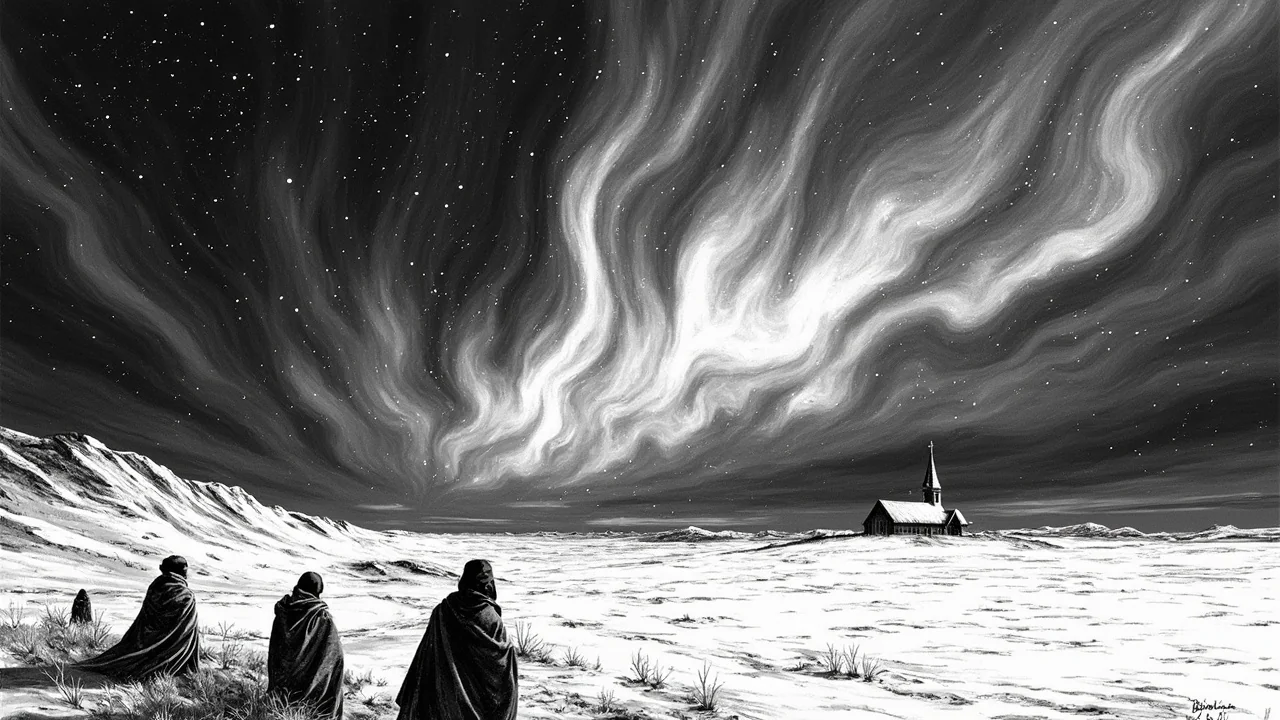
Iceland's skies erupted in vivid red auroras overnight due to a historic solar storm. The coronal mass ejection (CME) that sparked the display has been classified at a severe S4 level, the highest measurement since major storms in October 2003.
Sævar Helgi Bragason, the astronomer known as Stjörnu-Sævar, alerted the public via social media. He described the event as "very fast-moving and energy-rich." The resulting proton storm reached historically high levels, providing a direct indicator of the eruption's power on the sun. The event illuminated the sky over the Suðvesturhorn region, with residents across Southwest Iceland sharing images of the rare red hues.
The Science Behind the Glow
Solar flares and coronal mass ejections are explosions on the sun that blast charged particles toward Earth. When these particles collide with gases in our planet's magnetosphere, they cause the atmospheric glow known as the aurora borealis. The color is determined by the type of gas molecule that is hit and the altitude of the collision. Red auroras, like those seen, typically occur at very high altitudes when solar particles interact with atomic oxygen.
While the visual spectacle is the most immediate effect for the public, events of this magnitude have wider implications. The S4 classification indicates a severe solar radiation storm. This level of activity can pose significant risks to technology and infrastructure that modern society depends on.
Potential Impacts on Infrastructure
Severe space weather events can disrupt high-frequency radio communications, especially in polar regions. This can affect long-distance aviation communications on polar routes, which are frequently used for flights between Europe, North America, and Asia. Airlines operating these paths may be forced to reroute flights to lower latitudes to maintain communication, leading to delays, longer flight times, and increased fuel costs.
Satellite operations are also at risk during powerful solar storms. The increased radiation can damage satellite electronics, degrade solar panels, and cause tracking errors. Global navigation satellite systems, like GPS, can experience blackouts or significant accuracy degradation, impacting everything from commercial shipping to precision agriculture and cellular networks.
Perhaps the most critical infrastructure at risk is the electrical power grid. Intense geomagnetically induced currents (GICs) can flow into power lines and transformers. These currents can cause voltage instability, harmonic distortion, and in extreme cases, lead to the overheating and failure of large transformers. A prolonged, widespread blackout caused by a geomagnetic storm is considered a high-consequence, low-probability national security risk.
Iceland's Unique Vulnerability and Vigilance
Iceland's location just south of the Arctic Circle makes it a prime aurora viewing spot, but also places it on the frontline for space weather impacts. The country's reliance on undersea fiber-optic cables for global connectivity and its expansive power grid, which is essential for its aluminum smelting industry and geothermal plants, makes monitoring these events crucial.
The Icelandic Meteorological Office, in cooperation with other Nordic and international agencies, continuously monitors solar activity. Utilities have contingency plans designed to protect critical infrastructure from geomagnetic disturbances. These plans can include temporarily disconnecting certain equipment, adjusting grid load, and preparing backup systems.
A Look at Historical Precedents
The benchmark event for severe space weather is the Carrington Event of 1859. Telegraph systems, the high-tech network of that era, failed globally, with some operators reporting sparks and fires. A storm of similar magnitude today would cause unprecedented technological disruption. More recently, the March 1989 geomagnetic storm caused a nine-hour blackout across the entire province of Quebec, Canada, leaving six million people without power. The 2003 Halloween storms, referenced by Bragason, damaged satellites and caused power grid problems in Sweden and South Africa.
While this week's storm reached the same proton level as the 2003 events, its full geomagnetic impact is still being assessed. The orientation of the storm's magnetic field as it interacts with Earth's own field is a key factor in determining the level of technological disruption.
The Role of Public Observation
Astronomers like Bragason play a vital public role. His social media alerts turn citizens into a distributed network of observers, capturing the event's scope and beauty from countless vantage points across Reykjavik's districts and the Icelandic countryside. This public engagement also raises awareness about the broader phenomenon of space weather beyond the stunning visual display.
For now, scientists worldwide are analyzing data from satellites like NASA's Solar Dynamics Observatory and the DSCOVR mission. They are modeling the storm's progression to better understand its trajectory and potential lingering effects. Further auroral displays are possible in the coming nights as Earth moves through the wake of the CME, though the intensity may diminish.
The event serves as a vivid reminder that life on Earth is intimately connected to the dynamics of our star. It underscores the importance of continued investment in space weather forecasting and resilient infrastructure design, not just in Iceland but across the Nordic region and the globe. The red lights over Suðvesturhorn were a beautiful warning from the sun.