
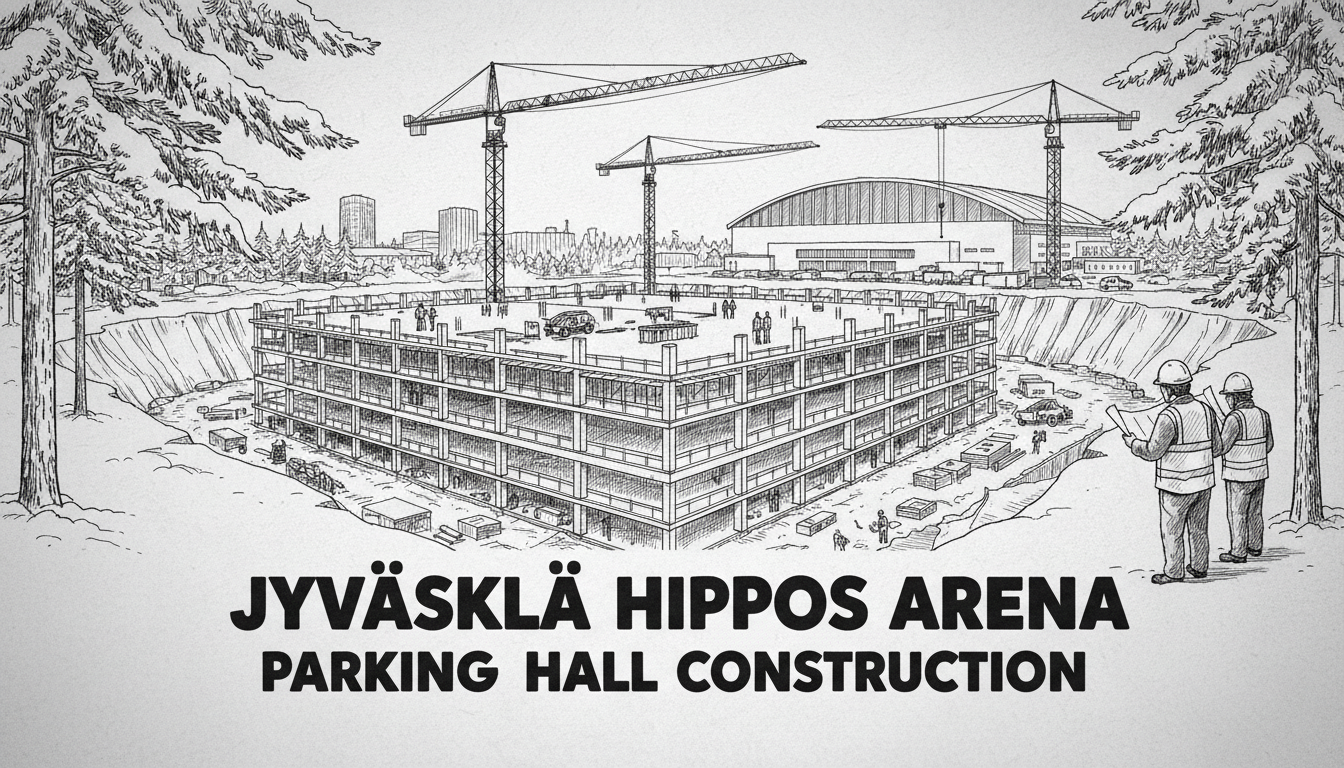
Construction work has officially begun on a new multi-story parking hall at the Hippos sports and event arena in Jyväskylä, Finland. The project started with initial groundworks on Monday, marking a significant infrastructure investment for the Central Finland region. The work will proceed in phases, with earthmoving operations first, followed by piling and foundational work expected around the turn of the year.
Project manager Marko Koskinen from Keski-Suomen Betonirakenne Oy outlined the ambitious timeline in a project statement. The goal is to have the entire structural frame of the hall completed by the autumn of 2026. Koskinen noted that the team aims to streamline the schedule by overlapping construction phases in blocks, a method carefully planned during the design stage to enhance efficiency.
This development is more than a simple parking solution. It represents a strategic investment in Central Finland's regional event and economic infrastructure. The Hippos Arena is a key venue for major sports competitions, concerts, and trade fairs. Improved parking capacity directly addresses a known bottleneck, potentially increasing the arena's attractiveness for larger events and boosting visitor numbers to the city of Jyväskylä. For international readers, this reflects a common Nordic focus on supporting regional centers outside capital cities, ensuring they remain competitive and well-serviced.
The project's scale and concrete-based construction method also signal confidence in the local construction sector. It provides steady work and utilizes regional expertise from Keski-Suomen Betonirakenne Oy. The decision to phase the work demonstrates a pragmatic approach to managing large-scale public infrastructure projects, aiming to control costs and timelines through detailed pre-planning. The success of this build will be closely watched by other municipalities considering similar ancillary developments for their main event venues.
Looking ahead, the completion of the parking hall by 2026 will likely be a prerequisite for the arena to bid for larger, more frequent international events. It solves a practical logistics problem that often limits venue capacity. The construction phase itself will bring temporary disruptions but is a clear investment in the long-term vitality of Jyväskylä as a hub for Central Finland. The project is a tangible example of how mid-sized Finnish cities are proactively investing in infrastructure to secure their future economic and cultural roles.