
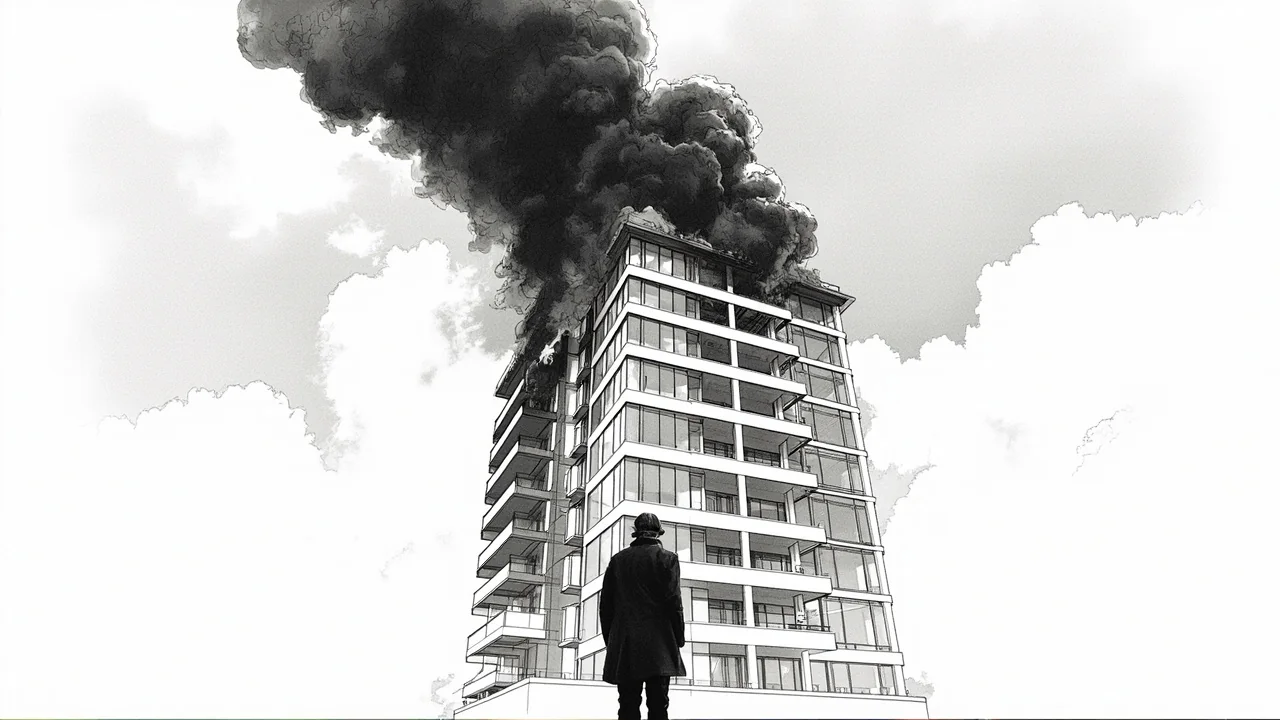
A fire that engulfed a 17-story rental tower in Helsinki's Kalasatama district on May 23 has put a spotlight on a common summer habit in Finland society: balcony grilling. The blaze started from a grill on a balcony and spread "exceptionally quickly" to the roof structures, according to YLE. Fire crews from 17 units responded, extinguishing took hours. No injuries were reported. The case is now being investigated as aggravated endangering of public safety (törkeä yleisvaaran tuottamus), a criminal charge that signals prosecutors see potential negligence beyond a simple accident.
The building at Leonkatu is owned by Lumon, a rental housing company. Its design is typical of newer Finnish high-rises: balconies stacked vertically, often with wooden decking and storage. The Ministry of the Environment decree on building fire safety sets rules for fire loads and compartmentation, but balconies are a grey area. They are not fully enclosed living spaces, so the regulations are less strict. The rapid spread from one balcony to the roof suggests that fire barriers between balconies may have been inadequate, or that the roof structure itself was vulnerable.
A summer ritual turns dangerous
Balcony grilling is a national pastime in Finland, especially in cities where summer terraces are small. Many apartment buildings allow gas or charcoal grills on balconies, though some housing companies restrict them. The fire in Kalasatama is not the first balcony grill incident, but its scale and speed make it stand out. "The fire spread from balcony to roof structures, which burned severely," the Helsinki Fire Department said per MTV Uutiset. The fact that 17 units were dispatched indicates the seriousness of the situation from the start.
The lack of casualties is remarkable. Evacuations were carried out quickly, and the building's fire alarms likely worked. But the structural damage is extensive. The roof and several upper floors are uninhabitable. Residents will need temporary housing, and the repair costs will be high. For Lumon and its insurers, this means a major financial hit.
Building regulations under question
Finnish fire safety rules are set by the Ministry of the Environment and enforced by local building control. The decree covers compartmentation, escape routes, and fire loads. But it was written before the boom in high-rise residential towers with large balconies. Kalasatama is one of Helsinki's tallest residential areas, and many buildings there have similar designs. The fire exposes a potential gap: how to prevent a balcony fire from climbing up the facade and into the roof.
Past research from the Technical Research Centre of Finland (VTT) has flagged the risk of fire spread via balconies, especially when they are not separated by fire-resistant barriers. The decree does not require such barriers for balconies unless the building is above a certain height. For a 17-story building, the rules are stricter for internal compartments but may leave the external envelope under-regulated.
The police investigation under aggravated endangering will look at whether the grill user acted recklessly, but also whether the building's design or maintenance contributed. If the charges stick, the case could set a precedent for holding both residents and property owners accountable.
What to watch next
Expect the Ministry of the Environment to review balcony fire safety rules before next summer. The political pressure from Helsinki city officials and the rental housing sector will be strong. The case may also push housing companies to ban balcony grilling or require fire-resistant screens. For now, the immediate lesson is clear: a single grill can turn a high-rise into a torch. Finnish society will have to decide if the pleasure of a balcony barbecue is worth the risk.
Read more: Massive Fire Engulfs Helsinki Apartment Building in Kalasata....
Read more: Helsinki Fire: High-Rise in Kalasatama Completely Engulfed i....