
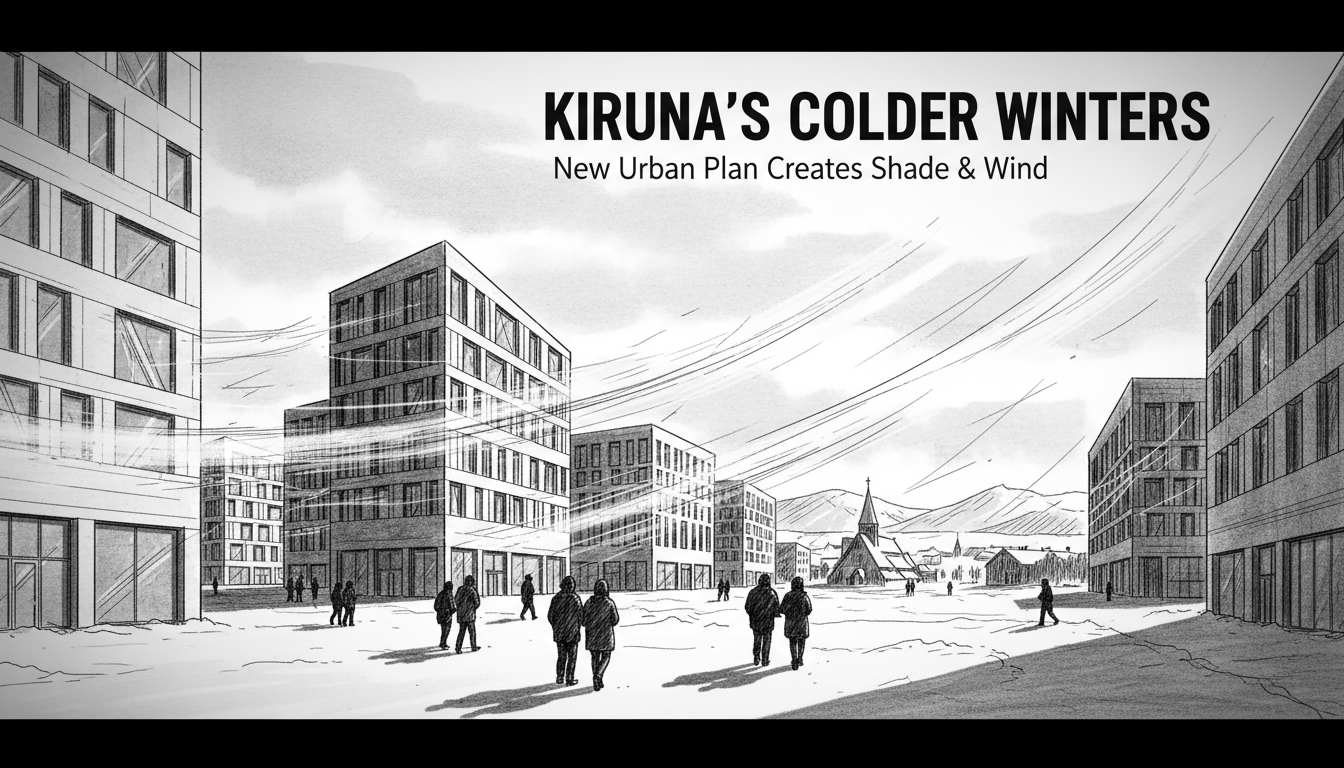
Kiruna's new city center feels noticeably colder after the town's massive relocation project. Narrower streets and taller buildings create more shade and wind exposure during Swedish winters.
Urban planning choices have altered the local microclimate according to researchers. The new layout makes winter conditions more challenging for residents.
Researcher Jennie Sjöholm from Gothenburg University has studied the relocation process. She said the planning didn't optimize for cold climate principles.
"It should be somewhat comfortable when you go outside," Sjöholm stated. "They've built in a way that creates more shade and wind exposure, and it can get very windy in Kiruna."
Historical documents show original planners took different approaches. When Kiruna was first designed in 1900, the town was placed on a south-facing slope for optimal sun exposure.
Streets followed the terrain in gentle curves to avoid wind tunnel effects. The new location sits in a valley where cold air accumulates during winter.
The new city center features higher buildings and narrower streets. This makes it harder for the low winter sun to reach between buildings.
A large central square with the city hall and hotel creates additional wind exposure. "From a microclimate perspective, it can become windy and drive snow," Sjöholm explained.
The researcher acknowledged the original town location was already occupied. Planners chose the best available alternative, though it wasn't equally optimal.
Future improvements might include trees and vegetation creating more sheltered spaces. Still, completely solving the climate challenges could prove difficult.
Kiruna markets itself as a winter city with strong winter climate identity. Failing to optimize outdoor comfort year-round represents a missed opportunity for residents.
The town relocation was necessary due to expanding mining operations undermining the original city center. This massive project continues as one of Sweden's most ambitious urban transformations.