
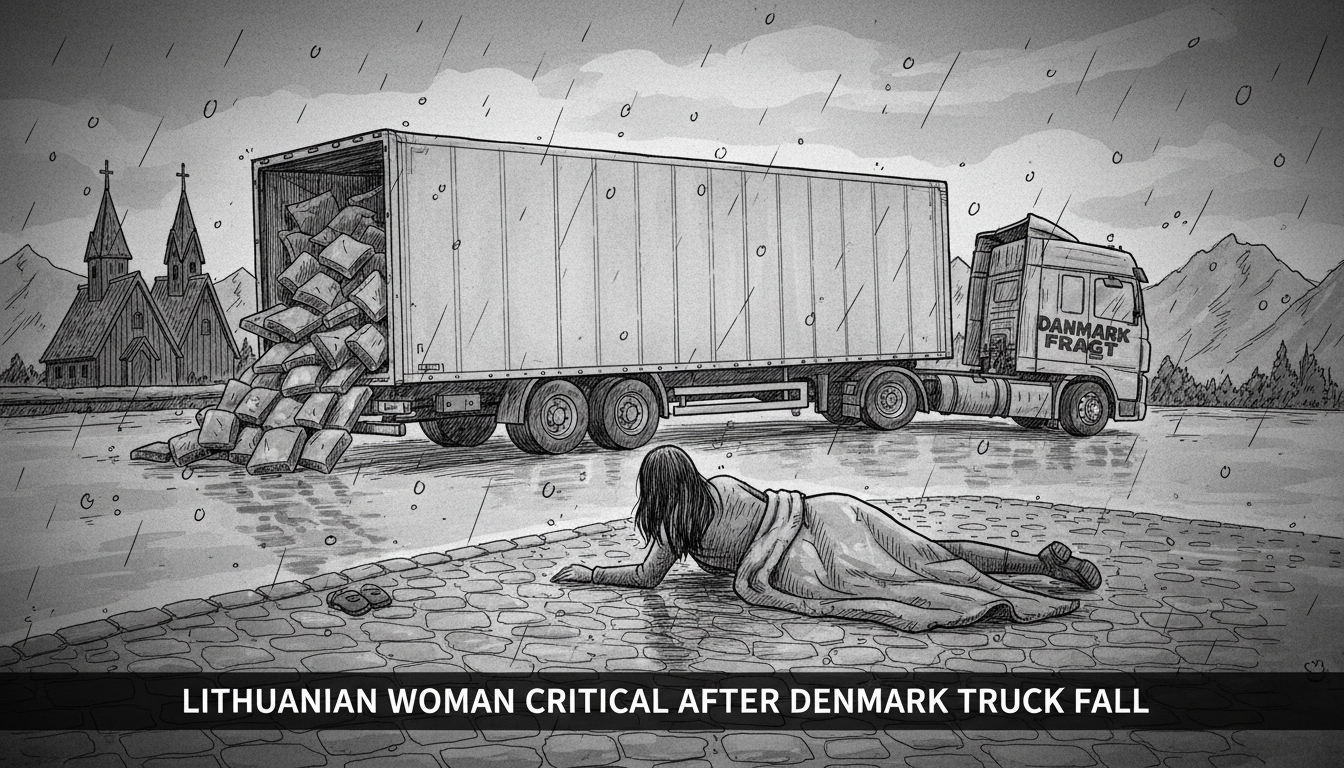
Denmark road accident investigators are piecing together a Friday night incident that left a 38-year-old Lithuanian woman fighting for her life. The woman fell from a moving truck on Kjellerupvej near Kjellerup in Silkeborg Municipality. Police were alerted at 7:01 PM after she was found lifeless by the roadside, leading to a critical hospital admission and an ongoing probe into how such a tragedy could occur.
A Friday Night Emergency Call
The call to Midt- and Vestjyllands Police described a woman lying motionless in a roadside ditch. An ambulance rushed to the scene, its crew working quickly to stabilize the severely injured patient for transport. "A truck driver came forward and told us she had been riding with him and that she fell out of the truck while it was moving," said duty officer Jeppe Holgersen. This statement forms the core of the initial police understanding, as the woman's critical condition has prevented her from giving any account.
Officers examined the scene and the truck itself for evidence. The male driver, also a Lithuanian citizen residing in Denmark, was questioned extensively on Friday. Police found no immediate grounds to arrest him. The investigation now focuses on technical checks of the vehicle and reconstructing the events leading to the fall. This slow, methodical police work continues as the woman remains in critical condition, her prognosis uncertain.
The Unseen Community on Denmark's Roads
This case highlights a segment of Danish society often invisible to the public: the East European migrant workers integral to logistics, construction, and agriculture. Both individuals involved are part of Denmark's Lithuanian community, one of the larger Eastern European groups contributing to the Danish economy. Their presence underscores a complex dimension of Copenhagen integration and Danish immigration policy, where language barriers and transient work conditions can sometimes create vulnerabilities.
Accidents involving heavy goods vehicles are statistically significant in Denmark's road safety landscape. In 2021, trucks were involved in 11% of all injury accidents nationally. While overall traffic fatalities have trended downward due to relentless safety campaigns by the Danish Road Directorate (Vejdirektoratet), each serious incident triggers a re-examination of protocols. This accident poses stark questions about passenger safety in commercial vehicles not designed for human transport.
Safety, Scrutiny, and Societal Integration
The incident inevitably turns scrutiny toward workplace and transport safety cultures, especially within industries reliant on migrant labor. Experts stress that investigations must look beyond the immediate mechanics. "A thorough investigation must consider the vehicle's condition, compliance with safety regulations, and all human factors," a road safety analyst, who asked not to be named, told Nordics Today. "When language barriers exist, ensuring clear communication of safety rules is paramount, and that is a shared responsibility between employers, crew leaders, and individuals."
Danish social policy aims to create a cohesive society through its welfare system, but effective protection extends into workplaces and private arrangements. The Danish Working Environment Authority (Arbejdstilsynet) enforces strict rules on safe transport of workers. Whether this journey fell under a work-related context or was a private arrangement remains a key line of the police inquiry. The answer will determine which regulatory frameworks apply and where accountability may lie.
For municipalities like Silkeborg, supporting resident immigrant communities includes ensuring their safety in all aspects of life. Local social centers and integration services often work to bridge information gaps. This tragic event may prompt local officials to review how safety information is disseminated to all residents, regardless of language. It is a challenging part of the Danish welfare system's promise of equal protection for all who live and work within its borders.
A Broader Look at Risk and Responsibility
National statistics provide context but little comfort. With 165 traffic fatalities in Denmark in 2022, every accident is a profound loss. The case on Kjellerupvej is unusual not for involving a truck, but for the specific nature of a passenger falling from one. It compels a broader discussion about risk acceptance, informal practices, and the intersection of personal responsibility with systemic safeguards.
Community leaders within the Lithuanian diaspora often emphasize the importance of navigating Danish norms and laws. This accident, while first a police matter, touches on themes they frequently address: knowing one's rights, understanding safety standards, and accessing reliable information. The coming days will reveal more about the specific circumstances, but the conversation it sparks about integration, safety, and community awareness will likely continue long after the investigation concludes.
The Human Cost Beyond the Statistics
Behind the police bulletins and statistical analyses lies a human story of sudden trauma. A woman's life hangs in the balance in a Danish hospital. A driver is involved in a horrific event. Two families, likely thousands of kilometers away in Lithuania, are grappling with shock and fear. This is the immediate, devastating impact that transcends policy discussions.
The Danish welfare system is now mobilized in its medical aspect, providing critical care. The social dimension—how the community around these individuals responds and supports—will unfold more quietly. It tests the real-world strength of the societal safety net designed to catch everyone, especially those who might be on its margins. The promise of the Danish model is universal care and dignity; tragic moments test its delivery.
As the investigation proceeds, answers may emerge about vehicle speed, door mechanisms, or the exact nature of the journey. Yet, some questions are harder to answer. How do societies truly ensure the safety of every individual navigating its spaces? How are complex rules of safety translated and made relevant across cultural and linguistic divides? The silent, critical patient in a hospital room is a stark reminder that Danish society news often involves grappling with these profound, unresolved challenges. The road to recovery, both personal and systemic, is long.