
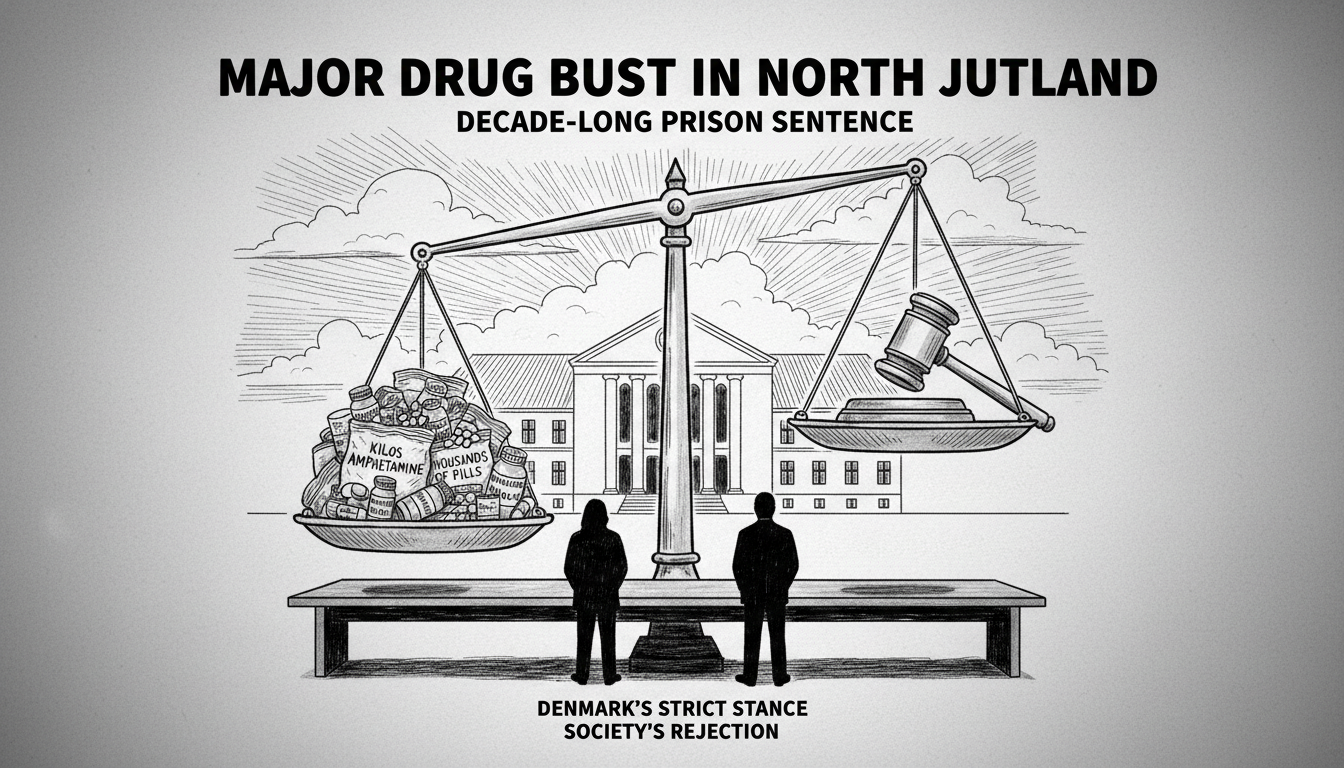
A court in Hjørring has sentenced a 29-year-old man to ten years in prison for large-scale drug possession. The case highlights Denmark's strict legal stance on narcotics and the tangible consequences for those involved in the trade. Police discovered nearly 6,000 ecstasy pills, over 21 kilograms of amphetamines, and hundreds of grams of ketamine during a search of the man's address earlier this year. The sheer volume classifies this as one of the more severe drug cases prosecuted recently in the region.
Prosecutors emphasized the sentence sends a clear societal message. 'The penalty clearly shows that we as a society do not accept drug crimes,' said the lead prosecutor in a statement. 'We therefore find it appropriate that the court has handed down a sentence that reflects the seriousness of the case.' The man was convicted under a specific penal code paragraph reserved for the most serious narcotics violations. In addition to the prison term, he lost his driver's license for three years due to a separate incident involving a stolen vehicle and cocaine impairment.
This case opens a window into Denmark's broader social policy and integration challenges. While the welfare system is renowned for its support, it operates alongside a zero-tolerance approach to serious crime. Large-scale drug operations are often linked to broader criminal networks that can exploit social vulnerabilities. For municipalities and social centers in cities like Copenhagen and Aalborg, preventing youth from being drawn into such activities remains a key integration goal. Statistics often show a correlation between lack of educational attainment or employment and higher risks of criminal involvement, making early social intervention critical.
The human impact extends beyond the individual sentenced. Such busts disrupt local supply chains but also point to persistent demand. Community leaders in integration-heavy districts frequently note that drug-related crime can undermine social cohesion and public safety, making residents feel less secure. The Danish model seeks to balance punitive measures for dealers with rehabilitation and prevention programs, though the effectiveness of this dual approach is a constant topic of debate among policymakers.
What does a ten-year sentence for possession actually signify in the Nordic context? It underscores that Denmark, while progressive in many social areas, maintains stringent penalties for crimes deemed to threaten public order and health. This contrasts with more lenient approaches seen in some other European nations regarding personal use. The outcome here is a direct result of the quantity involved, moving it far beyond personal consumption into the realm of large-scale distribution. For international observers, this case is a reminder that the Nordic commitment to social welfare is matched by a robust legal framework intended to protect it. The path forward likely involves continued police action against major suppliers while local social services work to address the root causes that fuel both demand and desperation.