
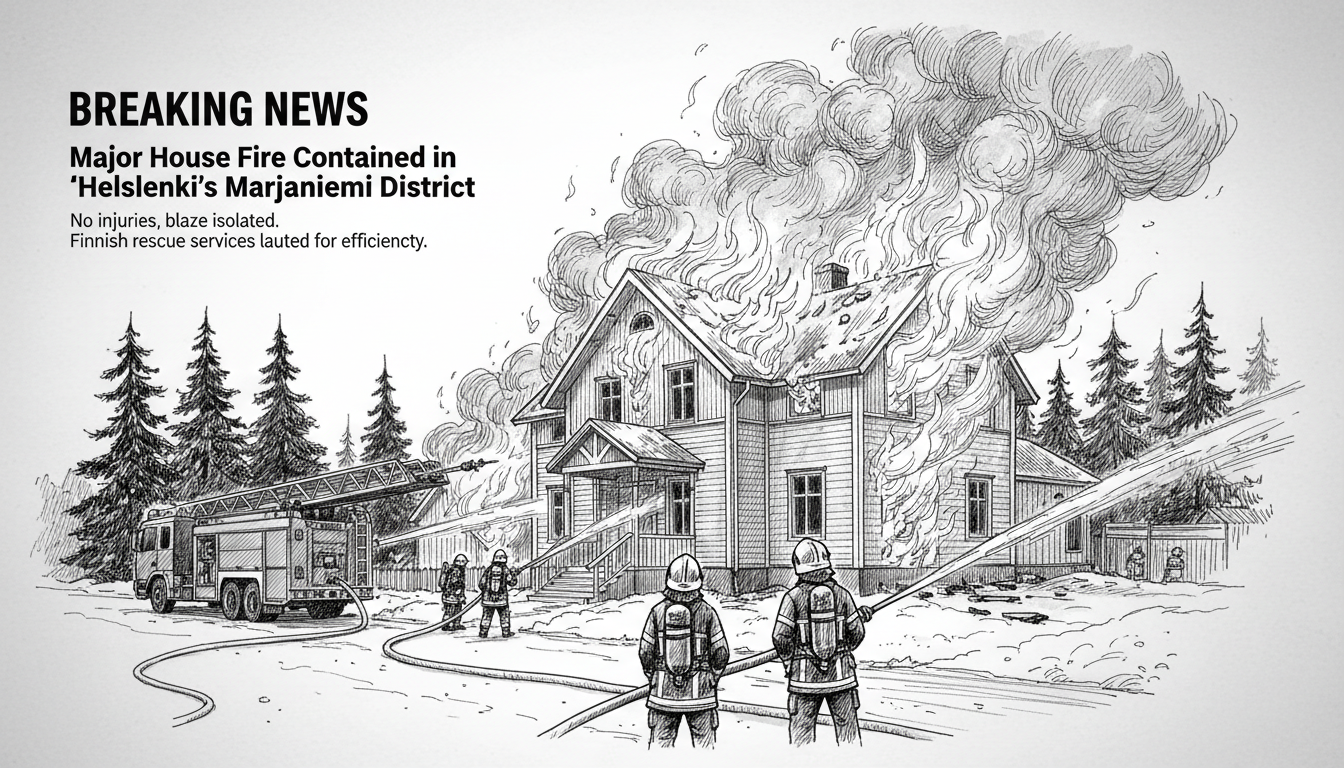
A substantial two-story detached house in Helsinki's Marjaniemi district caught fire in the early hours of Friday morning. The blaze, which ignited on Strömsintie street, engulfed the roof structure along nearly the entire length of the building. Rescue services received the alarm just after 3:30 AM and dispatched ten units to the scene. Fire Chief Timo Ustinov reported that the situation is now largely under control. Crews have made good progress in dismantling the roof to fully extinguish the flames. No injuries have been reported, and a thorough interior check confirmed the house was unoccupied at the time of the fire. The calm weather conditions have prevented smoke from spreading severely into the neighborhood. The fire also poses no immediate threat to surrounding properties. Extinguishing and clearing operations are expected to continue for a considerable time, according to rescue officials.
This incident highlights the critical importance of Finland's robust municipal rescue services, a system deeply integrated into the nation's social safety net. The rapid, coordinated response by Helsinki's Pelastuslaitos is a standard expectation, funded through local taxation and governed by the national Rescue Act. For international readers, it is key to understand that Finnish emergency services operate on a highly regionalized model. Each municipality is responsible for providing rescue services, leading to consistently high response times even in suburban areas like Marjaniemi. This structure is a point of political consensus, rarely debated even during government budget negotiations. The efficiency seen in this response is a direct result of that sustained public investment and planning.
From a policy perspective, such events quietly test the infrastructure and regulatory frameworks managed by the Ministry of the Interior. Building safety codes, which fall under the Ministry of the Environment's purview, are stringent in Finland. They mandate specific materials and construction methods to prevent fire spread, a factor that likely contributed to containing this blaze to a single structure. Investigations will now focus on determining the fire's cause, a process that will involve insurance assessors and possibly safety authorities if a systemic fault is suspected. For residents and expats, this serves as a reminder to check smoke detector batteries and review evacuation plans. While the system works well, individual preparedness remains the first line of defense. The financial and emotional toll on the homeowners will be substantial, but they will be supported by comprehensive home insurance, which is virtually universal in Finland. The community will likely rally around the affected family, a common social response in Nordic neighborhoods.