
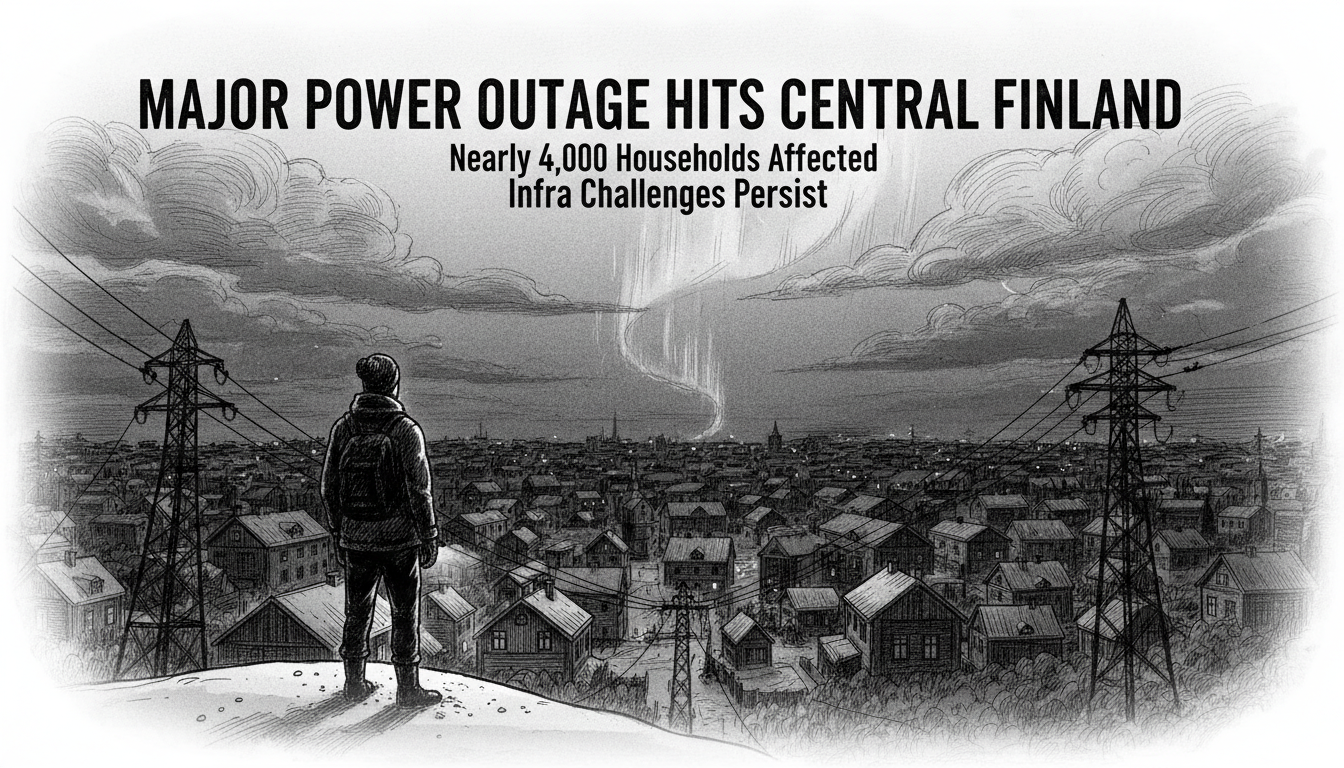
A widespread power outage struck the city of Jyväskylä during Friday evening, leaving nearly 4,000 households without electricity. The disruption affected 3,813 connection points across Alva Sähköverkko's service area according to company officials. The blackout began precisely at 8:14 PM and impacted neighborhoods north of Jyväskylä's city center including Seppälänkangas, Huhtasuo, Kangaslampi, Sulu, Mannila, Seppälä, Kangasvuori, Taulumäki, Palokankeskus, and Keski-Palokka regions.
Finnish infrastructure reliability typically ranks among Europe's highest, making this substantial outage particularly noteworthy. The incident highlights Finland's ongoing challenges maintaining century-old power distribution networks during extreme weather transitions. Energy authorities immediately launched investigation procedures to determine the blackout's root cause while restoration crews worked through the evening.
Finland's Ministry of Economic Affairs oversees the nation's energy security framework through comprehensive EU-aligned regulations. The country maintains strict power continuity requirements under Nordic energy cooperation agreements. This outage occurs during Finland's critical transition toward renewable energy sources while modernizing Soviet-era grid components.
Central Finland's regional development faces potential economic impacts from such infrastructure failures. Jyväskylä hosts several technology companies and educational institutions requiring uninterrupted power supply. The city's position as a growing innovation hub makes reliable electricity fundamental to its economic strategy and international competitiveness.
Finnish consumers enjoy strong protection under national energy laws mandating compensation for prolonged service interruptions. Households experiencing extended outages typically receive automatic payments from distribution companies. This financial safeguard represents one of Europe's most comprehensive consumer protection systems for utility failures.
Power restoration protocols follow standardized Nordic emergency response procedures developed through decades of cross-border cooperation. Finland's transmission system operator Fingrid maintains real-time coordination with Swedish and Norwegian counterparts to ensure regional grid stability during local disruptions. The country's interconnected Nordic power market provides additional security through import capacity during domestic generation shortfalls.
Energy infrastructure investment remains a government priority with several billion euros allocated to grid modernization in recent national budgets. Parliament's ongoing energy policy debates focus heavily on rural area reliability and climate adaptation measures. The current administration faces pressure to accelerate distribution network upgrades while managing consumer electricity costs.
International observers should note that despite this incident, Finland's power system reliability exceeds most European averages. The country's nuclear and hydroelectric generation mix typically provides exceptional stability. Temporary local disruptions rarely indicate systemic weaknesses in one of Europe's most robust energy networks.