
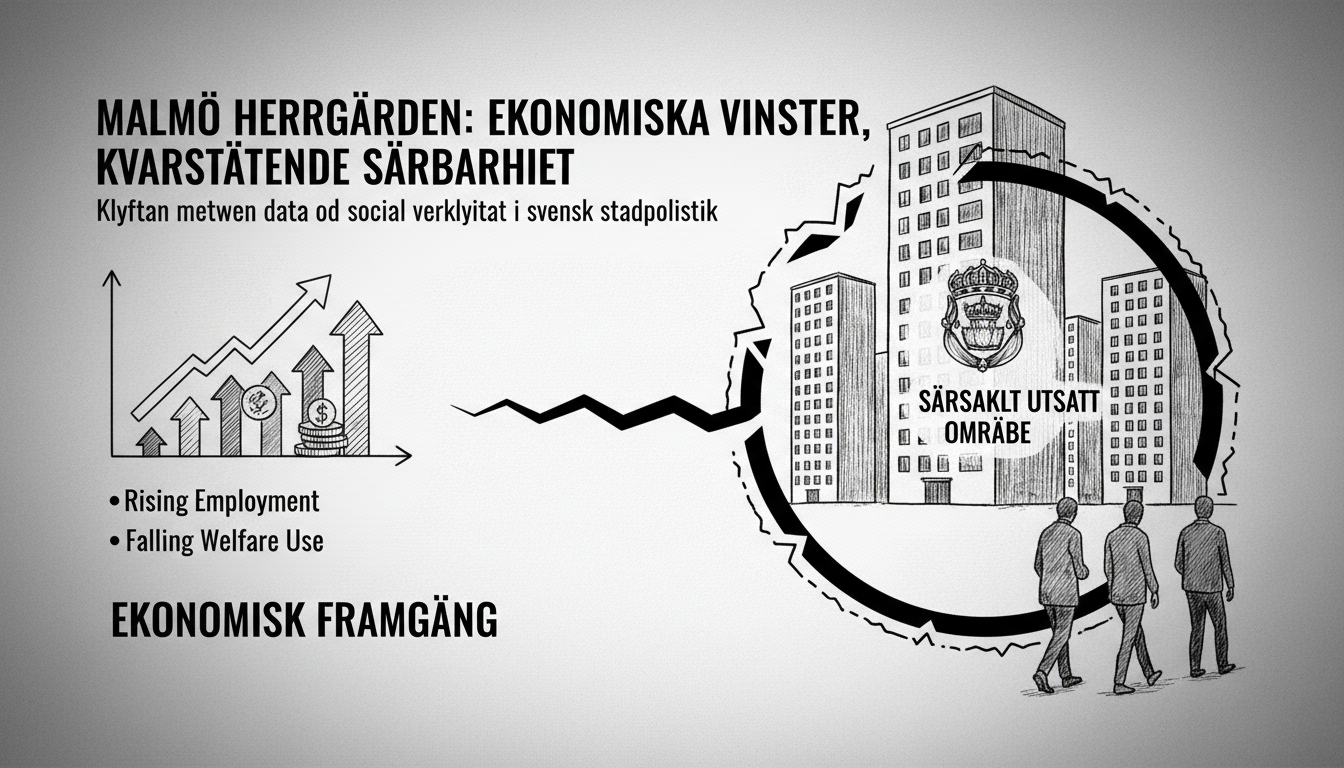
The Herrgården neighborhood in Malmö's Rosengård district is showing positive economic trends. Employment has risen sharply and welfare dependency has fallen. Yet it remains classified as a particularly vulnerable area by police. This highlights the complex reality of urban development in Sweden's major cities.
Employment in Herrgården hit a low point in 2009. Only 17 percent of residents were employed then. New data shows a dramatic improvement. By the third quarter of last year, the employment rate reached nearly 50 percent. In absolute numbers, 389 residents were employed in 2009. That figure grew to 1,229 by last year.
Welfare dependency has also decreased significantly. In 2016, 36 percent of Herrgården residents relied on financial assistance. That number dropped to 17 percent by last year. The area also saw one of the city's largest real income increases from 2012 onward. Only the Bellevue area posted a higher gain.
Despite these improvements, Herrgården's broader district, Rosengård, remains on the national police list. It is classified as a 'particularly vulnerable area.' This designation considers factors beyond pure economics, including crime and social unrest. Other areas in Malmö and nearby cities like Helsingborg and Landskrona are also listed.
This situation presents a clear contradiction. Measurable economic progress is evident. More people are working and earning more. Yet the official security assessment has not changed. This suggests economic metrics alone do not define an area's vulnerability. Social cohesion and perceived safety are critical factors.
The data comes from the city of Malmö, which compiled statistics from Sweden's national statistics agency. Officials point to the positive trends as a sign of effective local investment. They also acknowledge the persistent challenges that keep the area on the police list.
For international observers, this story reflects a broader Nordic urban challenge. Integration and economic mobility in immigrant-dense neighborhoods are ongoing policy tests. Sweden's approach combines social welfare with strict law enforcement classifications. The results, as seen in Herrgården, are mixed and evolving.
The next steps will be crucial. Can continued economic improvement eventually alter the security designation? Or do deeper social issues require a different set of solutions? The people of Herrgården are caught between statistical progress and a stubborn official label.