
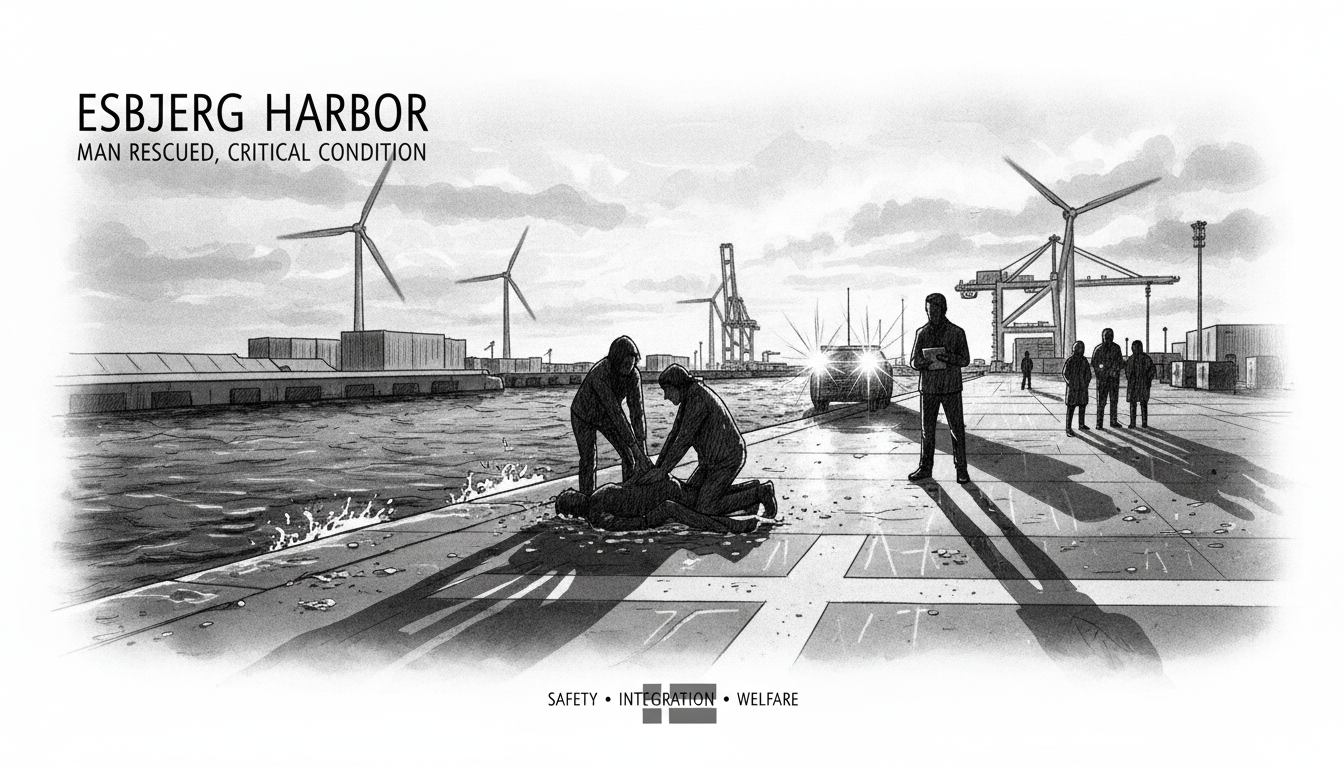
A man was pulled from the water at Esbjerg Harbor on Friday morning in critical condition. Rescue services responded to the scene after receiving an alert. The man was transported to a local hospital for emergency treatment. Police have not yet identified the individual or determined the circumstances of the incident. They currently describe the event as an accident. The investigation remains open as authorities work to understand what happened on the harbor that morning.
This incident in Esbjerg, a major port city on Denmark's west coast, highlights ongoing safety discussions in Danish maritime and industrial zones. Port areas are vital economic hubs but also present unique risks. Local social centers and community groups often engage with municipalities on safety outreach, especially in cities with diverse populations. Integration efforts sometimes include workplace safety education for new residents unfamiliar with Denmark's strict regulatory environment.
Danish society maintains a strong welfare system designed to respond to such emergencies. The coordinated response by police and rescue services reflects this institutional capacity. For international readers, it is important to understand that Danish social policy emphasizes prevention and rapid intervention. The country's integration policies often aim to familiarize newcomers with these safety norms and public resources.
Statistics show that successful integration correlates with understanding local systems, including emergency protocols. Community leaders in cities like Copenhagen and Esbjerg frequently stress this connection. They argue that clear communication about safety in workplaces and public spaces is a fundamental part of social cohesion. This incident, while tragic, may renew conversations about how safety information is disseminated across all community segments.
The man's condition raises immediate human concerns, but the story also touches on broader themes. How do municipalities ensure safety in complex industrial environments? What role do social policies play in accident prevention? These questions linger after the rescue teams depart. The Danish approach typically involves layered responsibility shared between employers, public authorities, and civic organizations.
As the investigation continues, the focus remains on the individual's recovery. The community will likely await answers about how such accidents can be prevented in the future. This reflects a societal tendency to seek systemic solutions even in cases initially deemed accidental. The integration of safety into the social fabric is a continuous process, one that Danish authorities monitor closely through various welfare and policy channels.