
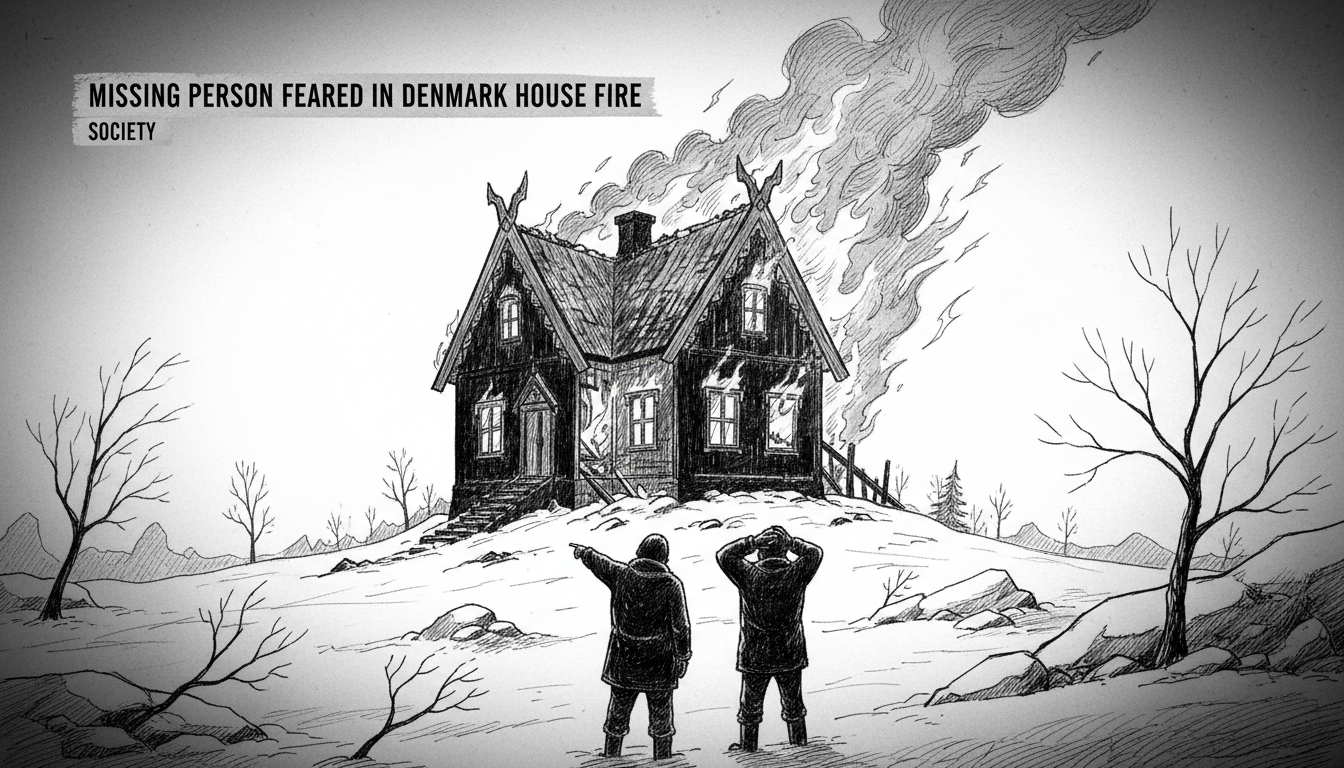
Denmark house fire crews fought a severe blaze in a Vordingborg home Friday morning as police feared a resident remained trapped inside. Emergency services received the alarm at 6:06 AM at a property on Østergårdsstræde in the village of Langebæk. By 9:30 AM, the South Zealand and Lolland-Falster Police stated the house was heavily damaged and extinguishing work was ongoing. Their primary concern was for the occupant's safety. “We cannot rule out that the resident of the house is on the premises,” police wrote in a social media update, confirming the critical missing person element of the response.
The Morning of the Emergency
The early morning call triggered a standard yet urgent protocol for rural Danish municipalities. Local fire brigades from Vordingborg responded first, with police deploying to secure the scene and assist with potential investigations. The location, Østergårdsstræde, is a residential street in a small community, where such emergencies immediately ripple through tight-knit social networks. Neighbors often become first informants in these situations, providing crucial details to arriving officers about who might be home. The timing of the alarm, just after 6 AM, suggests the fire may have started during the night or early dawn, a period statistically associated with higher fatality rates in residential fires due to sleeping occupants.
The Critical First Hours
For three hours, the primary focus was containment and suppression. Danish fire services are trained to conduct preliminary searches if conditions allow, but the severity of the damage noted by police indicates the structure's integrity was likely compromised. This severely hampers rescue efforts and elevates risks for firefighters. The coordination between police and fire crews in this phase is meticulous; police secure the perimeter, manage bystanders, and begin logging potential evidence, while fire commanders direct the tactical assault on the flames. The simple, grave police statement that they “cannot rule out” a person being inside underscores the uncertainty that defines these first hours. It transforms the operation from a purely technical firefight into a potential recovery mission, changing the atmosphere on the ground for all responders.
Danish Fire Safety and Rural Realities
While Denmark boasts some of Europe's strictest building codes for new constructions, the challenge often lies with older housing stock, particularly in pastoral areas like those around Vordingborg. National statistics show that most fatal fires occur in homes, not apartments, and often involve factors like faulty electrical systems, wood-burning stoves, or smoking materials—risks that can be more prevalent in older, detached houses. Since 2010, Danish law has required photoelectric smoke alarms in all homes, a rule enforced through homeowner responsibility. Compliance is generally high, but its effectiveness hinges on proper maintenance. “The beep of a low battery is a sound that must never be ignored,” a Copenhagen fire safety officer told me last year, emphasizing that technology is only as good as the vigilance behind it.
In rural municipalities, response times can be slightly longer than in cities, though Denmark's dense network of volunteer and professional brigades aims to mitigate this. The broader region of South Zealand and Lolland-Falster has seen significant municipal amalgamations over the years, which centralizes some services but aims to maintain local emergency readiness. The successful suppression of a fire, however, is only one metric. The human cost is measured in the police's anxious updates about a missing resident, a scenario every community fears.
The Community and the Aftermath
The impact in a village like Langebæk is profound and personal. Such events are not just news items; they are disruptions to the social fabric. Neighbors know each other, and the sight of emergency vehicles on a familiar street creates a collective dread. Local social media groups and community boards often light up with concern and offers of help, a modern extension of the traditional Danish community solidarity. The local council and social services in Vordingborg Municipality would typically stand by to offer immediate support to any displaced residents or affected families, providing temporary housing and crisis counseling—a function of the Danish welfare system that activates quietly in the background of such tragedies.
As the fire was brought under control, the next phase would begin. If a person is confirmed missing or found, the police investigation intensifies. The Danish National Police's forensic technicians would work alongside fire investigation experts to determine the origin and cause. This process is methodical and can take days or weeks. They will examine electrical wiring, potential heat sources, and any other evidence within the charred structure. In all cases, but especially where a life is lost, the goal is to provide answers—to the family, to the community, and for the official record to help prevent future tragedies.
A Broader Look at Prevention
This fire, like every residential blaze, will eventually contribute to the national data analyzed by agencies like the Danish Emergency Management Agency (DEMA). Their work focuses on trends: Are fires increasing in certain building types? Are particular demographics at higher risk? Public campaigns consistently stress the essentials: working smoke alarms on every floor, a practiced escape plan, and caution with open flames and electrical appliances. For single-person households, which are common in Denmark, the risk profile changes; there is no one else to raise an alarm from within the home. This makes the role of neighbors and connected community alarms even more critical, a point often highlighted by safety advocates in community meetings across the country.
The Langebæk incident is a somber reminder that safety is a shared responsibility, woven between individual action, municipal infrastructure, and national regulation. As the smoke clears on Østergårdsstræde, the questions will linger long after the final embers are cold. Was the alarm heard? Was the escape route clear? And for the community of Vordingborg, the most painful question of all: will they be mourning a neighbor? The answers, now in the hands of responders and investigators, will define this story's lasting imprint.