
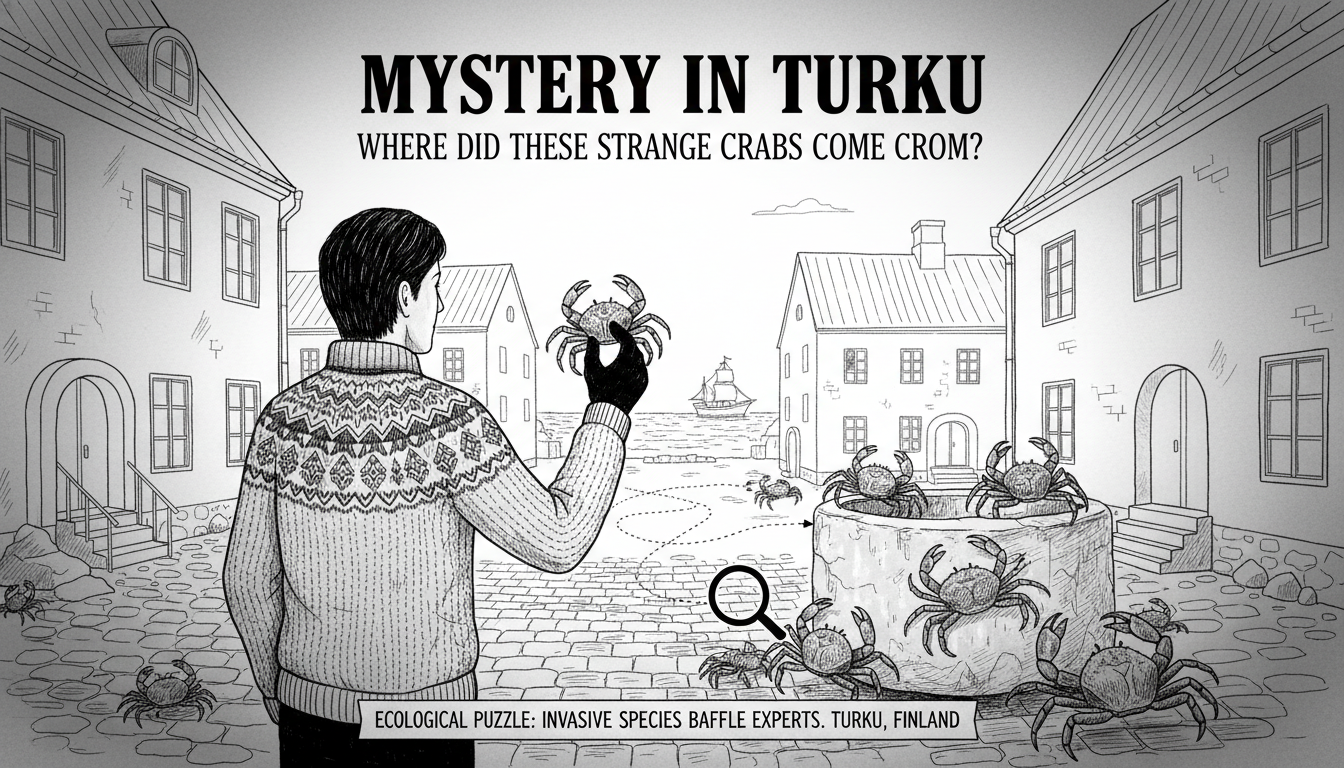
A morning walk turned into a puzzling discovery for Turku resident Heli Pettersson and her 12-week-old Irish wolfhound puppy last Friday. The puppy suddenly became frightened during their routine outing near their apartment building.
'I noticed my puppy was scared of something,' Pettersson recalled. 'I used my phone flashlight to see what was on the ground. There was a crab with its claws raised ready to fight. I just shouted 'what the heck?''
The surprise crab encounter repeated itself this past Wednesday morning. Again, Pettersson's puppy found another crustacean in the early morning darkness.
'Luckily it didn't grab his nose,' she added.
The first crab found on Friday appeared lively and healthy, remaining on the lawn beneath Pettersson's balcony. Her sister collected the shore crab on Saturday to prevent dogs or other pedestrians from getting injured. However, just an hour later, her sister reported the bucket-contained crab had died.
The second crab appeared more tired than the first and also died shortly after being found on the lawn.
These cases are particularly confusing because Pettersson lives about one kilometer from the nearest seaside. How did crabs end up on an apartment building's lawn?
Retired museum conservator Ari Karhilahti, who worked 40 years at the University of Turku's zoological museum, collected the second crab for research. He identified the species as the shore crab (Carcinus maenas).
'This crab will go to my former workplace as a specimen,' Karhilahti said.
Researchers first discovered one live juvenile shore crab in Finland during test fishing at Naantali repair dock in the early 2000s. Karhilahti handled that initial species identification.
'Back then we didn't have internet information available, so I probably spent half a workday confirming it was a shore crab,' he remembered. 'That was Finland's first recorded sighting.'
Observations of shore crabs have remained relatively scarce over the years, which has puzzled Karhilahti. The crabs found in Pettersson's yard were adults with carapaces measuring 8-9 cm wide.
Karhilahti cannot explain what the crabs were doing nearly one kilometer from the sea.
'If this was someone's prank, you'd think they'd leave them where people gather, not an apartment building's inner courtyard under a balcony,' he speculated. 'In that sense, this doesn't have the characteristics of a logical prank.'
Karhilahti doesn't completely rule out the possibility that the crabs traveled from the sea independently.
'We know that their relative, the green crab, sometimes migrates across dry land,' he explained. 'For some reason they come onto land, with tens of thousands moving simultaneously. People have tried to stop them from invading everywhere by crushing them with road rollers.'
However, Karhilahti suspects something other than migration instinct prompted these two crabs' journey since many more would likely be moving if that were the case.
He also dismisses the theory that birds or other animals carried the crabs to the yard, since both were alive and unharmed when found.
Shore crabs are classified among the world's 100 worst invasive species, threatening to spread globally.
'That's why I'm not very happy about this discovery that they've now established themselves here on Finland's coast,' Karhilahti admitted. 'We'll probably never get rid of them.'
He warned about their potential ecological impact: 'If people wonder why herring spawning no longer succeeds in shallow bays, it's not very surprising when there are millions of shore crabs waiting to eat the spawn before it can hatch.'
Shore crabs likely reached Finnish waters in ships' ballast water. Their original habitat spans the entire eastern Atlantic coast from Norway and Denmark to Africa. They entered the Baltic Sea long ago through Danish straits, reaching Polish and Lithuanian coasts.
'It was only a matter of time before they spread here too, even on their own,' Karhilahti noted. 'They appear to survive in freshwater too.'
The appearance of marine creatures so far inland suggests either human intervention or unexpected animal behavior that deserves closer monitoring.