
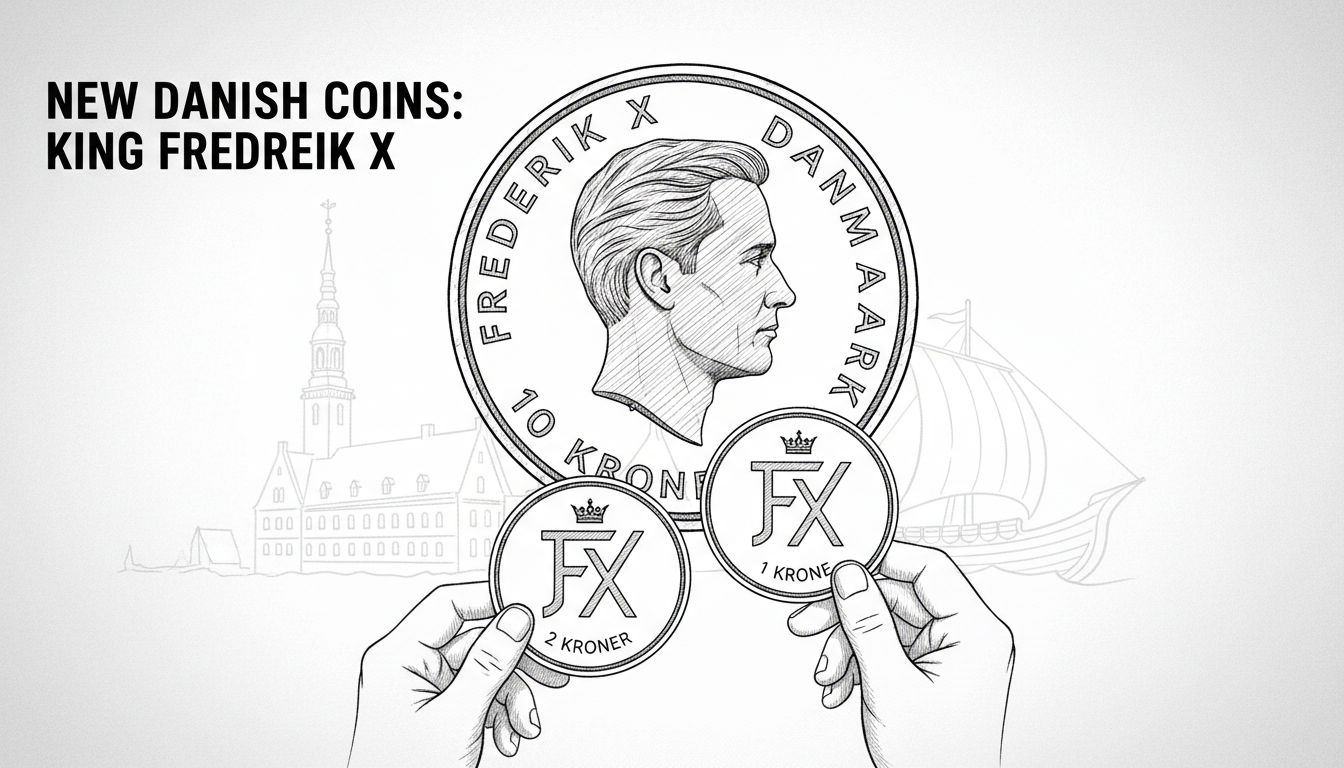
The familiar jingle of change in Danish pockets will soon carry a new royal portrait. The Danish National Bank has unveiled the first coins featuring King Frederik X, marking a significant moment in the nation's monetary history. This change, arriving after a transition period, sees the monarch's portrait on new 10 and 20 kroner coins, while his monogram adorns the 1, 2, and 5 kroner pieces. The 50-øre coin remains unchanged, preserving the image of the Danish royal crown. For many residents, this is a tangible update to a daily object, a small piece of national identity they physically hold.
The introduction follows a royal tradition stretching back over a millennium to King Sweyn Forkbeard. A senior official from the National Bank stated that the new coins continue a centuries-old practice of placing the reigning monarch's portrait on larger denominations. The official noted the tradition also includes featuring the national coat of arms or royal heraldry. A royal commentator explained the deeper historical significance. She said the monarch's image on currency originally symbolized royal authority and guaranteed the coin's value. This practice drew inspiration from ancient Greece and England, embedding power and trust in physical money.
From a practical standpoint, the new coins are standard legal tender. They possess the same weight, size, and metallic composition as their predecessors. They are not a special collector's edition. Distribution has already begun through cash-handling companies to supermarkets and retailers. Some reports indicate the coins are already available in select locations. Their production was outsourced to the Royal Mint of Spain for this issue, a shift from recent suppliers. This logistical detail highlights the globalized nature of even the most national symbols.
As a reporter focused on integration, I see this event as a subtle but powerful lesson in Danish civic culture. For new citizens and long-term residents alike, handling these coins becomes a small, repeated interaction with the state and its history. It is a quiet, constant reminder of the constitutional monarchy's role. The design choice to use a portrait on higher-value coins and a monogram on lower ones is itself a hierarchy of royal representation. It mirrors the structured nature of Danish society, where symbols and systems are ordered with clear intent. The decision to keep the 50-øre coin unchanged due to existing stockpiles is a pragmatic, fiscally responsible move typical of Danish administration. It shows how tradition is balanced with practical economic management.
The rollout will be gradual. It may take weeks or months for the new coins to fully circulate and become commonplace. This slow integration into daily life allows for a natural public acclimatization. For international observers, this change is more than a numismatic update. It is a reflection of a stable, continuous state where institutional transitions are managed with deliberate calm. The coins are a metallic thread connecting modern Denmark to its Viking-age origins, a continuity rarely found in the modern world. They represent a society that values its history enough to mint it anew for everyday use.