
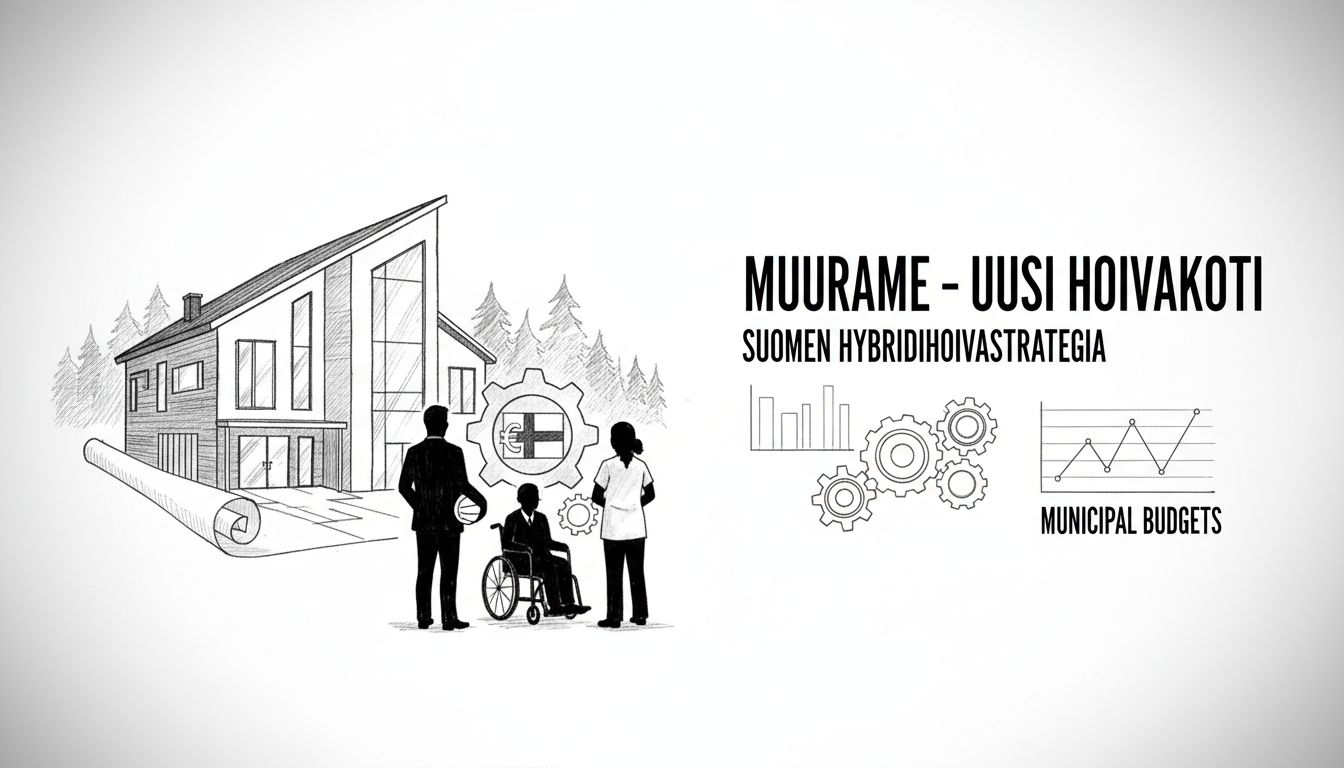
A new elderly care facility is set to open in the Central Finnish municipality of Muurame, representing a notable public-private partnership in the nation's care sector. The service provider Esperi Care will operate the 50-place home located at Kinkorannantie 9, while the property itself will be built and owned by the investment firm Plus Hoivakodit. Construction is scheduled for completion in the third quarter, with operations commencing shortly after. This development is part of a broader national trend where Finnish municipalities increasingly rely on outsourced service providers to meet the demands of an aging population, a strategy that has drawn both support and scrutiny in recent parliamentary debates.
The Finnish model for elderly care has undergone substantial transformation over the past decade. The system blends municipal responsibility with private service provision, a structure formalized in the Act on Supporting the Functional Capacity of the Older Population and on Social and Health Care Services for Older Persons. The Ministry of Social Affairs and Health oversees national guidelines, but local municipalities like Muurame hold the primary operational and financial responsibility. This decentralization often leads to regional disparities in service quality and availability, a persistent challenge discussed frequently in the Eduskunta, Finland's parliament.
This specific project in Muurame highlights the operational mechanics of this model. Plus Hoivakodit acts as a long-term property investor, financing and owning the physical asset. Esperi Care, one of Finland's largest private providers of housing services for seniors and people with disabilities, then leases the facility and delivers the day-to-day care. This separation of real estate ownership from service provision is designed to attract investment into the care infrastructure while allowing specialized companies to manage operations. The arrangement is common but not without controversy, as critics argue it can prioritize profitability over care standards.
The political context for such developments is complex. Finland's coalition government, led by Prime Minister Petteri Orpo, has emphasized efficiency and cost-control in public services. The Minister of Social Affairs and Health, Kaisa Juuso, has previously stated that partnerships with reliable private actors are necessary to ensure adequate service coverage nationwide. Meanwhile, opposition parties, particularly the Social Democrats and the Left Alliance, frequently call for stronger municipal resources and direct public provision to guarantee uniform care quality. This tension reflects a fundamental European debate on the role of the welfare state.
For international observers and expatriates in Finland, this news underscores the pragmatic and often hybrid nature of Nordic welfare. While the system is robust and universally accessible, its delivery is increasingly a mix of public funding and private execution. The Muurame project is a single example of a nationwide pattern, where the need for new care homes is acute. Demographic projections show Finland's over-65 population growing significantly, placing continuous pressure on municipal budgets and prompting these strategic partnerships. The success of such models is measured not just in beds created, but in the quality of life they enable for residents, a metric that will be closely watched by local officials and national regulators alike.