
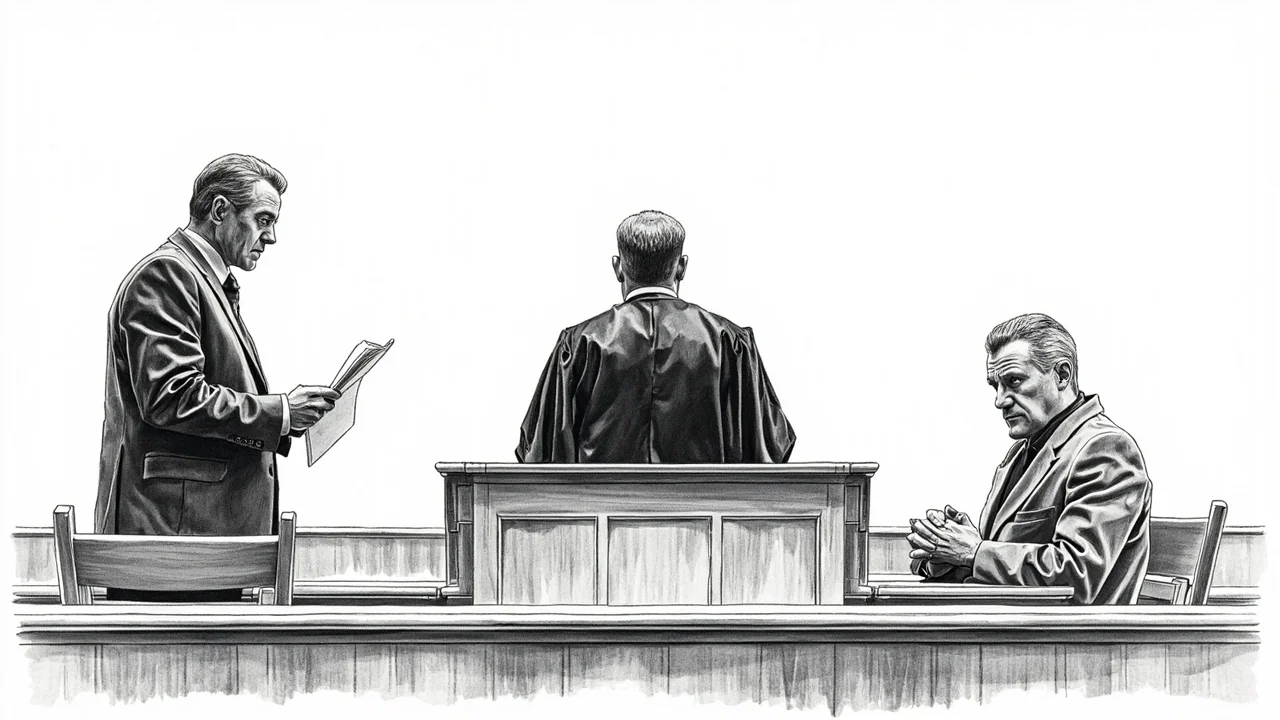
Norway’s sexual violence cases see fewer than 12% of reported sleep rapes result in convictions, a stark backdrop for one of this year's most watched trials. Marius Borg Høiby stood in Oslo District Court to answer a series of grave charges. A coffee-stained chair sat beside him as courtroom monitors flickered. For a packed courtroom, Høiby’s first impression was composed. He was well-dressed, freshly groomed, and appeared calm as he entered. That composure faced a severe test in the minutes that followed.
Høiby did what was expected. He stood and gave his personal details. For 24 minutes, he remained upright while the serious indictment was read aloud. He spoke softly. At times he merely nodded, or shook his head, almost inaudibly. He acknowledged guilt on several points. But he did not admit to the most serious charges: sleep rape and violence in close relationships. In his hands, he fidgeted nervously with a bracelet. Several times he bent down to confer with his defense lawyer before answering. Once, he corrected himself.
The words of the indictment flew past: slaps with an open hand against a girlfriend, destruction of a chandelier, a woman thrown against a refrigerator, insults like "whore," threats, sex videos on encrypted apps. Høiby struggled. He received support from the head of the law firm representing him.
A Tense Arrival in Court
The scene in Oslo District Court's Room 250 was charged. Høiby, the 29-year-old defendant, faced the court amid intense public and media scrutiny. The formal reading of the charges painted a picture of repeated domestic abuse and sexual violation. The prosecution detailed a pattern of alleged control and violence across multiple relationships. Høiby’s partial admission of guilt was a strategic start, but his denial of the core rape allegations set the stage for a contentious legal battle. His physical demeanor—the fidgeting, the quiet voice, the need to consult his lawyer—contrasted with the graphic descriptions presented by the state.
The Defense Mounts Its Counterattack
When his defense lawyer, Ellen Holager Andenæs, raised her desk in the courtroom, the atmosphere shifted. The seasoned legal veteran launched an aggressive counteroffensive. Speaking from behind her adjustable podium, she referred to her client as "Marius" and thundered against the public prosecutor. She accused him of seeking attention. Not surprisingly, she also criticized the media, speaking of massive pre-trial judgment. The special treatment she sees in this case is, according to her, negative. She pointed to what she views as an overactive police force that pulled on tactical gear and drove to Gausdal on a Friday evening to arrest Høiby because of a single phone call.
Here, the contours of the Høiby team's strategy became visible. Whether assuming a victim role will impress the court remains to be seen. Therefore, Holager Andenæs also painted a picture of a particular environment: lots of partying, lots of drugs, lots of sex. A place where boundaries are blurred, and where many people participate in a lot, is what she wants the court to envision. She hinted that the real fear concerns videos that could be spread. The defenders will do everything to sow doubt: Is the court convinced that this was not consensual sex?
The Legal Challenge of Proving Sleep Rape
Sleep rape cases are notoriously difficult to prosecute. Legal experts note the evidentiary hurdle is often insurmountable, as it typically boils down to one person's word against another's with no witnesses. The defense’s tactic of contextualizing the events within a consensual, hedonistic lifestyle directly targets this vulnerability in the prosecution's case. By describing a milieu of blurred lines, the defense aims to create reasonable doubt about the complainant's ability to consent and the defendant's awareness of non-consent. The mention of encrypted apps and fears of video leaks adds a layer of modern digital complexity to the traditional he-said-she-said dynamic.
The Strategy of Doubt and Context
The defense’s narrative is two-pronged. First, it seeks to portray the prosecution as overzealous and the defendant as a target of a media frenzy. Second, and more critically, it aims to reframe the alleged crimes within a normalized context of excessive behavior. This approach attempts to shift the jury’s focus from specific criminal acts to a broader, murkier social setting. The implication is that within this context, interactions that might now be viewed as criminal were at the time part of an accepted, if reckless, pattern of behavior. The success of this strategy hinges on the court’s willingness to separate the morality of a lifestyle from the legality of specific actions alleged to have occurred within it.
What Comes Next in the Trial
The trial will now proceed to witness testimonies and the presentation of forensic evidence. Key to the prosecution's case will be the testimony of the complainants, who must withstand cross-examination that will likely seek to exploit the defense's narrative of a chaotic, consent-ambiguous environment. Digital evidence from phones and encrypted apps may play a pivotal role. The court must weigh the graphic details of the indictment against the defense's framing of events and its claims of an unfair investigatory process. The outcome rests on whether the prosecution can prove, beyond a reasonable doubt, that clear criminal boundaries were crossed despite the messy personal contexts described.
The trial continues, with a verdict expected later this spring. The final judgment will not only determine Høiby’s fate but will also serve as a barometer for how Norwegian courts navigate the complex interplay of personal relationships, intoxication, and digital evidence in severe sexual assault cases.