
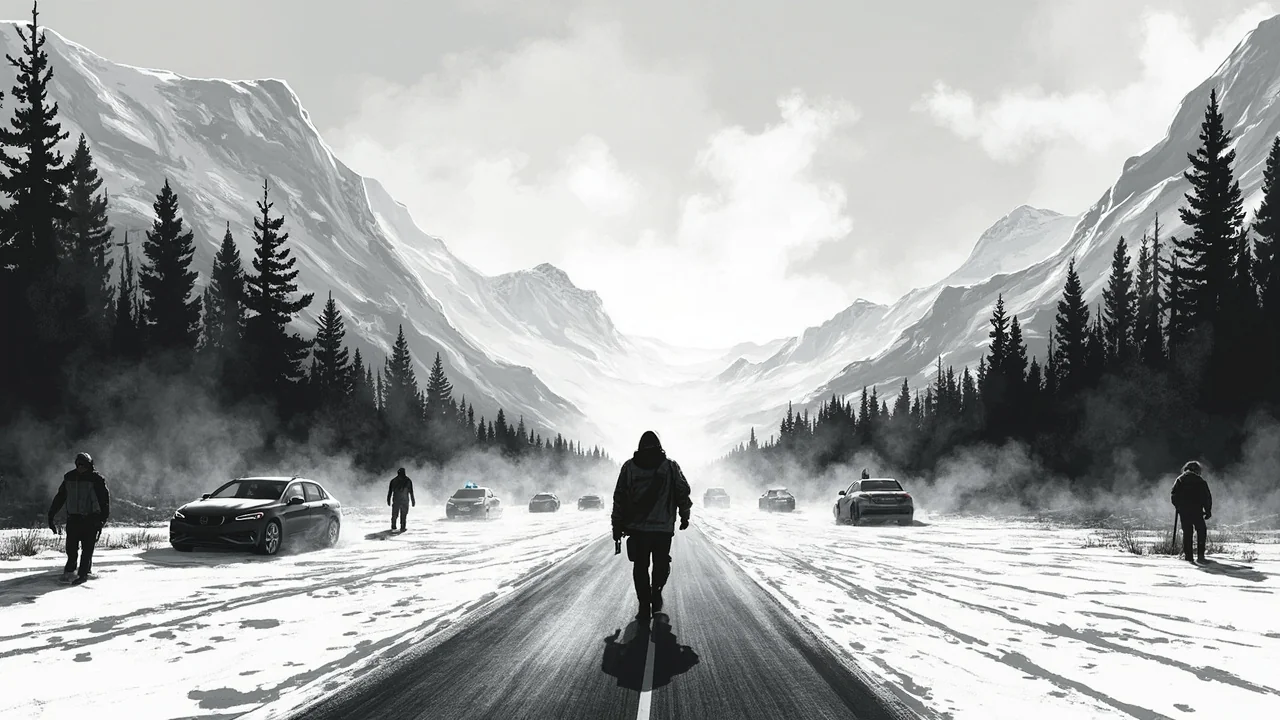
Norway's main Arctic highway, the E45, is closed after a serious collision between a passenger car and a truck-trailer unit north of Mieron. Emergency services are on the scene, and one driver is receiving medical care.
The crash occurred on the E45, a vital transport artery connecting southern Norway to the Finnmark plateau, between Mieron and Kautokeino. Police confirmed the passenger car is blocking the roadway, causing significant traffic disruptions and queues in the remote area. Authorities have initiated an on-site investigation and are managing traffic flow.
The main rescue center for Northern Norway reported that the SAR Queen search and rescue helicopter was dispatched to the location following a request from the emergency medical coordination center in Tromsø. This indicates the potential seriousness of the incident and the challenges of providing rapid medical aid in such a sparsely populated region.
Emergency Response in Remote Terrain
The deployment of the SAR Queen helicopter underscores the logistical complexities of accidents in Norway's far north. The E45 in this region traverses open, exposed tundra with long distances between settlements and limited alternate routes. A road closure here can strand travelers and disrupt freight transport for essential goods. The helicopter's primary role is likely to provide rapid medical evacuation to a major hospital, as ground ambulance travel times to advanced care from this location can be exceptionally long.
Local police have not released details on the condition of the driver receiving care, nor any information about other potential passengers or the driver of the truck. The involvement of a 'vogntog'—a large truck with a trailer—suggests a significant impact force. The investigation will focus on determining the cause of the collision, examining factors such as road conditions, visibility, and driver attention on the long, straight stretches characteristic of this highway.
The E45: Norway's Northern Lifeline
This incident brings attention to the E45, known as the 'Arctic Highway.' It is a critical piece of infrastructure for both local communities and the broader economy. The highway facilitates tourism, provides access to remote villages, and serves as a transport route for goods heading to and from the North Cape. Any prolonged closure has immediate ripple effects, isolating communities and complicating supply chains.
The stretch between Mieron and Kautokeino is particularly sensitive. It is a key route for reindeer herding communities of the Sami people, especially during seasonal migrations. An accident and closure during such periods can create critical conflicts between modern transport needs and traditional livelihoods, adding another layer of complexity for authorities managing the situation.
Economic and Community Impact
The closure of the E45 forces all traffic, including heavy goods vehicles, onto long detours via other national roads, which are often narrower, slower, and less suited for high-volume traffic. For the logistics and energy sectors, which rely on predictable transport schedules for equipment and supplies to remote industrial sites, such disruptions can be costly. While not on the scale of an offshore oil field disruption, it is a reminder of how vulnerable land-based supply lines in the Arctic can be to single-point failures.
For local residents, a closed highway means delays for routine travel, medical appointments, and the delivery of everyday goods. In these communities, the main road is not just a route but a lifeline. Schools, businesses, and municipal services all depend on its reliability. The social impact of an extended closure, while less quantifiable than economic cost, is deeply felt.