
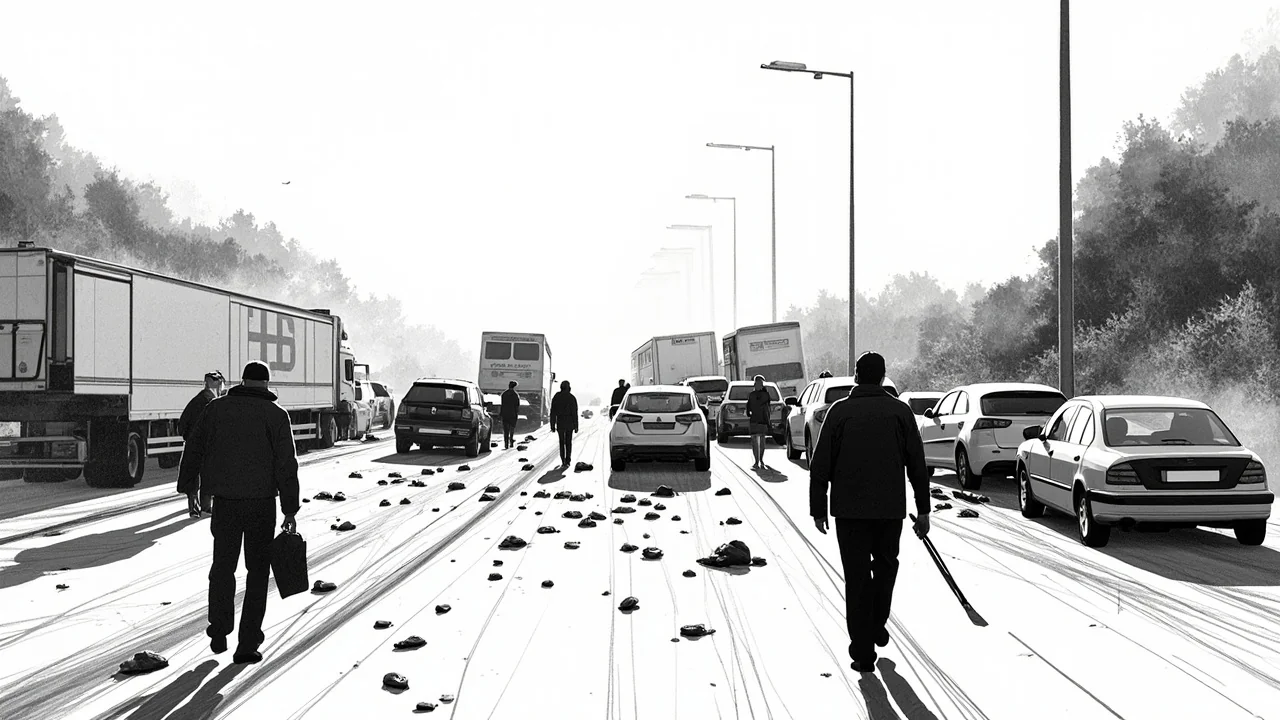
Norway's crucial E6 motorway faced significant disruption after a multi-vehicle collision south of Oslo on Thursday afternoon. Police confirmed the accident occurred in the southbound lanes near the Teisen area, involving several cars. Emergency services were quickly dispatched to the scene.
Operational manager Øyvind Hammervold provided an update at 14:52, stating that responders were on site. He confirmed the most critical detail: no one was injured. "Two lanes are now open past the site. A vehicle recovery truck is on its way. It has been assessed that none of those involved are injured, only material damage," Hammervold said in a statement. The swift reopening of two lanes helped to alleviate the growing traffic backlog during the early afternoon.
The Arterial Road's Vulnerability
The E6 is Norway's primary national highway, running from the southern coast to the Russian border in the north. The section near Teisen, just inside Oslo's municipal boundary, is one of the most heavily trafficked stretches in the country. It serves as the main conduit for commuters entering the capital from the populous municipalities in Viken county, like Bærum and Asker. Any incident causing a lane closure here creates immediate ripple effects, with congestion often backing up for kilometers and causing delays for thousands of drivers. This accident, while minor in terms of human cost, highlighted the infrastructure's sensitivity to disruptions.
A Pattern of Disruption
This event fits into a broader pattern of incidents on Oslo's approach roads. The E6, E18, and Ring 3 regularly experience accidents that strain the capital's traffic network. Data from the Norwegian Public Roads Administration (Statens vegvesen) consistently shows that the stretches leading into major urban centers have the highest frequency of reported collisions. These are often attributed to high traffic density, variable speeds as drivers approach the city, and driver inattention during peak commute times. The economic cost of these disruptions is substantial, calculated in lost work hours, increased fuel consumption from idling vehicles, and delayed freight transport.
Norway's Road Safety Context
Norway maintains some of the world's most ambitious road safety vision zero (nullvisjon) policies, aiming for no fatalities or serious injuries on its roads. The country has seen a steady decline in serious traffic accidents over recent decades. The outcome of the Teisen incident—material damage only—aligns with this positive trend, suggesting effective vehicle safety standards and immediate emergency response protocols. However, the frequent occurrence of such non-injury collisions still represents a significant burden on emergency services, police resources, and daily commuters. It underscores the ongoing challenge of preventing all incidents, not just the fatal ones.
The Emergency Response Protocol
The response to this collision demonstrated a standard and well-rehearsed Norwegian emergency protocol. Police, fire, and medical services were mobilized simultaneously. The first priority is always securing the scene to prevent further accidents and assessing potential injuries. Hammervold's prompt update about the lack of injuries is a key piece of public information that guides subsequent actions. With injuries ruled out, the focus shifts to traffic management and clearing the wreckage. The deployment of the vehicle recovery truck (bilberging) is a standard final step to restore normal traffic flow. The efficiency of this process is critical to minimizing the wider impact on the Oslo region's transportation network.
Economic and Logistical Repercussions
Beyond the immediate traffic jam, an accident on this scale has subtle economic repercussions. The E6 southbound corridor is vital for logistics and supply chains moving goods from Oslo's port and industrial areas toward southern Norway. Even a temporary blockage forces recalculations for transport companies. For commuters, the lost time has a direct, though diffuse, economic impact. Furthermore, such incidents consume considerable public resources. The cost of deploying multiple police patrols, fire engines, and other emergency units for what is ultimately a property damage incident is a recurring expense for municipal and state budgets. It highlights the broad societal cost of traffic incidents beyond the immediate parties involved.
A Look at Infrastructure Pressures
The repeated strain on the E6 near Oslo feeds into larger national debates about infrastructure investment and capacity. There are ongoing discussions and projects aimed at increasing resilience on these key arteries, including the expansion of the E6 southward through Bærum and the continued development of alternative routes and public transport options like the Fornebubanen metro line. Each incident adds weight to the argument for accelerating these projects to reduce the vulnerability of the single point of failure that major highways can represent. The challenge is balancing the enormous cost of major infrastructure projects with the incremental, daily cost of disruptions like the one at Teisen.
While Thursday's collision ended as a best-case scenario—no injuries and a relatively swift resolution—it served as another reminder of the perpetual pressure on Norway's key transportation infrastructure. As traffic volumes continue to grow, the interplay between road safety, efficient emergency response, and long-term infrastructure planning will remain a central issue for policymakers in Oslo and at the national level. The event concluded with lanes reopened and vehicles cleared, but the questions about capacity and resilience on the E6 corridor remain very much open.