
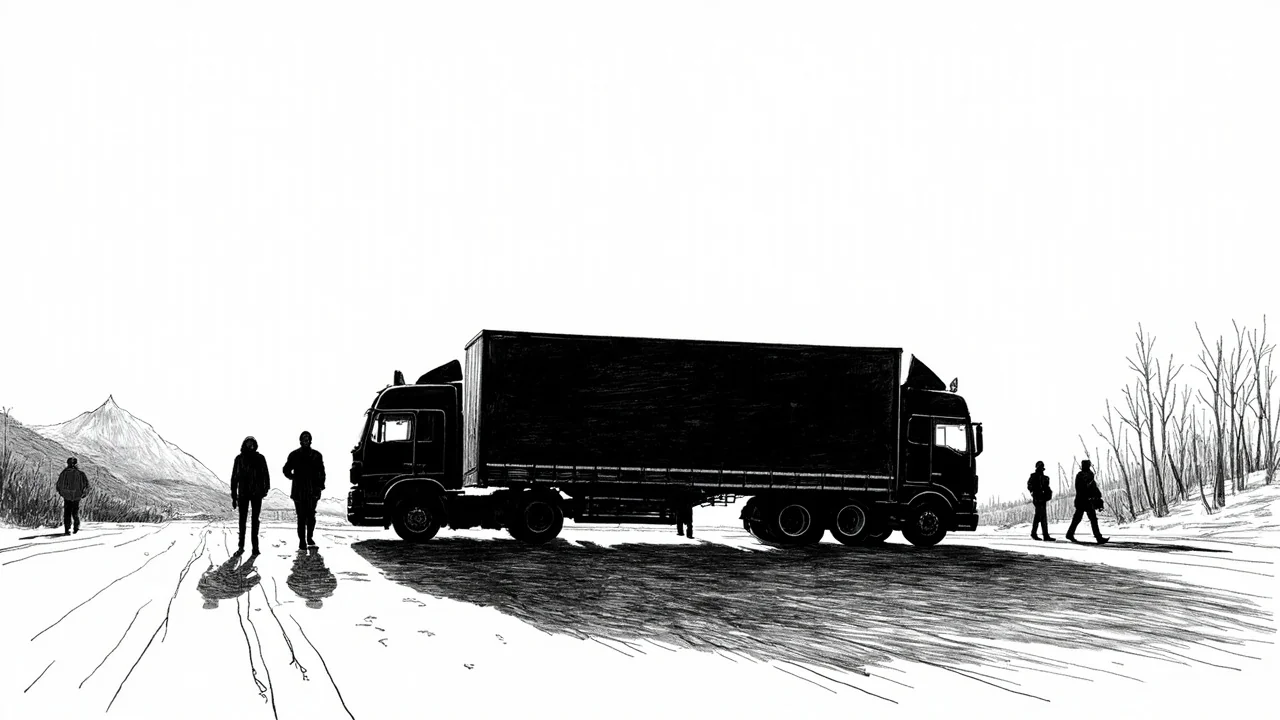
Norway fatal truck blind spot incident on January 16 has sparked legal and safety debates after surveillance footage captured the moments before a woman’s death at Bring’s goods terminal in Skedsmokorset, Romerike. The tragedy unfolded when the woman entered the blind zone directly in front of a heavy goods vehicle just seconds before it began moving again.
Tragic Sequence Captured on Camera
According to police, the victim was struck by the truck and became trapped underneath as the vehicle pulled forward onto the E6 highway. She later fell from beneath the trailer and was hit by multiple passing cars. Central to the investigation is surveillance video showing her entering the area directly in front of the truck while the driver was outside the cab, closing the rear doors of the trailer.
The driver—a foreign national—had stopped briefly after exiting the loading dock, stepped out to secure the trailer, then returned to the cabin. Approximately 35 seconds passed between his last visual check of the vehicle’s surroundings and the moment he resumed driving. During that window, the woman appeared on the terminal grounds and moved into the truck’s forward blind spot.
Legal Proceedings and Conflicting Accounts
The driver has been formally charged under Section 281 of Norway’s Penal Code, which addresses negligent homicide—specifically, causing death through careless or reckless conduct such as unsafe driving. If convicted, he faces up to six years in prison. His attorney, Skjalg Røhne Halvorsen, confirmed the driver denies criminal liability.
In statements to authorities, the driver claimed he checked his mirrors and surveyed the area before restarting the engine. He also asserted that due to the design of the truck, anyone standing closer than two meters directly in front of the cab would be invisible without stepping out of the vehicle—an action he says he took during the stop.
However, legal representatives for the victim’s family dispute this version. Attorney Mette Yvonne Larsen, who is assisting the deceased woman’s relatives, stated the truck was equipped with sensors meant to prevent exactly this kind of accident. “Our understanding is that the vehicle has systems that should detect nearby persons,” she said. “My clients believe the driver was grossly inattentive.”
Questions About Vehicle Safety Systems
Police have not publicly confirmed whether the truck’s sensor system was operational or if it issued any alerts during the incident. The Norwegian Public Roads Administration (Statens vegvesen) conducted a technical examination of the vehicle as part of the probe, but findings have not been released.
What is clear is that the surveillance footage played a decisive role in the decision to press charges. “The video shows the collision and what happened immediately beforehand,” said police prosecutor Anders Briskodden. “It is part of the basis for the indictment.” He declined to share specific details from the recording, citing the ongoing legal process.
The case highlights persistent concerns about large vehicle blind spots in industrial and logistics zones—areas where pedestrians and drivers often share tight spaces. While many modern trucks include proximity sensors, cameras, or automatic braking systems, their effectiveness depends on maintenance, calibration, and driver response.
Family Seeks Accountability
For the victim’s family, the fact that the driver allegedly did not notice a person trapped under his vehicle for even a few meters is deeply troubling. “They are stunned that he didn’t feel or hear anything,” Larsen said, reflecting the family’s position. The emotional weight of the case has intensified scrutiny of standard procedures at freight terminals, where foot traffic and heavy machinery intersect daily.
Bring, the logistics company operating the terminal, has not commented publicly on the incident or its internal safety protocols. The company, part of PostNord Group, handles parcel distribution across Norway and maintains multiple hubs nationwide.
Awaiting Court’s Determination
The case is now before Borgarting Court of Appeal, following earlier proceedings in lower court. Legal experts note that proving negligence in such cases hinges on whether the driver met the “reasonable person” standard—would another professional driver, under similar conditions, have acted differently?
Key factors will include the duration of the stop, the driver’s stated checks, the visibility limitations of the vehicle, and whether technological aids were functional. The surveillance video remains the most critical piece of evidence, offering a silent but vivid account of the final moments before the collision.
As Norway’s transport sector continues its digital transformation—with increasing adoption of AI-assisted driving and automated safety features—this tragedy underscores the gap between available technology and real-world human behavior. Even with sensors and cameras, accidents can occur if drivers rely too heavily on systems or fail to perform basic safety routines.
The courtroom outcome may influence future training requirements for commercial drivers, especially those operating in mixed-use logistics environments. For now, the victim’s family waits for justice, while the logistics industry watches closely to see how responsibility is assigned in an era where both humans and machines share the road.
Will clearer regulations on blind-spot monitoring—and mandatory use of detection systems—emerge from this case? Or will it remain a tragic reminder of how quickly routine tasks can turn fatal?
Read more: Norway Oil Fund Loses $40B as Tech Bet Backfires.
Read more: Norway Submarine Base Faces Power Grid Rejection Crisis.