
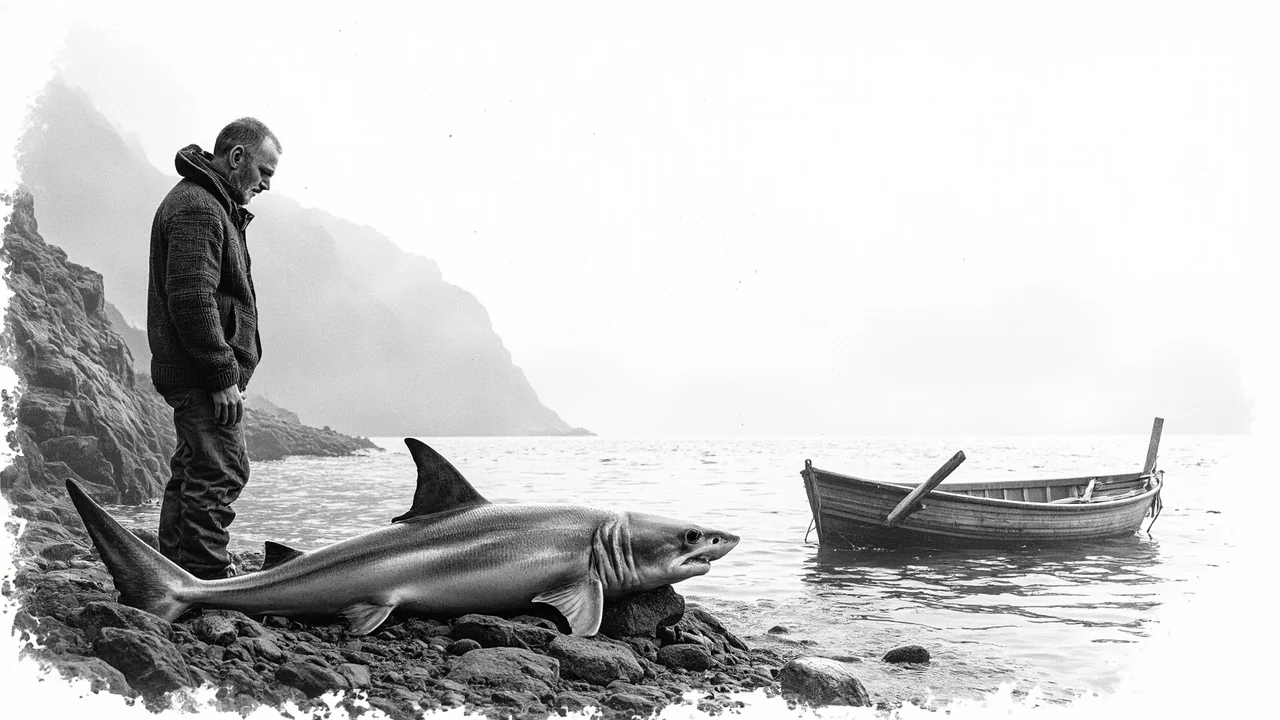
Norway's coastal waters yielded an unexpected catch this week when a hobby fisherman pulled up a 220-centimeter shark instead of the pollock he sought. Bernt Vatne, 62, was hauling in his fishing gear near Reipå in Ørnes, Nordland county, when his routine trip turned into a remarkable encounter with marine life. The experienced fisherman, who has spent decades on these fjords, found himself facing a tangled mass of netting and a massive håbrann shark, dead but imposing, setting the stage for a story that blends human perseverance with the mysteries of the deep.
An Unexpected Guest in the Nets
Bernt Vatne had set out that day aiming to catch sei, or pollock, a common target in these fertile Arctic waters. He was retrieving the first of four or five fishing nets when he noticed the gear was unusually heavy and knotted. "It lay in the first net I pulled up," Vatne said. "It was dead, just hanging there loosely in the net. But the net was one big knot." The shark, a håbrann species, was entangled but not aggressively caught. Vatne noted that if it had thrashed more, it might have freed itself. With careful cuts using a knife on the net remnants, he managed to release the creature, then attached a cod hook to bring it alongside his boat. However, landing it required the effort of three strong men to hoist the shark onto the dock, highlighting the sheer physical challenge of such a find.
The shark measured 2 meters and 20 centimeters in length, with an estimated weight between 170 and 200 kilograms. Vatne, who described himself as an avid hobby fisherman, expressed astonishment at the size. "I have never gotten anything like it," he said, emphasizing that this catch stood out in his long fishing history. The location, Reipå in Ørnes, is part of Nordland's rugged coastline, where cold currents from the Norwegian Sea support rich biodiversity, making such surprises rare but not unheard of in local fishing lore.
The Anatomy of a Surprise
Upon closer inspection, Vatne and others discovered more about the shark's life. They opened its belly, revealing it was a female specimen. Inside the uterus, they found two dead håbrann fetuses, indicating the shark had been pregnant. Additionally, the stomach contents showed evidence of its last meals: two large cod, suggesting it had fed well in the Norwegian Sea before encountering the net. This detail paints a picture of an active predator in its natural habitat, suddenly halted by human fishing activity. The shark's size, while impressive, is within the normal range for adult håbrann, but its capture as bycatch in standard fishing gear is what made the event unusual.
The process of handling the shark underscored the practicalities of fishing in Norway's remote communities. Vatne used simple tools—a knife and hook—to manage the situation, reflecting a hands-on approach common among coastal dwellers. The incident did not disrupt local fishing operations, but it sparked curiosity and conversation in Ørnes, where news spread quickly through word-of-mouth and local reports before gaining broader attention.
Expert Insights on Håbrann
Claudia Junge, a researcher at the Institute of Marine Research, provided context on the catch. She explained that a håbrann of around 220 centimeters is large but not abnormal for the species. "It is nevertheless unusual to get individuals of that size as bycatch," Junge said, noting that such events are infrequent in Norwegian waters. She emphasized that håbrann sharks are not dangerous to humans. "They are large and have big teeth, but are not aggressive and are fundamentally afraid of people," Junge stated. However, she added a cautionary note, underscoring that it is wise to show respect for all shark species, given their power and role in marine ecosystems.
Junge's comments align with broader knowledge about håbrann, which are often misunderstood due to their size but are generally placid and avoid human interaction. In Norway, these sharks are part of the diverse marine life that includes species vital to the fishing industry, such as cod and pollock. The incident highlights the occasional overlaps between human activities and wildlife, raising subtle questions about sustainable fishing practices without delving into policy specifics. For hobby fishermen like Vatne, such encounters serve as reminders of the ocean's unpredictability and richness.