
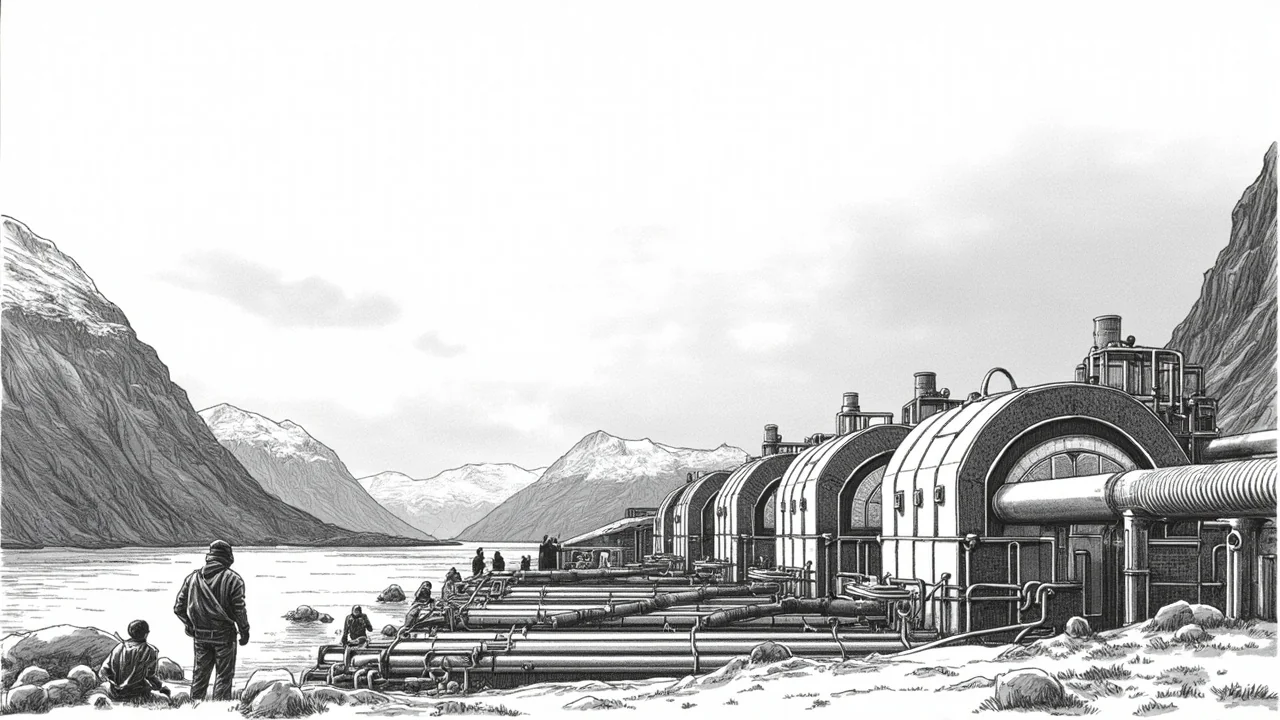
Norway's climate targets rely heavily on capturing and storing over 90% of emissions by 2050, according to a new report from the country's Environment Directorate. The "Climate Measures in Norway 2026" report outlines the path to cutting national emissions, identifying carbon capture and storage (CCS) as the single most effective measure. The directorate argues that removing emitted carbon can be more efficient than implementing other, more demanding climate actions.
"We cannot wait until it's nearly 2050 to make a move. We must deploy the solutions we already have if Norway is to reach its climate goals," said Environment Director Hilde Singsaas. The report sketches out actions the population can take to contribute, but its central focus is on large-scale technological intervention. By 2040, approximately 8 million tonnes of CO₂ could be captured and stored annually, equating to about 18% of Norway's current yearly emissions.
The Central Role of CCS
Carbon capture and storage technology involves capturing CO₂ from industrial sources and power production, transporting it, and storing it permanently deep beneath the seabed. Key sources include the cement, steel, and waste industries, as well as power generation from natural gas and coal. The Environment Directorate's analysis positions this technology not as a side project but as a cornerstone of national climate strategy. For Norway to meet its strict climate goals, all sectors combined must emit under 5 million tonnes of greenhouse gases. CCS is projected to deliver a significant portion of the necessary reductions.
This focus is backed by research institutions. SINTEF and CICERO have stated that to meet the two-degree global warming target, carbon capture must be part of the solution. The technology addresses emissions that are otherwise difficult or costly to eliminate through direct electrification or process changes.
A Norwegian History of Storage
Norway is not new to this field. The first ideas about carbon capture in the country emerged in the 1980s. Sixteen years later, Norway began pumping carbon from a platform and storing it beneath the North Sea. This early experience provided valuable subsurface data and operational knowledge. In 2025, the "Langskip" project, Norway's first carbon capture plant and the world's first installed at a cement factory, was opened. This marked a significant step in applying the technology to heavy industry.
Despite this progress, such facilities remain rare globally. CICERO notes that high costs are a primary barrier. Estimates from SINTEF indicate that the cost for large-scale capture, transport, and storage from coal-fired power plants can run around 830 Norwegian kroner per tonne. This financial challenge is a key hurdle for widespread adoption, even in a country with substantial geological storage capacity and petroleum sector expertise.
Sector-Specific Challenges and Actions
The report provides a sobering look at sectoral responsibilities. For the petroleum sector, which accounts for a major share of national emissions, 85% of emissions come from burning natural gas in turbines during extraction. The directive for this industry is clear. "These must be electrified – either with power from shore, or with gas power plants equipped with carbon capture," the report states. This underscores a dual path: reducing operational emissions through grid electricity while developing CCS for remaining combustion processes.
For the broader economy, the next decade is critical. The Environment Directorate emphasizes that decisions made now will lock in emission pathways for 2050. Waiting to deploy proven technologies like CCS risks missing the mid-century targets entirely. The report implies a need for accelerated policy support and investment to bring costs down and scale the technology beyond pilot projects.