
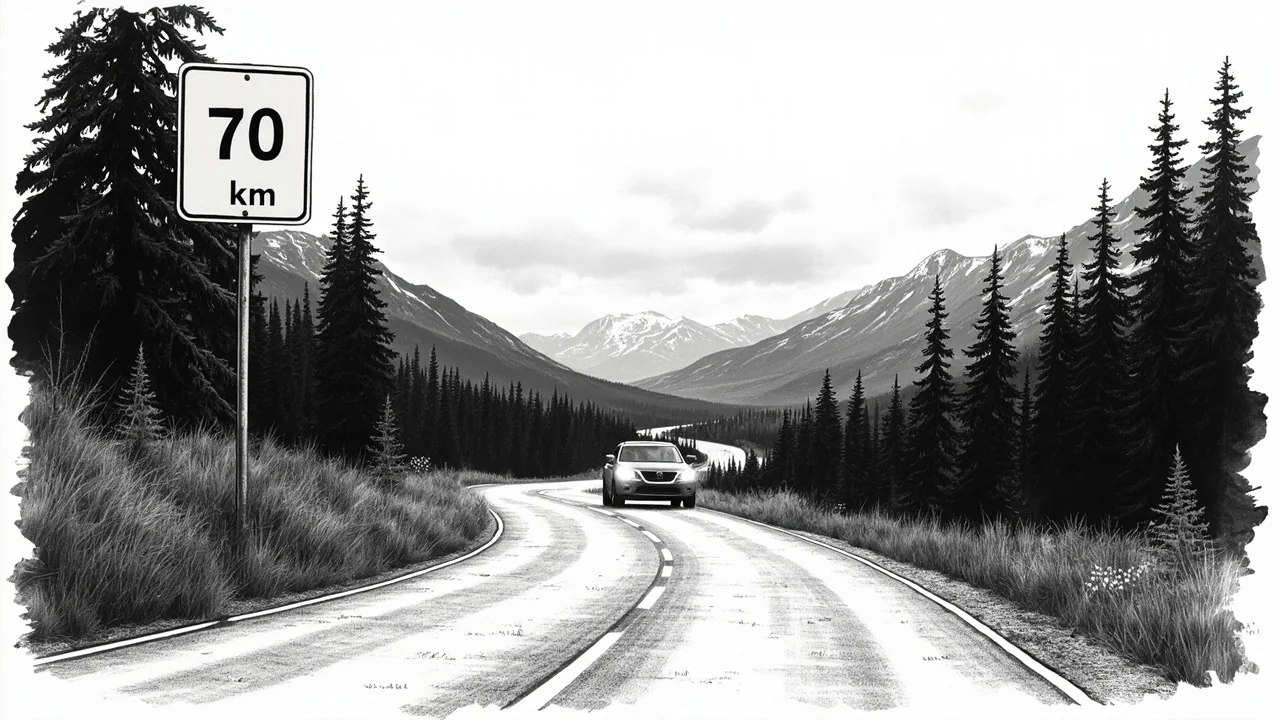
Speed is a contributing factor in one of every three fatal traffic accidents in Norway. This stark statistic is the driving force behind a new government proposal to lower speed limits on many of the country's rural highways. The Norwegian Public Roads Administration aims to increase the use of 70 km/h zones on roads where the current 80 km/h limit is deemed unsafe.
The Safety Vision Behind the Proposal
The proposal is a key part of the agency's action plan for traffic safety from 2026 to 2029. Guro Ranes, the agency's director for traffic safety, states the measure is targeted and necessary. "Reducing the speed limit to 70 kilometers per hour will lead to fewer accidents," Ranes said. "The accidents that do occur will also be less severe." The agency is currently revising the criteria used to classify roads, aiming to systematically identify stretches where 80 km/h is unsafe. These roads would then see their limits lowered to 70 km/h. The final version of the national action plan is due by March 1, 2026.
This initiative falls under the government's "zero vision," a long-term goal of eliminating all traffic fatalities and serious injuries. The Roads Administration justifies the move by pointing to the varying standards of Norway's road network. "We must find the roads where 80 kilometers per hour is not safe. These roads can have the speed limit reduced to 70," Ranes explained. The agency maintains it prioritizes safety while still wanting people to reach their destinations efficiently.
Strong Opposition from Motorists' Association
The proposal has met immediate and fierce resistance from Norway's largest motorists' organization. Stig Skjøstad, managing director of the Norwegian Automobile Federation (NAF), calls the plan misguided. "This is completely the wrong measure," Skjøstad stated. He argues that fatal accidents are primarily caused by reckless driving, not by appropriate speed on safe roads. NAF believes the measure will disproportionately affect all drivers rather than target the specific problem of high-risk behavior.
Skjøstad advocates for alternative solutions he views as more direct. "Therefore, we need more visible police, in addition to more physical speed controls, speed cameras, and section control," he said. He characterizes the blanket lowering of limits as governmental overreach that could backfire. "This will not catch reckless drivers," Skjøstad argued, expressing concern that it might reduce overall respect for speed limits. "This is not a targeted measure. It feels like an unnecessary intrusion to lower speed in this way when we need to get from A to B on the roads we have in the country."
Analyzing the Road Safety Debate
The clash between the Roads Administration and NAF highlights a fundamental tension in traffic safety policy: systemic change versus targeted enforcement. The government's approach is rooted in the principles of "Safe System," where the transportation system is designed to accommodate human error. Lowering speeds is a proven method to reduce both the likelihood and severity of crashes. International research consistently shows that even small reductions in average speeds lead to significant decreases in fatalities. For instance, a drop from 80 km/h to 70 km/h can reduce the risk of a fatal crash by approximately 30-40%, due to the laws of physics governing kinetic energy.
NAF's position reflects a driver-centric viewpoint, emphasizing personal responsibility and the punitive deterrence of law-breaking minorities. Critics of this view, often safety researchers, point out that enforcement can never be omnipresent and that road design and rules must protect people even when mistakes are made. The argument about "respect for limits" is a common one in such debates, safety experts counter that realistic, self-explaining limits based on actual road design foster greater compliance than arbitrarily high limits that drivers instinctively ignore.
The economic and practical implications are also significant. Lower speed limits increase travel time, which has aggregate costs for commerce and daily life. The Roads Administration acknowledges this but weighs it against the societal cost of deaths and serious injuries, which includes emergency services, healthcare, lost productivity, and human suffering. A detailed cost-benefit analysis of the specific road segments identified would be crucial for the final plan.
The Path Forward and Public Reaction
With the action plan still in the hearing phase, the proposal is not yet finalized. The public consultation period allows municipalities, organizations, and citizens to provide feedback. The outcome will depend on how the Roads Administration responds to the criticism and whether it can present compelling, road-specific data to justify each proposed limit reduction. The agency will need to clearly demonstrate which criteria—such as lane width, sightlines, crash history, and roadside obstacles—are used to designate a road for a 70 km/h limit.
Public reception is likely to be mixed. While many support any measure that improves safety, especially in communities with dangerous local roads, others will echo NAF's concerns about unnecessary hindrance and overregulation. The success of the policy may hinge on transparent communication and a demonstrable link between the new limits and a drop in serious accidents on the treated stretches.
The debate ultimately circles back to a core societal question: How much are we willing to adjust our behavior and expectations for a measurable increase in safety? As Norway works toward its ambitious "zero vision," the controversy over 70 km/h limits shows that the road to safer traffic is paved with difficult compromises and competing philosophies. The decision made by March 2026 will set a clear direction for the country's safety strategy for the latter half of this decade.