
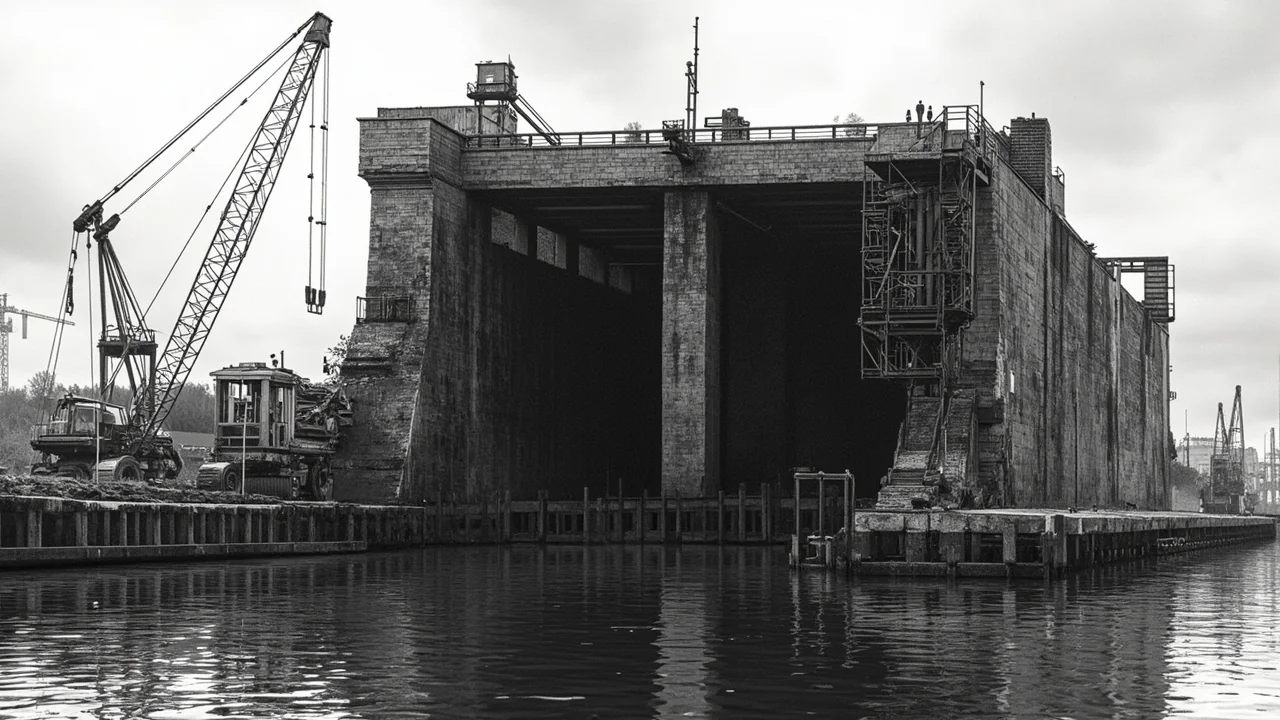
Norway's oldest operating dry dock, a stone-built maritime treasure in Bergen, is at the center of a preservation battle as city planners advance a tram line that could render it obsolete. The 152-year-old structure in Laksevåg still turns a profit servicing ships, but its future hangs in the balance with transformative area development. Local maritime firms and heritage advocates are pleading with authorities to reconsider routes that would encroach on the dock's operation, warning that a key piece of living industrial history could be lost.
A Maritime Relic in Full Swing
Constructed in 1872, the dry dock is the oldest remaining building on the former BMV area in Laksevåg. It is built stone by stone, shaped like a ship's hull, showcasing fine, old traditional craftsmanship. The grey stone masonry has withstood heavy loads for over 150 years. The dock gate and pumping system are also notable features worth preserving. Today, it remains in full, profitable operation, used by both old and modern vessels for inspection, maintenance, and repairs. There is often a waiting list for its services. Knowledge of docking ships with a single pointed keel, like the 'Statsraaden,' is an art that cannot be learned from books, it must be transferred from person to person. This immaterial cultural heritage shows that Laksevåg has a business sector with in-demand, solid maritime competence that also upholds old traditional knowledge.
The Impending Threat from Development
During this spring, the Plan- og bygningsetaten (PBE) is set to present its recommendation for the tram line route westward. It is understood that the alternatives PBE prefers to proceed with go through the narrow Damsgårdsveien and extremely close to the dry dock. This will have consequences for continued use. The City Antiquarian has stated that the dry dock has a very high antiquarian preservation value, both as a single object and as part of an industrial cultural environment. Its authenticity value is also very high, as the dock has been little changed since 1898. However, the City Antiquarian has only an advisory role. Developers' future illustrations show a dry dock without a dock gate, reduced to a water mirror with a footbridge over it. If this happens, it will become impossible to sail into the dock, and one would need a diving suit to view this pearl of a structure entirely. If it does not regularly stand dry, it will soon overgrow with seaweed, kelp, and other marine life.
Economic and Cultural Stakes
The dry dock is not merely a historical artifact, it is a functioning business hub. In 2024, Endúr Maritime, which leases the dry dock, won the contract for the maintenance of the Royal Ship Norway. Simultaneously, there is a severe shortage of professionals within maritime trades. Right here, there are good opportunities for apprentice placements and vocational training. The community cannot understand that only the outline of the dock should be preserved. In their view, it is obvious that the entire construction must be encompassed. Bergen municipality writes that Laksevåg's industrial history should be safeguarded and used as a resource. Advocates believe the dry dock must be central to this. The historical value should also be communicated through, for example, public engagement and education programs.
The Path Forward and Unanswered Questions
As the PBE finalizes its recommendations, stakeholders are urging a solution that integrates the dry dock into the area's transformation rather than sidelining it. Proposals include routing the tram line to avoid proximity issues or designing infrastructure that allows the dock to remain fully operational. The municipality's commitment to preserving Laksevåg's industrial history as a resource will be tested by the choices made in the coming months. Will Bergen honor its maritime roots by finding a way to let this 152-year-old engineering marvel live on, or will progress pave over a piece of living history? The answer will resonate far beyond the fjords, speaking to Norway's priorities in an era of rapid urban change.