
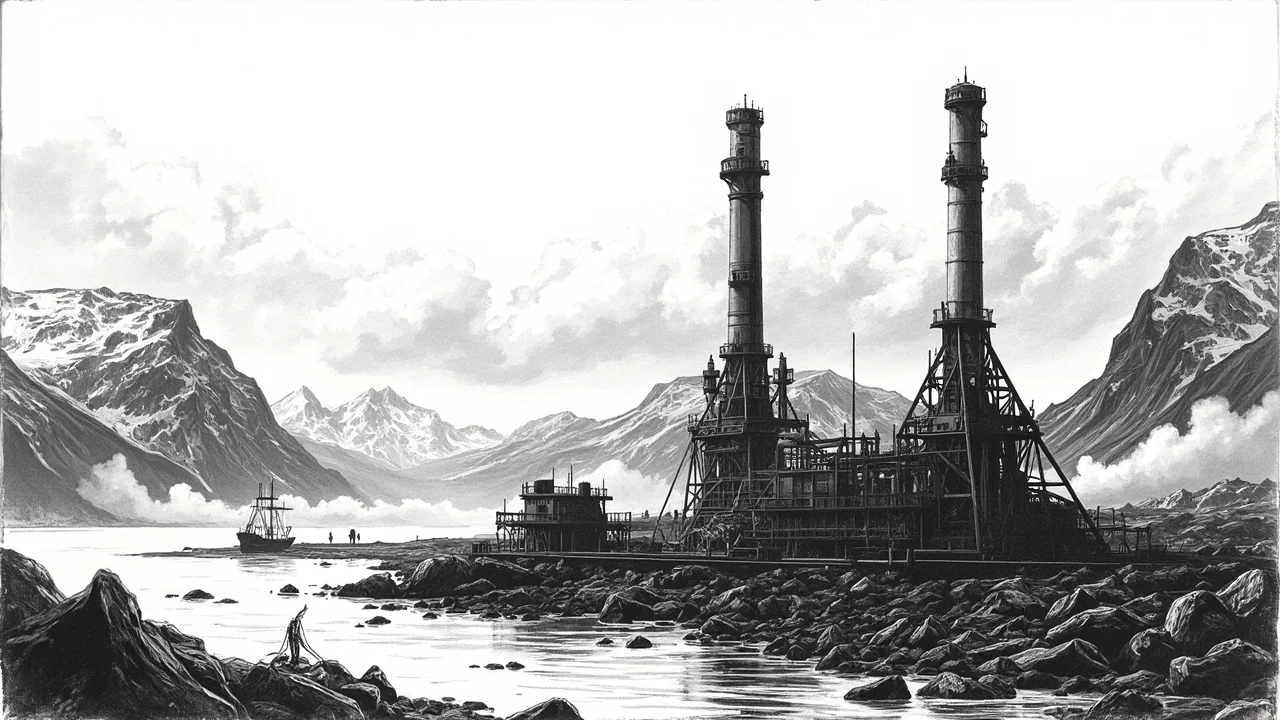
Norway's Socialist Left Party (SV) has reversed its position, allowing energy giant Equinor to keep its dedicated power allocation for the Melkøya gas plant. The surprise move, decided in a party group meeting Wednesday, effectively kills a parliamentary proposal that would have freed up that electricity for other users. This secures the current path for the plant's controversial electrification project, which aims to cut 850,000 tons of CO2 emissions annually by replacing onsite gas turbines with renewable power from the mainland grid.
SV's Deputy Leader Lars Haltbrekken confirmed the party will not support the proposal from the Red Party (Rødt) during Thursday's parliamentary vote. "The problem is that we cannot proceed to adopt things which the minister and the government have no possibility to follow up on," Haltbrekken said in a statement. This reversal strips the proposal of its majority. Last week, a coalition comprising the Progress Party (Frp), the Centre Party (Sp), SV, Rødt, the Green Party (MDG), and the Christian Democrats (KrF), with 89 mandates, signaled support. Without SV's 13 seats, support falls to 80 mandates, below the 85 needed for a Storting majority.
The Core Parliamentary Conflict
The defeated proposal sought to instruct the government to facilitate grid operator Statnett in reallocating the power reserved for Melkøya. This electricity is crucial for the planned 7.8 billion NOK electrification project, approved by the government in 2023. The project is designed to extend the plant's operational life beyond 2050 by replacing its gas-fired generators. If partners on Melkøya, including Equinor, Petoro, TotalEnergies, Neptune Energy, and Wintershall Dea, lost their guaranteed power allocation, a likely alternative would have been the continued operation of the existing, high-emission gas power plant.
Haltbrekken stressed that SV's opposition to the government's broader energy plans for Finnmark county remains firm. The party rejects both new onshore wind farms and gas power with emissions for the region. Instead, they advocate for gas power with carbon capture and storage (CCS) or offshore wind. "We will fight against all the wind farms planned in Finnmark. We will fight for a gas power plant that captures and stores CO2, and we will put forward proposals for that," Haltbrekken stated. When asked about the chances of such a proposal passing, he replied, "That will tomorrow show. But this issue is not decided tomorrow."
The Path Forward for Arctic Gas
The immediate effect is regulatory certainty for Equinor and its partners. They can continue planning the complex technical operation of connecting the Barents Sea facility to the national grid via a subsea cable. However, SV's continued opposition to the government's preferred energy mix for the north signals ongoing political battles. The party's pivot to advocating for CCS-equipped gas power or offshore wind presents a different set of economic and technical challenges. Carbon capture technology remains expensive and unproven at the scale needed for power generation, while offshore wind in the Arctic involves harsh conditions and high costs.
This episode reveals the deep contradictions in Norway's approach to its fossil fuel industry and climate obligations. The state majority-owned Equinor is tasked with both providing Europe with gas and leading the energy transition. The Melkøya electrification project embodies this dual role, aiming to reduce the carbon footprint of fossil fuel extraction itself. The political maneuvering in Oslo this week shows that even projects with clear emission reduction targets remain contentious, caught between national climate goals, local environmental protection, and the realities of Europe's energy security.
The question now is where the political pressure to address power shortages in northern Norway will be directed next. With the Melkøya solution locked in, attention may turn to other proposed power generation projects in Finnmark, setting the stage for new conflicts over onshore wind, grid infrastructure, and the future of industry in the Arctic.