
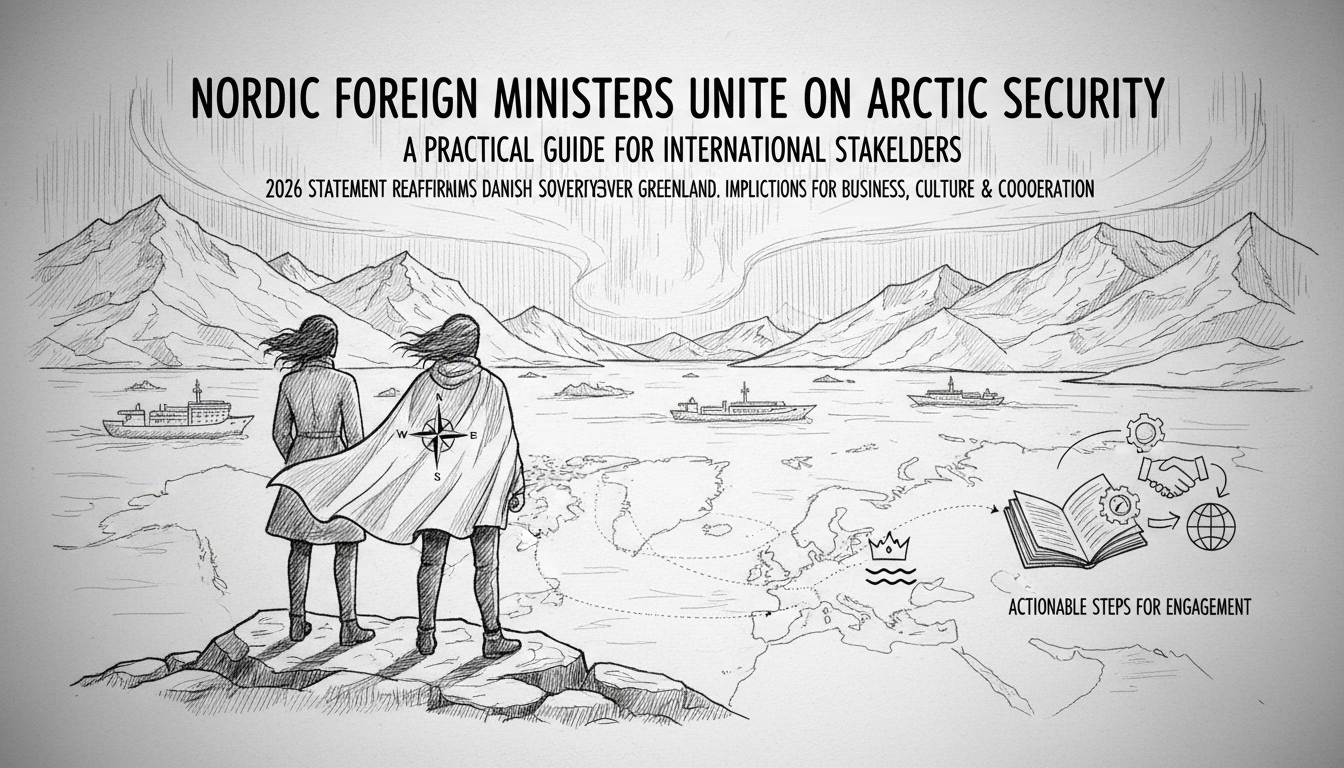
A New Chapter in Nordic Cooperation
Nordic foreign ministers from Denmark, Sweden, Norway, Finland, and Iceland gathered in Copenhagen in January 2026, issuing a landmark joint statement on Arctic security that reaffirms Danish sovereignty over Greenland. This coordinated declaration demonstrates the Nordic model of pragmatic cooperation, where countries with differing security affiliations—Denmark (NATO founding member), Sweden and Finland (NATO applicants), Norway (NATO member outside EU), and Iceland (unique security arrangements)—unite on shared regional priorities. The statement addresses growing international attention to Arctic resources and shipping routes, marking a significant moment for Denmark's foreign policy and broader Nordic regional alignment.
Understanding Denmark's Arctic Position and Nordic Context
Denmark maintains sovereignty over Greenland through the Kingdom of Denmark framework, with Greenland having gained self-government in 2009 while Denmark handles foreign affairs and defense. This 2026 joint statement specifically reaffirms this constitutional relationship. Comparatively, Norway manages Svalbard under the Svalbard Treaty, Sweden and Finland have Arctic territories within their borders, and Iceland focuses on maritime interests. The Nordic approach differs from Russia's militarization or Canada's indigenous partnership model by emphasizing multilateral cooperation, environmental stewardship, and existing legal frameworks.
The Human Impact: Daily Life Connections
As a reporter focused on Danish society, I observe how this Arctic policy connects to daily life in tangible ways. For the approximately 17,000 Greenlanders residing in Danish municipalities (65% in Copenhagen area), this statement affects cultural identity and family ties. Social centers in Copenhagen (like Grønlandske Hus) and Aarhus provide support services, while traditional Greenlandic foods appear in Torvehallerne market. The policy reinforces their unique status—Greenlandic citizens can move freely between Greenland and Denmark without immigration restrictions, accessing healthcare and education equally under the Danish welfare system.
Tools
Call home for less
Save up to 90% on international calls to family and friends.
Links may be monetized via affiliate partners.
Actionable Guidance for International Stakeholders
Step-by-Step Process for Engagement
- Initial Research: Review the full joint statement text available on the Danish Ministry of Foreign Affairs website (um.dk) and Greenland's Self-Government Agreement.
- Document Preparation: Gather required documents including business registration, environmental impact assessments (for resource projects), and compliance plans with Danish/Greenlandic regulations.
- Agency Contact: Engage with the Danish Agency for International Recruitment and Integration (SIRI) for workforce matters, the Danish Environmental Protection Agency for projects, and the Greenlandic Government's Ministry of Mineral Resources for mining interests.
- Timeline: Allow 3-6 months for initial consultations, 6-12 months for permit processing (mining projects may require 18-24 months).
- Costs: No fees for accessing policy documents. Business licensing varies by sector: tourism operators pay approximately 5,000 DKK annually, while mining exploration licenses start at 50,000 DKK plus royalties.
Required Documents
- Joint Statement on Arctic Security (2026)
- Denmark's Arctic Strategy 2021-2030
- Greenland Self-Government Act (2009)
- Nordic Council cooperation agreements
- United Nations Convention on the Law of the Sea (UNCLOS)
Practical Examples and Common Pitfalls
Example 1: A German shipping company planning Arctic routes should first consult the Danish Maritime Authority for updated navigation regulations, then coordinate with Greenland's Port Authority for specific port requirements, anticipating 2-3 months for approval.
Example 2: A Canadian mining firm interested in Greenland's rare earth elements must apply through the Greenlandic Ministry of Mineral Resources, partner with local enterprises (as encouraged by policy), and allocate 20% of positions to Greenlandic workers, with environmental monitoring reports submitted quarterly.
Common Pitfalls to Avoid:
- Mistaking this as new restrictions rather than reaffirmation of existing frameworks
- Overlooking the need for both Danish AND Greenlandic approvals for economic projects
- Assuming uniform Nordic policies—each country maintains distinct Arctic approaches within shared principles
Nordic Unity in Practice: System Rationale
The joint statement exemplifies the Nordic cooperation model where the Nordic Council of Ministers facilitates coordination across environmental protection, cultural exchange, and now Arctic security. This pragmatic approach allows countries with different EU and NATO statuses to present a united front. The system rationale balances national sovereignty with regional solidarity, using consensus-based decision-making rather than supranational authority. Sweden's research expertise, Norway's energy experience, Finland's icebreaker technology, and Iceland's maritime knowledge complement Denmark's sovereign responsibility.
Economic Dimensions and Business Opportunities
The statement clarifies regulatory frameworks: Denmark maintains authority over licensing and regulation for Greenland's mineral resources, ensuring benefits flow to Greenlandic communities. Danish companies like Royal Greenland and Ørsted have established partnerships creating jobs in both regions. International businesses should note: environmental standards are stringent, local partnership requirements exist, and traditional knowledge must be incorporated into projects. Tourism operators developing sustainable Arctic experiences must obtain permits from both Danish and Greenlandic authorities, with typical processing taking 4-8 months.
Security Implications and Environmental Protection
The statement addresses military and environmental security, emphasizing protection of indigenous communities and sustainable development. Melting ice increases shipping through the Northwest Passage, raising environmental risks. The Nordic countries commit to monitoring pollution through established systems like Denmark's Arctic Command and the Nordic Environmental Monitoring Network. Practical measures include mandatory reporting for vessels over 300 tons, oil spill response plans filed with the Danish Environmental Protection Agency, and climate research collaboration through institutions like the University of Copenhagen's Arctic Research Centre.
Educational and Cultural Connections
Approximately 1,200 Greenlandic students study at Danish universities annually through programs like "Learning in Denmark" that provide housing and language support. Cultural institutions bridge communities: the National Museum of Denmark features Greenlandic collections, while Copenhagen's Kulturtårnet hosts annual Greenlandic festivals. Municipal programs in Aarhus (Greenlandic Culture Week) and Odense (school pen-pal programs) build personal connections. These exchanges strengthen the human dimension behind policy decisions.
Future Directions and Practical Implications
The 2026 statement establishes biannual Nordic foreign minister consultations on Arctic matters, with coordination in the Arctic Council. Future initiatives may address search and rescue capabilities (building on Norway's Joint Rescue Coordination Centre North model) and environmental monitoring systems. For international readers: this demonstrates Nordic unity but doesn't create new restrictions. Travel and business continue under existing rules. The primary impact is signaling coordinated approaches that may influence international discussions at forums like the UN Climate Change Conference.
Community Voices and Statistical Context
Greenlandic community leaders in Denmark welcome the statement's recognition of Greenland's importance. Statistics show employment rates for Greenlandic immigrants improving gradually, with educational attainment rising among younger generations. Municipal integration programs in Copenhagen report successful outcomes when combining cultural preservation with practical support. Business associations note potential economic benefits, while environmental groups emphasize the statement's protection measures for fragile Arctic ecosystems.
Essential Contacts and Next Steps
- Policy Questions: Danish Ministry of Foreign Affairs, Arctic Unit (+45 3392 0000)
- Business Inquiries: Danish Business Authority, Greenland Desk (+45 3529 1000)
- Research Collaboration: Danish Polar Secretariat (polar.secretariat@um.dk)
- Community Resources: Grønlandske Hus in Copenhagen (+45 3315 0700)
Next steps include monitoring the Arctic Council meetings (next scheduled October 2026) and the Nordic Council's 2027 Arctic cooperation review. International stakeholders should engage through established diplomatic channels rather than assuming unilateral approaches will succeed in this consensus-based regional framework.
Read more: Denmark's Green Card Scheme: A Strategic Path for Skilled Pr....
Read more: Securing a Danish Student Residence Permit: The Complete Gui....