
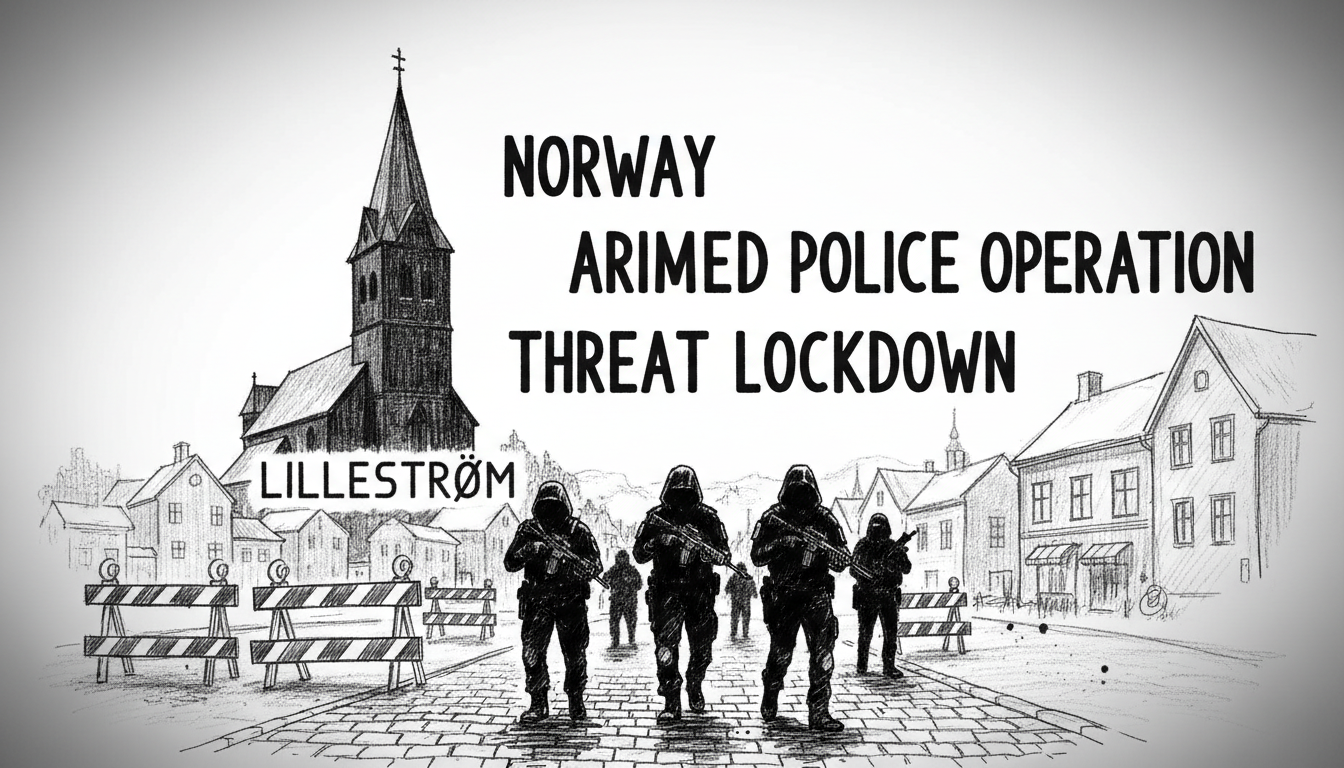
Norway police armed with weapons launched a major operation in Lillestrøm Tuesday evening, responding to what authorities described as an "unclear threat situation." The incident, which saw a significant armed police presence in a residential area, prompted officials to urgently warn the public to stay away from the scene. The operation highlights the rare but decisive protocols activated when Norway's typically unarmed police force perceives a direct danger.
"We do not want people moving toward the site," said operations leader Melissa Krag Mørch of the East Police District in a statement issued just before 8:30 PM. Her directive underscored the seriousness with which police treated the unfolding event. The sight of armed officers in Lillestrøm, a commuter town just northeast of Oslo, is an unusual disruption to the area's normal calm.
A Rare Display of Armed Force
Norwegian police officers do not routinely carry firearms. Their standard equipment consists of a baton, handcuffs, and pepper spray. The decision to deploy armed police is not taken lightly and follows strict national guidelines. It typically requires authorization from a senior officer when intelligence or circumstances indicate a heightened threat level, such as a potential armed suspect or a terror-related warning.
This fundamental principle of Norwegian policing—that officers are public servants first and foremost—makes any armed response immediately noteworthy. "When you see armed police on the streets in Norway, it signals that the police assessment is one of significant and immediate risk," explains security analyst Henrik Lunde. "The system is designed to escalate only when necessary, so an armed deployment automatically commands public attention and caution."
The operation in Lillestrøm mobilized what police termed "large resources," suggesting multiple units and specialized teams were involved. While the exact nature of the threat remains undisclosed, the combination of an armed response, a large-scale mobilization, and a public exclusion zone points to a scenario police believed could involve violence.
Community Impact and Police Strategy
Lillestrøm, with a population of around 22,000, is the administrative heart of its municipality and a key transport hub linking eastern Norway to Oslo. The police operation, centered on a specific address, would have disrupted evening routines for residents in the immediate vicinity. Roads may have been cordoned off, and neighbors likely received instructions to remain indoors.
This community-level disruption is a calculated part of police strategy during such incidents. Securing a perimeter protects both the public and officers, allowing police to manage the threat without the complication of bystanders. The public's general compliance with such instructions in Norway is high, a factor that security experts say is critical to operational success.
"The social contract in Norway is strong. When police ask people to avoid an area, the vast majority do so immediately," says Lunde. "This public cooperation is a force multiplier for the police. It allows them to focus entirely on resolving the threat, knowing the community is heeding their warning."
The incident also tests local emergency coordination. While the East Police District leads the operation, it would involve communication with local municipal crisis staff and potentially the Norwegian Police Security Service (PST) if the threat had any wider implications.
Context of Police Armament in Norway
The debate over arming police in Norway is perennial but has gained specific contours in recent years. Following the 2011 terror attacks in Oslo and Utøya, and the 2022 terror alert in Oslo, there have been calls for a more permanently armed police force. Proponents argue it reduces response time during critical incidents. Opponents maintain it would damage the historically close, low-conflict relationship between the public and police.
Currently, police armaments are stored in locked boxes in patrol cars. Officers can access them after receiving authorization from a duty officer. Furthermore, specific units, like the Emergency Response Unit and the PST's operational teams, are permanently armed. The system represents a compromise, aiming to balance preparedness with the principle of minimum force.
Tuesday's event in Lillestrøm fits within this existing framework. It was a targeted, intelligence or incident-driven response, not a general change in posture. Each such operation is later reviewed internally to assess whether the use of armed officers was justified and proportionate.
Analyzing the 'Unclear Threat'
The police's description of an "unclear threat situation" is a deliberate and careful term. It indicates that while police have information suggesting potential danger—perhaps from a tip, a communication, or observed behavior—the exact parameters are not yet fully known. It could involve a person believed to be armed, a potential hostage situation, or a threat made against a person or institution.
This ambiguity dictates the police's cautious, resource-intensive approach. They must prepare for the worst-case scenario while working to clarify the situation. The armed response is a precaution to ensure officer safety and to have the capability to neutralize a threat instantly if it materializes.
"An 'unclear threat' is one of the most challenging scenarios for police," notes Lunde. "It requires them to deploy substantial resources without the certainty of what they will face. The goal is to contain, gather information, and de-escalate, all while being prepared for a sudden escalation. It is a tense and fluid process."
Resolution and Aftermath
As of this writing, the police operation in Lillestrøm has concluded. The area has been secured, and the immediate threat appears to have been resolved. No reports of injuries or shots fired have emerged, which, given the armed deployment, would be a positive outcome. The police will now shift to an investigative phase, seeking to understand the origins of the threat and whether any charges are warranted.
For local residents, the return to normalcy will be swift, but the memory of armed police on their streets will linger. Such events, while rare, serve as reminders that even in societies with low levels of violence, police must be prepared for acute crises. The incident also demonstrates the procedural chain Norway follows: threat assessment, authorized escalation, public communication, and containment.
The Lillestrøm operation will become another data point in Norway's ongoing conversation about security, policing, and public trust. It tested protocols without, based on initial reports, leading to violence—a scenario that likely aligns with the operational hope of every police commander. The ultimate measure of success in such situations is the protection of life, both public and police, often achieved through a show of force that never has to be used.
Does the sight of armed police in a Norwegian town represent a system working as intended to manage a rare threat, or does it signal a slow erosion of a foundational principle of policing? For the residents of Lillestrøm, the answer on Tuesday night was simply a matter of safety.