
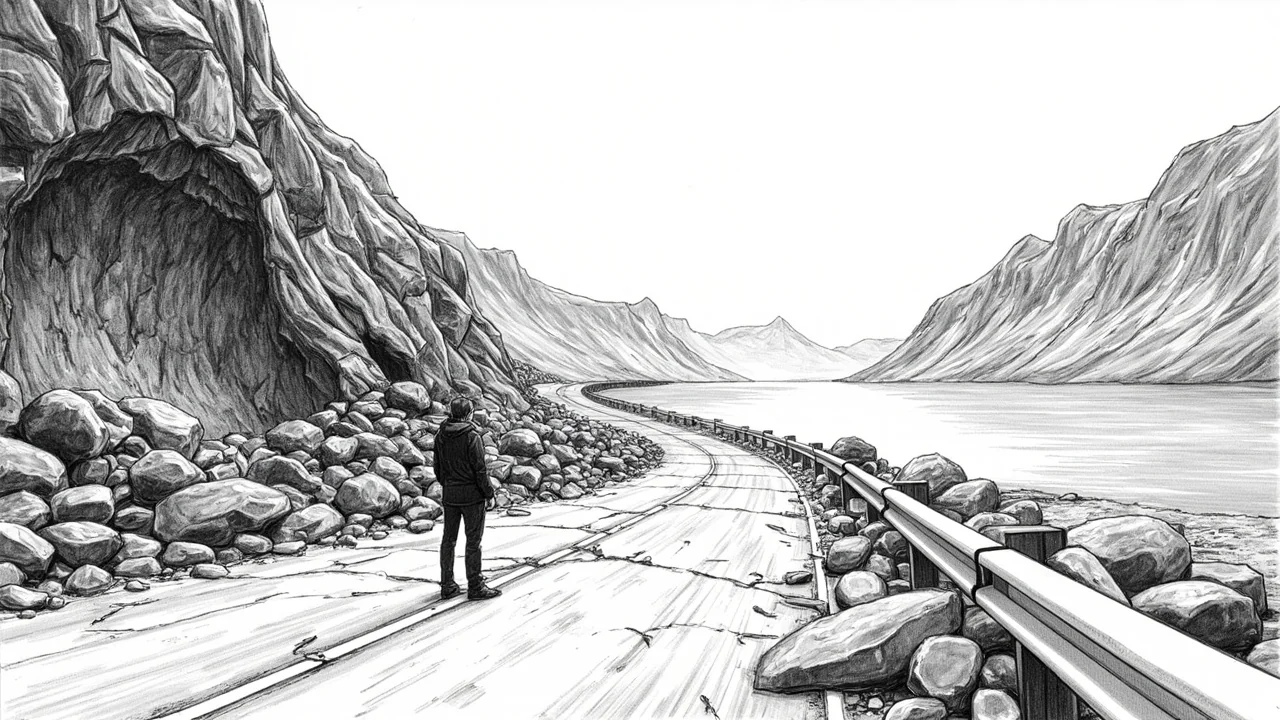
A massive rockslide on E134 Haukelivegen near Fjæra in Etne kommune has forced evacuations and closed one of western Norway's key transport arteries until at least Wednesday. The Sunday morning incident reveals deeper questions about Norway's preparedness for climate-driven geological instability. Source: Norwegian Water Resources and Energy Directorate (NVE) - Landslide Early Warning Service.
Recurring crisis pattern emerges
This isn't Fjæra's first encounter with falling rocks. According to Forbes, some residents have been evacuated 16 times in five years, with both the Rauma Line railway and E134 frequently shuttered. The pattern disrupts local business and tourism in a region already struggling with economic isolation.
Statens vegvesen (Norway's Public Roads Administration) now faces the familiar challenge of clearing "massive kampesteiner" while ensuring slope stability. A geologist's helicopter survey Sunday afternoon confirmed what locals already knew: the mountainside needs extensive clearing of loose rock before residents can return home.
The human cost is immediate and personal. NRK reported that Monica Fjæra and eight others at a nearby cabin experienced "enormous crashes and rumbling" as rocks fell "like balls" around them. Multiple people sought shelter in a roadside tunnel as the slide continued past noon.
Transport network under strain
E134 serves as a critical east-west corridor connecting Bergen to inland Norway. With RV13 as the only viable detour, the closure creates bottlenecks that ripple through freight transport and commuter patterns. The road closure forces traffic through the Hardanger tunnel, adding 90 minutes to Bergen-Oslo freight routes.
Local contractor Ole Rullestad, who assessed the damage for Mesta, found the situation beyond quick fixes. His neighbor's reaction after braking hard to avoid the slide zone illustrates how suddenly these events can trap residents and travelers.
The economic impact extends beyond inconvenience. Hordaland Chamber of Commerce estimates each E134 closure costs regional businesses 2.3 million kroner daily in delayed shipments and missed connections. Tourism operators in Hardanger report 30% booking cancellations when rockfall warnings are issued.
Climate adaptation costs mount
Norge geologiske undersøkelse (NGU) data shows rockfall incidents have increased 40% since 2015 as freeze-thaw cycles intensify. Traditional slope stabilization methods prove inadequate against accelerating weathering patterns.
The government faces stark choices. Permanent relocation assistance for Fjæra's 47 residents would cost an estimated 150 million kroner. Alternative route construction through stable terrain could reach 2 billion kroner. Neither option appears in current Stortinget infrastructure planning.
Meanwhile, residents live with monthly evacuation alerts. Insurance companies have begun excluding rockfall damage from standard policies, leaving homeowners exposed to total loss.
With 16 evacuations in five years and geological surveys predicting increased instability, Norway's mountain communities are becoming uninsurable and potentially uninhabitable. Expect similar closures to multiply as the 2025 infrastructure budget allocates only 400 million kroner nationwide for rockfall prevention - less than the cost of a single major highway rerouting project.
Read more: Norway TB Case Exposes Kindergarten Health Gaps.
Read more: Norway PM Spouse Stock Scandal Exposes Elite Accountability ....