
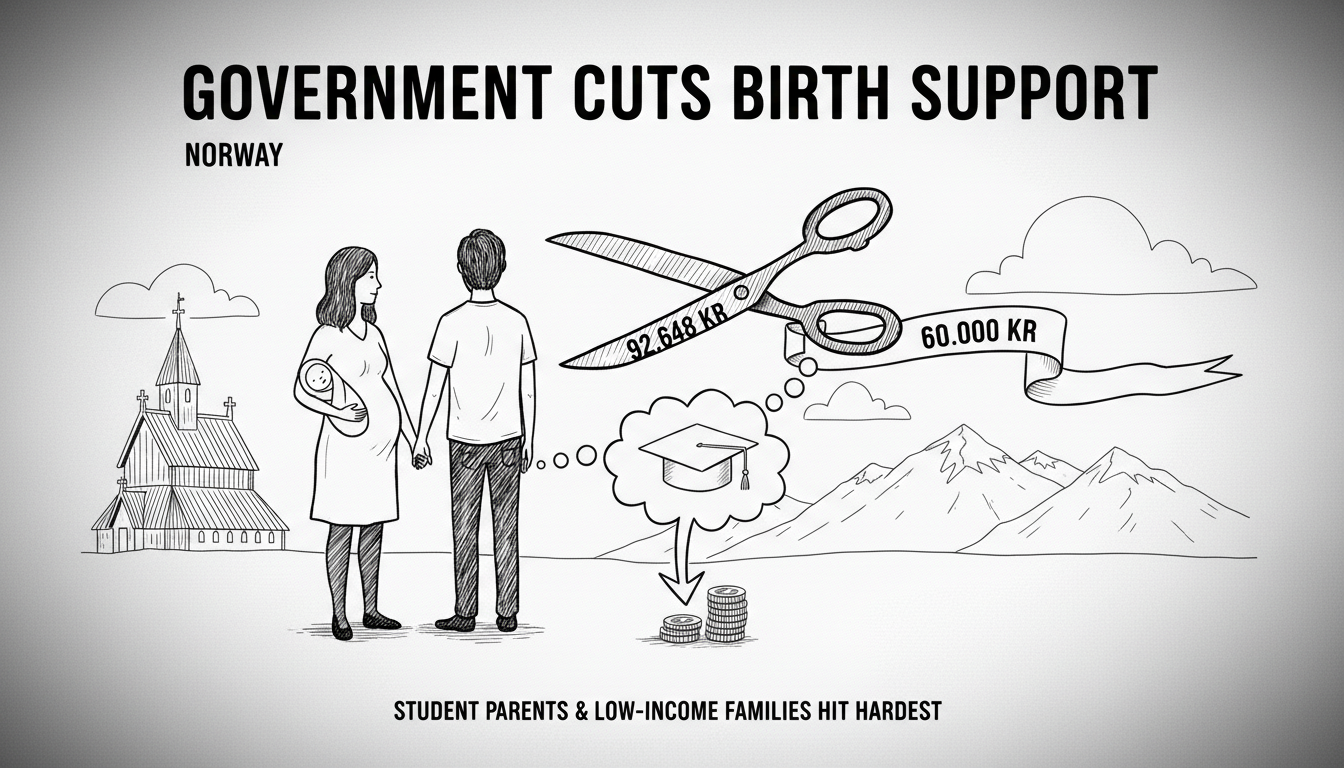
The Norwegian government plans to slash the one-time birth support payment from 92,648 kroner to 60,000 kroner. This represents a 35% reduction for parents who don't qualify for parental leave benefits.
Magnhild Jenssen, a psychology student in Bodø, relied on this payment when she had her first child in 2022. She wasn't working enough to qualify for paid parental leave.
"The payment was what we survived on," Jenssen said. "The stroller alone cost 15,000 kroner. After that we had maybe 60,000 left to live on during the leave period. It wasn't much."
She worries about the proposed cuts. "If I'd only received 60,000, I wouldn't have had a chance. I would have had to borrow money, take work during leave, or postpone having children."
The government justifies the cut by citing research from SIFO, Norway's Consumer Research Institute. Their reference budget estimates first-year baby costs at 57,000 kroner.
But the researchers behind these numbers say the government is misusing their data.
Andreea Ioana Alecu, a SIFO researcher who leads the budget project, expressed concern. "The reference budget cannot give a complete picture of the costs of having a child," she said.
The budget assumes households have good health and stable conditions. It excludes major expenses like housing, electricity, and shared household costs.
"For families in the establishment phase, our numbers will most likely be an underestimate," Alecu explained.
The budget also assumes many items are already in place. It doesn't account for major first-time purchases or the mother's needs before and after birth.
Alecu questioned whether the proposal would pass if more factors were considered. "Would this proposal have passed if they accounted for establishment, health, and the mother's needs?"
Student organizations are reacting strongly. The Norwegian Student Organization says the cut will hit student parents and recent graduates hardest.
NSO leader Sigve Næss Røtvold called the reduction dramatic. "The government says they want more children, but they cut support for those who have the least. It's very disappointing."
A student survey shows 11% of students want children during their studies, but only 5% plan for it. Economy is cited as the main reason.
Professor Anne Eskild, a chief physician at Akershus University Hospital, strongly opposes the proposal.
"It will obviously affect women with the lowest income," Eskild said. "They're already struggling enough, and I think it's strange that a Labor Party government would make it harder for those with least to have children."
She pointed to major disparities in the current system. A family without parental leave rights might get 60,000 kroner, while a high-income family can receive over one million kroner.
"It's the state valuing children so differently from birth," Eskild noted.
She believes this creates insecurity and affects birth rates. Many women delay their first child until approaching 30 to secure employment, and some choose abortion due to financial constraints.
Eskild criticized how parental rights are tied to workforce participation. "To do the most important work in society - having children - you first must be in paid work. That's meaningless."
Children and Family Minister Lene Vågslid defended the proposal in an email statement.
"Parental benefits should compensate for lost work income," she wrote. "The one-time payment should cover expenses for having children for those who haven't earned the right to parental benefits."
Vågslid said the government wants to link the payment more closely to actual first-year expenses, pointing to SIFO's reference budget.
She emphasized that the government prioritizes families through increased child benefits, free after-school programs, and reduced kindergarten prices.
"The most important measure to reduce the number of children in low-income families is to get more people into work," the minister stated. "Work is the key to welfare, participation, and security."
The ministry clarified that the proposal covers only the child's first-year expenses, including baby equipment and ongoing costs like food and clothing.
With the child benefit included, the total first-year support would be 83,616 kroner under the new proposal. This exceeds SIFO's reference budget for child expenses.
The government's approach appears contradictory - claiming to support families while cutting direct financial support to those most vulnerable. This comes as many young Norwegians already delay childbearing due to economic concerns.