
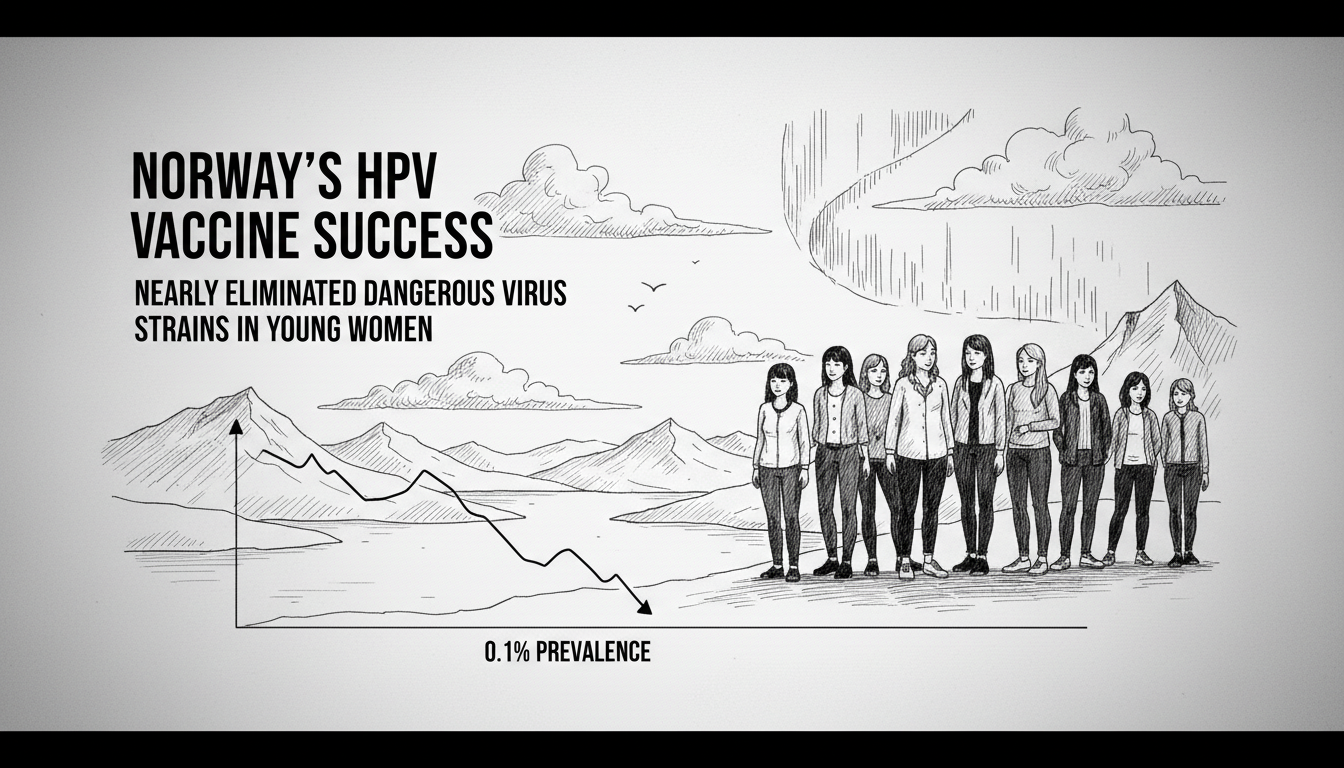
Norway's national vaccination program against the human papillomavirus has achieved a landmark public health victory. The most cancer-causing HPV strains are now nearly eradicated among the first generation of vaccinated women. This outcome carries profound implications for national healthcare costs and long-term cancer prevention strategies.
The Norwegian Institute of Public Health released the latest screening data. Women born between 1997 and 1999 received the HPV vaccine as part of the national program. They are now between 25 and 27 years old. These women were invited for cervical cancer screening through the national Cervical Cancer Screening Programme.
More than 100,000 women were eligible for this follow-up screening. Around 70,000 have participated so far. The results are striking. The prevalence of HPV types 16 and 18 has fallen below 0.1 percent in this vaccinated cohort. These two strains are responsible for the majority of cervical cancer cases globally. Their near-elimination represents a direct success of the vaccination strategy.
This public health achievement did not happen by accident. Norway implemented a systematic, school-based vaccination program for girls starting in 2009. The program's design ensured high coverage from the outset. It was integrated into the existing childhood immunization schedule. This approach minimized barriers to access and maximized public trust. The data now proves the wisdom of that investment.
The financial and human impact is substantial. Treating advanced cervical cancer is incredibly costly for the national health service. It involves surgery, radiation, and long-term follow-up care. Preventing these cases through vaccination frees up significant resources within the Norwegian healthcare system. These resources can be redirected to other pressing medical needs. The human benefit is, of course, immeasurable. It means thousands of women will avoid a terrifying diagnosis and grueling treatment.
What does this mean for the future of cancer screening in Norway? Health authorities now face a new set of policy questions. Screening protocols may need revision as the vaccinated population ages. The very high cost-effectiveness of the vaccine program strengthens the case for including boys in vaccination. Several Nordic neighbors have already adopted gender-neutral HPV vaccination. Norway's data provides a powerful evidence base for considering a similar policy shift.
The success also highlights the importance of long-term public health planning. Norwegian policymakers made a decision with a payoff horizon of decades. They funded a program whose full benefits would not be visible for a generation. This requires political courage and a commitment to evidence-based medicine. The result is a quieter, more profound victory than daily political headlines. It is a testament to the value of stable, well-administered public institutions like the Norwegian Institute of Public Health.
For international observers, Norway's experience offers a clear blueprint. High vaccine coverage, sustained over time, can drastically reduce the burden of HPV-related cancers. The Nordic model of centralized, publicly-funded healthcare delivery was crucial to this outcome. It allowed for uniform program implementation and comprehensive data collection. Other nations looking to replicate this success must consider not just the vaccine itself, but the system required to deliver it effectively to an entire generation.