
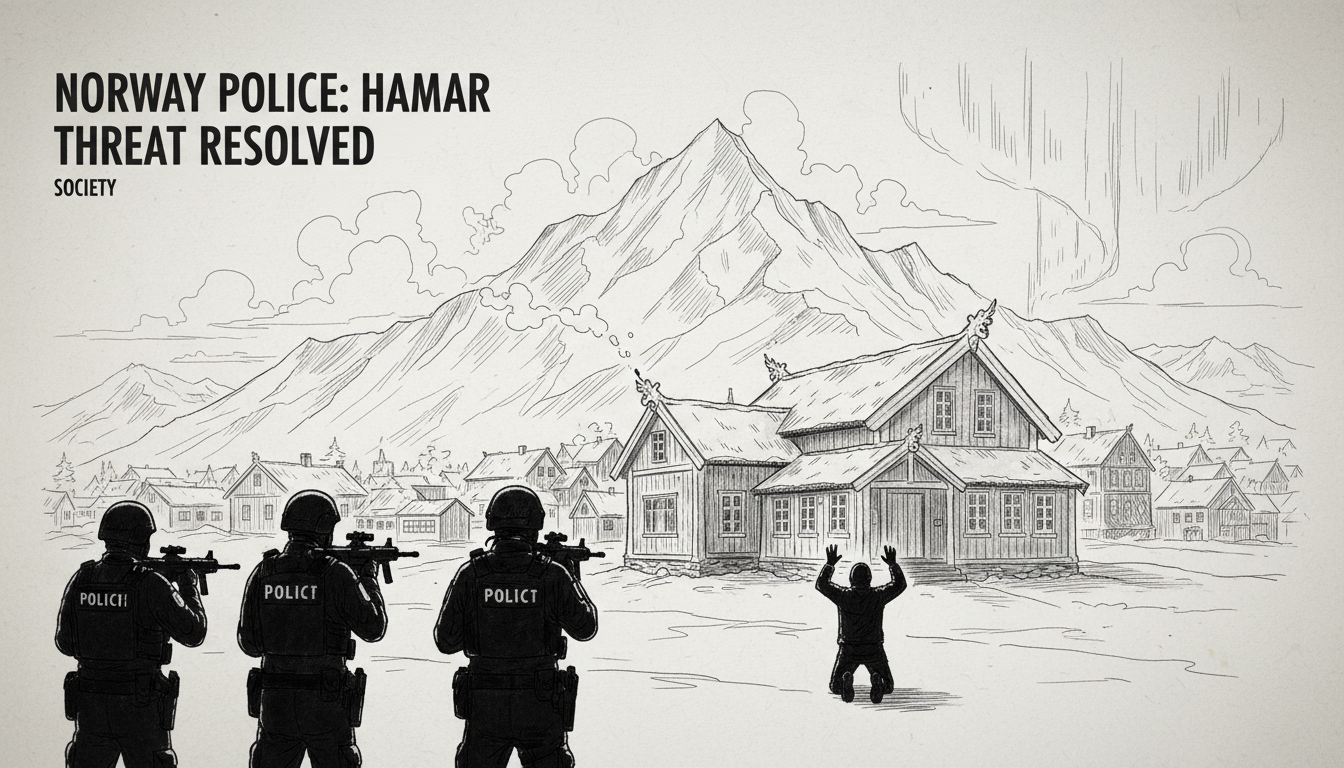
Norway police discharged a warning shot in Hamar on Monday, resolving a threat situation without injury. The Innlandet Police District confirmed officers had taken control of one individual, stating there was no danger to the public. The incident, which concluded by late afternoon, highlights the exceptional nature of armed police response in a country where officers are typically unarmed.
Operational commander Jannicke Silseth Eide issued a statement at 4:30 PM local time. "No one is injured and there is no danger to third parties," she wrote. Fifteen minutes later, police updated the public, confirming they had secured one person and that no other individuals were involved. The swift resolution prevented escalation in the municipality, located roughly 130 kilometers north of Oslo.
A Rare Escalation of Force
The discharge of a police firearm in Norway is an uncommon event, governed by strict national regulations. Norwegian police officers do not routinely carry sidearms. They retrieve firearms from locked safes in patrol vehicles only when a specific threat assessment authorizes their use. This protocol makes any warning shot a significant escalation, automatically triggering a mandatory internal investigation.
"The use of firearms is the absolute last resort in Norwegian policing," explains a former senior police advisor, who spoke on condition of anonymity due to the ongoing inquiry. "A warning shot is itself a serious use of force. It signifies that officers perceived an immediate threat that required a powerful, audible deterrent before considering aimed fire." The investigation by the Innlandet district will scrutinize whether the threat level justified retrieving weapons and if the warning shot followed correct procedure.
The Calm After the Incident
By Monday evening, calm had returned to the address in Hamar. Police cordons were lifted, and the scene was secured. The identity of the individual in police custody has not been released, nor have the specific nature of the threats that prompted the armed response. Under Norwegian law, details may remain confidential during the initial investigation phase.
The Innlandet Police District, one of Norway's largest geographically, covers vast rural and urban areas. Its officers are trained for a wide spectrum of incidents, from domestic disputes in remote valleys to public order situations in towns like Hamar, with its 30,000 residents. This training emphasizes de-escalation and communication, making the decision to fire a shot a profound departure from standard practice.
Local residents reported hearing the single shot but described a subsequent police operation that was measured and controlled. There were no reports of panic or public disturbance following the incident, a testament to the police's clear communication and the public's general trust in law enforcement institutions.
The Broader Context of Police Armament
This event in Hamar reignites a perennial debate in Norway about police armament. The traditional model of largely unarmed officers is deeply ingrained, reflecting societal values of trust and low aggression. However, isolated high-profile incidents, including a 2022 shooting in Oslo, have led some to call for a more permanent armed capability.
Proponents of the current system argue that the rarity of firearm use proves its effectiveness. It forces a deliberate decision-making process, reducing impulsive reactions. The system is designed to prevent tragedies seen in countries with routinely armed police. Critics, however, suggest that the time taken to retrieve weapons from vehicles could delay response in a fast-moving, critical situation.
"The Hamar incident will be studied closely by both sides of this debate," says a professor of criminology at the University of Oslo. "For one side, it shows the system working: a threat was contained with a warning shot, no one was hurt, and the situation was resolved. For the other, it is an example of a scenario that required immediate armed readiness. The investigation's findings on the timeline will be critical."
Protocols and Public Trust
Every instance of police firearm discharge undergoes a multi-layered review. The local district conducts an initial internal investigation. The Norwegian Bureau for the Investigation of Police Affairs may also review cases involving injury or death. This transparent, albeit slow, process is intended to maintain public confidence.
Norwegian police operate under a principle of proportional force. A warning shot sits on a specific rung of this ladder. It is considered a use of force intended to gain control without causing physical injury. Its deployment signals that officers judged the situation as severe enough to warrant this step but not so immediate as to require shooting at a person.
Public trust in Norway remains high compared to international averages. Events like the one in Hamar test that trust, but the structured response and immediate transparency—confirming no injuries and public safety—are designed to reinforce it. The police's clear, timely statements via official channels helped manage public perception and prevent misinformation.
Looking Ahead: Investigation and Implications
The coming weeks will see the Innlandet Police District complete its internal review. Key questions will include the intelligence that led officers to arm themselves, the communication attempts made before the warning shot, and the exact nature of the threat posed by the individual. The findings, though not all made public, will inform future training and operational guidelines.
For the community of Hamar, life has quickly returned to normal. The incident, while startling, appears as an isolated event contained by professional police work. It serves as a reminder of the challenges law enforcement faces, even in one of the world's safest nations, and of the robust systems Norway has in place to manage crisis moments with restraint.
Does Norway's model of selectively armed police, tested again in Hamar, strike the right balance between officer safety and public trust? The answer depends on a society's appetite for risk and its fundamental view of police authority. For now, the system's outcome—a resolved threat with no physical harm—will be cited as evidence of its continued viability.