
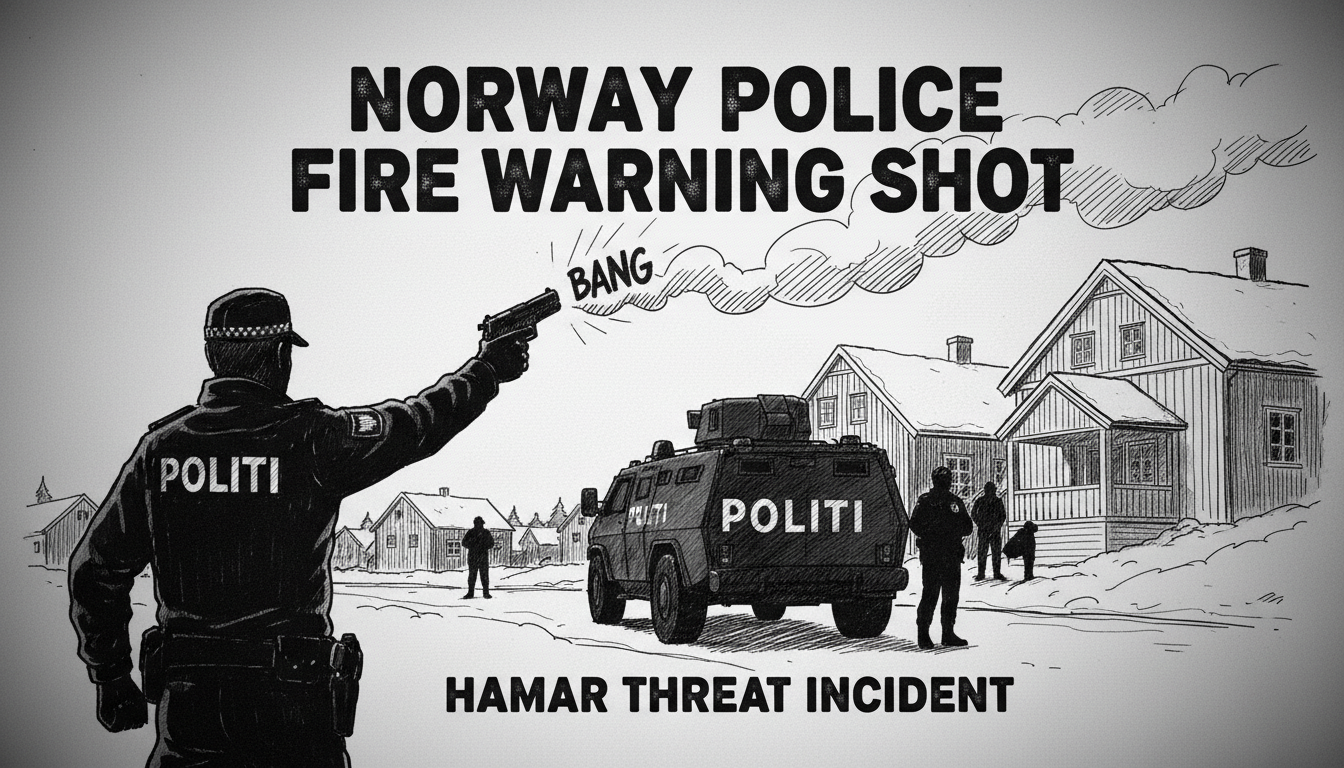
Norway police fired a warning shot to gain control of a threat situation at an address in Hamar on Monday afternoon. The incident, which involved multiple police resources, resulted in one person being taken into custody. No injuries were reported, and authorities stated there is no ongoing danger to the public.
"No one is injured and there is no danger to third parties," said operations manager Jannicke Silseth Eide in a statement. Police confirmed they have control of one person connected to the event and that no other individuals are involved. The discharge of a firearm by Norwegian police is a rare event that triggers automatic internal review procedures.
A Rare Escalation in Norwegian Policing
The use of a warning shot in Hamar represents a significant escalation in police response by Norwegian standards. Police in Norway carry firearms but operate under some of the world's strictest use-of-force regulations. These rules emphasize de-escalation, proportionality, and the absolute minimization of harm. An officer drawing their weapon, let alone discharging it, typically indicates a scenario where an immediate and serious threat to life has been perceived.
"The firing of a warning shot is not a routine measure. It is used in very specific circumstances where there is an acute threat that cannot be contained by other means, and where firing at a person is not yet justified or necessary," explains Professor John Christian Elden, a legal expert familiar with police procedures. "It serves as a powerful auditory signal meant to shock and halt a threatening individual's actions."
Every instance where a police firearm is discharged is subject to a mandatory internal investigation by the Norwegian Bureau for the Investigation of Police Affairs, known as Sivilrettsforetaket. This independent body examines whether the officer's actions complied with legal statutes and internal guidelines. The process is rigorous, reflecting a societal expectation that police use of lethal force is a last resort.
The Hamar Incident and National Context
The incident unfolded at a specific address in Hamar, a city of approximately 30,000 residents located on the shores of Lake Mjøsa, about 130 kilometers north of Oslo. Local police mobilized several resources to the scene in response to what they officially termed a "threat situation." While details remain sparse during the initial investigation, the confirmation of a warning shot points to a dynamic and volatile event.
Norwegian police are trained extensively in communication and conflict resolution. The standard operational toolkit includes pepper spray, batons, and Tasers, with firearms seen as a final defensive option. Statistics show that Norwegian police rarely fire their weapons. In a typical year, officers might draw their firearms a few dozen times nationally, with actual shots fired occurring only in a handful of incidents. Most of these involve warning shots, not shots aimed at individuals.
This stands in stark contrast to policing in many other Western nations. The low frequency of firearm use is a point of professional pride and a reflection of a policing philosophy built on citizen trust and a generally unarmed populace. Incidents like the one in Hamar therefore capture significant attention precisely because they are exceptional.
Procedures and Aftermath of a Police Shooting
Following the secured scene in Hamar, a multi-stage process begins. The involved officers will provide initial statements and are typically placed on administrative duties during the preliminary fact-finding phase. The independent investigators will secure the scene, collect ballistic evidence, interview witnesses, and review any available bodycam or other footage.
The investigation will seek to answer several key questions: What was the precise nature of the threat? Did the individual in custody possess a weapon? What de-escalation tactics were attempted prior to the decision to fire a warning shot? Was the discharge of the firearm a proportional and necessary action to neutralize the threat and protect life?
"The legal standard is one of necessity and proportionality," says Professor Elden. "The investigation will reconstruct the seconds leading up to the shot to determine if the officer's assessment of imminent danger was reasonable. The fact that it was a warning shot, and that no one was injured, will be central facts, but they do not automatically mean the action was justified. Each step is scrutinized."
The individual taken into custody will face charges related to the original threat that prompted the police response. Their actions will be examined separately by the criminal justice system. The police's use of force, however, is judged on its own separate legal and administrative track.
Societal Impact and the Trust Imperative
Events where police fire weapons resonate deeply in Norway. They touch on the fundamental social contract between the state's monopoly on force and the citizenry. High trust in police is a cornerstone of Norwegian society, built over decades through a community-oriented policing model. That trust is maintained through transparency and accountability when force is used.
Public reactions to such incidents are often measured. There is an understanding that police work can involve dangerous situations requiring split-second decisions. However, there is also an unwavering expectation that every such decision will be thoroughly examined. News coverage focuses not only on the event itself but on the investigative process that follows.
This model has contributed to Norway's consistently high rankings in global surveys of public trust in institutions. It creates a feedback loop: police are trusted to use extreme restraint, and when they must use force, the transparent investigation process reinforces public confidence that the system works.
Looking Ahead: Investigation and Answers
The immediate situation in Hamar is contained. One person is in custody, the scene is secure, and the public is not at risk. The longer process of accountability and understanding is now beginning. The independent investigation will take weeks or months to complete its report, which will eventually be made public.
Key details about the nature of the threat—whether it involved a weapon, the mental state of the individual involved, and the precise sequence of police actions—will emerge through this official channel. The police district involved will also likely conduct its own internal review of tactics and resource deployment.
For the residents of Hamar and observers across Norway, the incident serves as a sobering reminder that even in one of the world's safest countries, police can face moments of extreme peril. It also reaffirms the robust systems in place to ensure that when the threshold for using a firearm is crossed, it is done within a strict framework of law, necessity, and ultimate public accountability. The echo of that warning shot in Hamar will now be followed by the meticulous work of investigators, ensuring that sound judgment prevailed in a moment of crisis.