
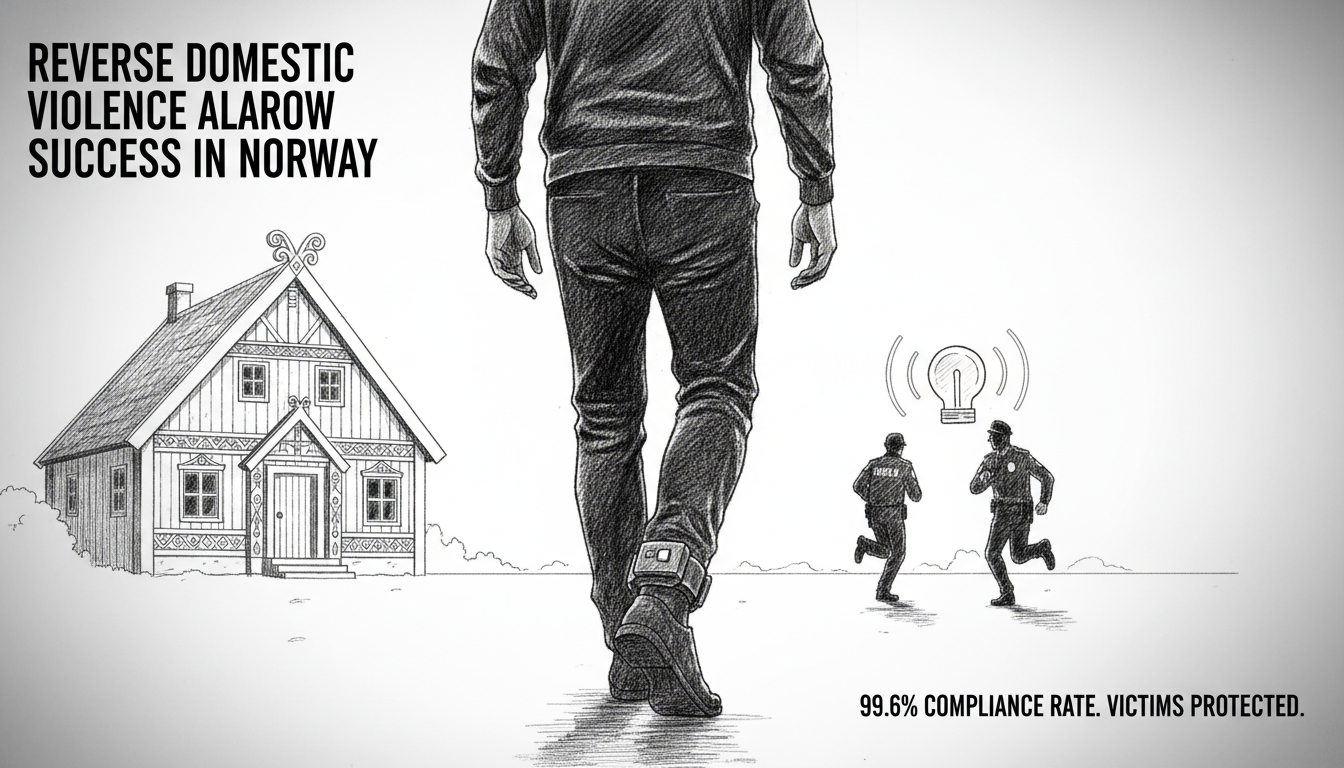
A Norwegian program using electronic ankle monitors to protect victims of domestic violence is proving highly effective. Only two individuals out of 546 monitored have attempted to breach their exclusion zones since a key legal change last year. Both attempts on the country's populous Austlandet region were intercepted by police before the protected person was reached. Officials and legal experts call the system a success, noting it shifts the burden of protection from the victim to the state.
Hans Christian Dragvoll, the national professional manager for the system within the police, explained its preventive power. 'The reverse violence alarm works very well in almost all cases,' Dragvoll said. 'It gives police a real chance to protect the victim. The person with the ankle monitor knows police are constantly checking they stay within the zone.' The system, known as 'omvendt voldsalarm,' triggers an alert to police operations centers if the wearer enters a prohibited geographic area. Police then see the perpetrator's location on a map and can intervene.
For comparison, standard violence alarms, worn by victims, have been triggered 217 times so far this year. The reverse system represents a fundamental shift in approach. Lawyer Lise Ligaard, who has represented both victims and those subjected to the monitors, called the tool 'very useful' and 'consistently effective.' 'For the victim, the measure brings almost exclusively benefits,' Ligaard noted. 'It is far less burdensome than a traditional alarm because the responsibility to react moves from the vulnerable person to the police.'
The legal framework for these orders has expanded. Since April, prosecutors have gained the authority to impose electronic monitoring alongside a restraining order for up to one year as a preventive measure. Courts can also impose it as an additional penalty for up to five years following a conviction, such as for a violent crime. This expansion aims to address a chronic problem where restraining orders are repeatedly violated without consequence, a situation Oslo Crisis Center's section leader Torill Halvorsen called a serious risk. 'In the worst case, it can lead to murder,' Halvorsen stated, expressing a desire for the tool to be used even more widely.
The measure is not without significant impact on the monitored individual. Exclusion zones can be extensive, sometimes covering entire cities like Oslo or even larger regions of South Norway, to give police time to respond to an alarm. In densely populated areas like Austlandet, zones range from 600 to 1,000 square kilometers. 'This is quite intrusive? Yes, it is,' acknowledged Dragvoll. 'But previously, it was the victim who had to move.' Monitored individuals may be forced to relocate or even quit their jobs if they live or work near the protected person. The equipment requires charging, consistent GPS coverage, and strict adherence to movement limits, necessitating regular legal reviews of its necessity.
This policy reflects a broader Norwegian commitment to state-led social protection and technological solutions within the justice system. The low breach rate suggests the psychological and practical barrier created by constant electronic surveillance is a powerful deterrent. The program's success will likely fuel debates in other Nordic and European nations grappling with how to effectively enforce restraining orders and prevent domestic violence tragedies. The data indicates that proactive, perpetrator-focused monitoring can be a more effective shield than reactive measures placed on victims.