
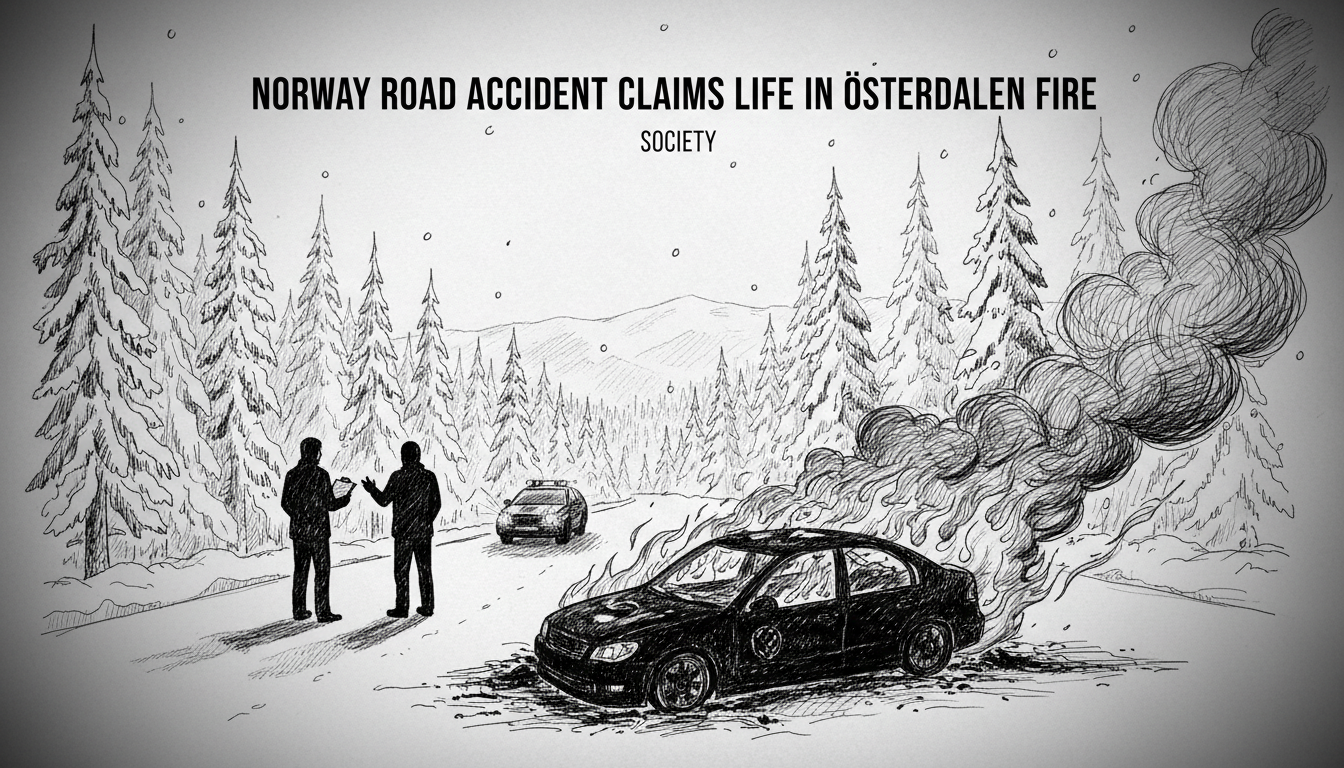
Norway road accident investigators are probing a fatal crash on a regional road in Østerdalen that ended in an explosive vehicle fire. A single person died in the incident on County Road 2142 east of Rena on Sunday evening. Emergency services described arriving to find the vehicle engulfed in intense flames, making rescue impossible. The victim's next of kin have been notified, police confirmed.
A Sudden and Fatal Blaze
The crash occurred on Fv. 2142, a regional road serving the communities of Østerdalen. Police reports state the vehicle was already consumed by what responders termed an "explosive fire" upon their arrival. The rapid and severe nature of the blaze prevented any attempt to extract the occupant. The exact cause of the initial collision and the subsequent fire remains under investigation by local authorities and forensic traffic specialists. This stretch of road, like many in rural Norway, winds through varied terrain, presenting challenges for drivers.
The Persistent Challenge of Rural Road Safety
This tragedy highlights an ongoing national concern. While Norway boasts one of the world's lowest road fatality rates per capita, accidents in remote areas often have graver outcomes due to longer emergency response times and more complex rescue logistics. The vast distances and sometimes demanding road conditions in regions like Østerdalen add layers of risk. A vehicle fire dramatically compounds these dangers, reducing the window for survival and complicating the work of first responders. The Norwegian Public Roads Administration has long focused on improving safety on such regional networks through better signage, guardrails, and road surface treatments.
The Numbers Behind the Headlines
In 2023, 118 people lost their lives on Norwegian roads. The same year saw 625 people suffer serious injuries in traffic accidents. These figures represent a long-term downward trend, a result of decades of concerted safety campaigns, stricter enforcement, and vehicle technological advances. However, each number remains a profound personal tragedy. Experts note that single-vehicle accidents, particularly those involving fire, are among the most difficult to mitigate. The final statistics for 2024 will now include this incident from Åmot municipality.
Expert Analysis on Risk Factors
Road safety researchers frequently cite a confluence of factors in rural accidents. "Driver fatigue on long, monotonous stretches, variable speed adaptation to changing conditions, and momentary lapses in attention are recurring themes," explains a senior analyst with the Institute of Transport Economics. "When a collision leads to a fuel leak and ignition, the situation becomes catastrophic within seconds. Modern vehicles have numerous safety features to prevent fires, but a high-energy impact can compromise these systems." The analyst emphasized that while emergency services in Norway are highly trained, their effectiveness depends on reaching the scene in time—a race against the clock that is lengthened by remote geography.
Community Impact and Emergency Response
For small communities like those in Østerdalen, such incidents resonate deeply. The victim was likely known locally, and the sudden loss affects the entire social fabric. The police, fire services, and medical personnel who responded face the difficult task of managing a traumatic scene while beginning the investigative process. Their rapid deployment to County Road 2142 underscores the preparedness of Norway's decentralized emergency systems, yet the outcome reminds us of their operational limits. The psychological support services for both the bereaved families and the responders are a critical, though less visible, part of the aftermath.
A National Priority with Local Consequences
Norway's Vision Zero policy—the goal that no one should be killed or seriously injured in road traffic—frames the government's approach. This strategy involves continuous improvement of infrastructure, vehicle safety standards, and driver education. Investments in safer road designs, such as removing dangerous roadside obstacles and building more roundabouts, have proven effective. However, retrofitting every kilometer of regional road across a nation of Norway's topography is a monumental, ongoing task. This fatal fire on Fv. 2142 will likely prompt a fresh safety review of that specific route by local road authorities.
The Road Ahead for Safety
The investigation will seek to determine the precise sequence of events. Specialists will examine vehicle wreckage, road marks, and any available witness statements or camera footage. Their findings contribute to a national database used to identify recurring accident patterns and inform future safety measures. For the public, the takeaway is a somber reminder of the inherent risks of mobility, magnified on quieter roads where drivers may feel a false sense of security. The promise of autonomous emergency braking and other advanced driver-assistance systems offers hope for the future, but their widespread penetration into Norway's vehicle fleet, especially in rural areas, will take years.
As the sun sets over the forests of Østerdalen, a stretch of Fv. 2142 remains closed, marked by tragedy. The incident is a stark data point in Norway's relentless pursuit of perfect road safety—a goal that remains just out of reach, measured in individual lives.