
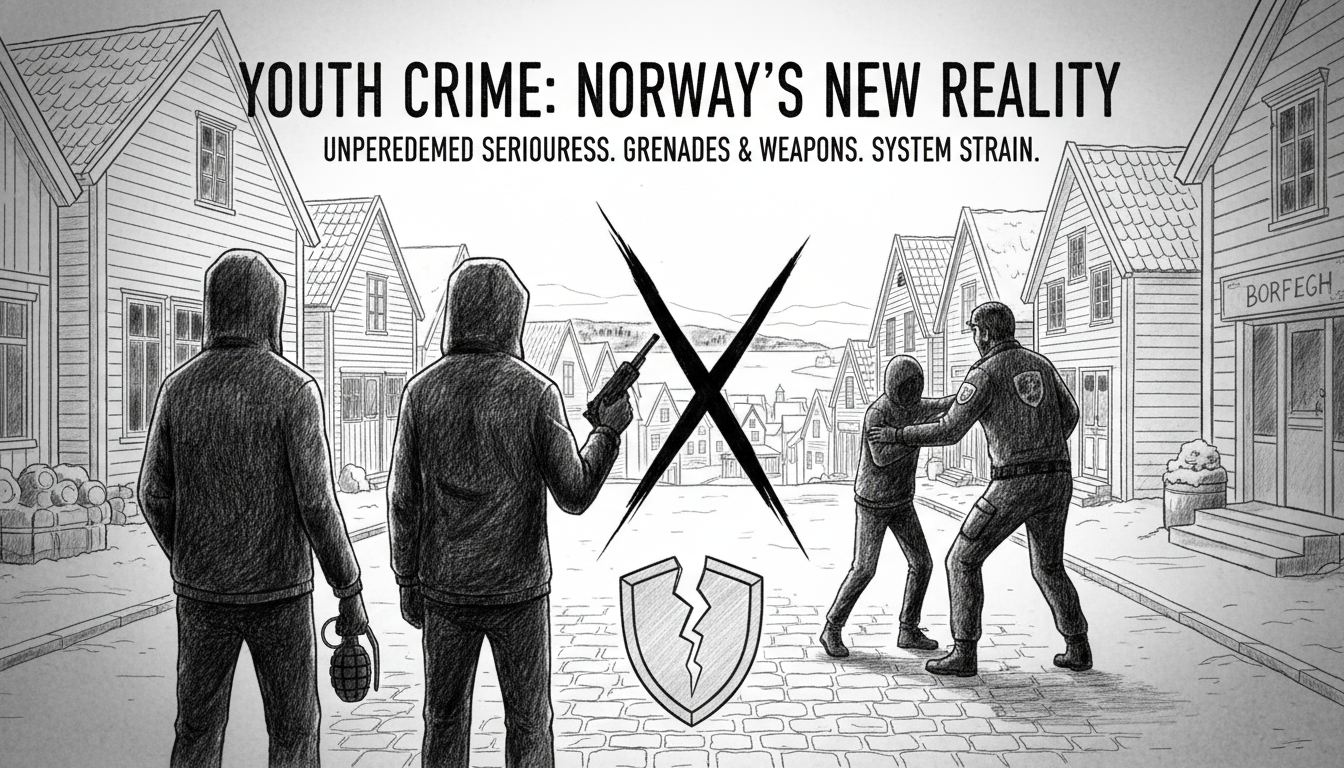
Youth crime in Norway's eastern region has escalated to unprecedented levels. Authorities report a double-digit number of children involved in serious criminal incidents within recent weeks.
Children below Norway's criminal age of responsibility, which is 15 years, cannot face legal punishment. When they commit serious offenses, they enter an already strained child protection system.
Kjetil Andreas Ostling, director of Oslo's child and family services, expressed deep concern about the situation. "We are worried, like everyone else," he stated. "Serious violent incidents among youth in Oslo have occurred for some time, but the development involving grenades and similar weapons marks a new and more serious level."
Oslo's child protection services currently manage to follow up with "the vast majority" of youth committing serious crimes, according to Ostling. He noted that institutions provide close monitoring through movement restrictions and high staff density.
However, the rising youth crime creates increased pressure on these facilities. The municipality has already taken steps to address the growing need.
Last year's analysis predicted increased demand for treatment placements for youth both under and above the criminal age. The forecast also suggested slightly lower need for care places. Consequently, authorities converted one care institution into a treatment facility scheduled to open at year's end.
Ostling explained that child protection services continuously work to dimension the number of available places. Failure to secure placement constitutes a breach of assistance duty.
"We try to plan for average needs," he said. "Building capacity for peak demand would cost hundreds of millions without providing better results. Therefore we also use private placements as supplementary options."
Sometimes during the year, no placements remain available. This situation violates assistance duty requirements. Solutions include finding family members to take the child or using emergency child protection services.
Many youth arrive at child protection institutions from heated situations, often involving substance abuse or other factors that escalate incidents. Most children calm down under institutional care, but a small group maintains high violence potential even within facilities.
This concerns child protection workers greatly. "The challenge is that institutions are ordinary buildings where social workers and child protection educators work," Ostling noted. "When youth with high violence potential enter, management becomes extremely demanding."
Staff receive safety and security training focusing on gentle self-defense that considers both children in crisis and employee safety. Despite this preparation, workers still face violence and threats.
Statistics show that professionals working in child protection institutions experience violence more frequently than police officers, prison guards, or military personnel.
The contrast becomes stark when police deliver youth to child protection facilities. Police might arrive with two vehicles—one transporting the youth and another following for security. They meet child protection educators and social workers who must receive the child.
Institutions have several measures available when deemed necessary. Ostling emphasized that rules remain extremely strict, and measures aren't imposed or extended for "security reasons" alone.
Hege Nilssen, director of Bufdir, which oversees state child protection services across Norway except Oslo, echoed this position. "Youth in institutions should live as normal lives as possible—having friends, attending school, and participating in activities," she stated.
Such measures must align with the purpose of the child's stay, typically combining protection, treatment, and reversing negative development. Decisions require concrete, individual assessments based on the child's best interests.
Before summer, Parliament passed several changes to child protection laws that haven't yet taken effect. The Minister of Children and Families has indicated willingness to implement stricter measures.
Nilssen confirmed that child protection services have provided good care offerings to several children below criminal age involved in serious crime. She stressed that very few children in Norwegian institutions have committed serious criminal acts.
Nevertheless, many children and youth in institutions face complex challenges and multiple risk factors for continued negative development. Institution staff experience difficulties containing and protecting children adequately.
Authorities now work to address these challenges. "We're testing enhanced institutional offerings for children with major, complex needs, including children with repeated or serious criminal behavior," Nilssen said.
The situation reveals a troubling gap between Norway's progressive child protection ideals and the harsh reality of dealing with increasingly violent youth. While the system prioritizes normalization and rehabilitation, staff safety concerns and institutional limitations create practical challenges that current resources struggle to address.